
“He Told Me I Was Too Broken to Be Loved—So I Made It My Mission to Prove Him Wrong”
Choosing Hope Over Hurt

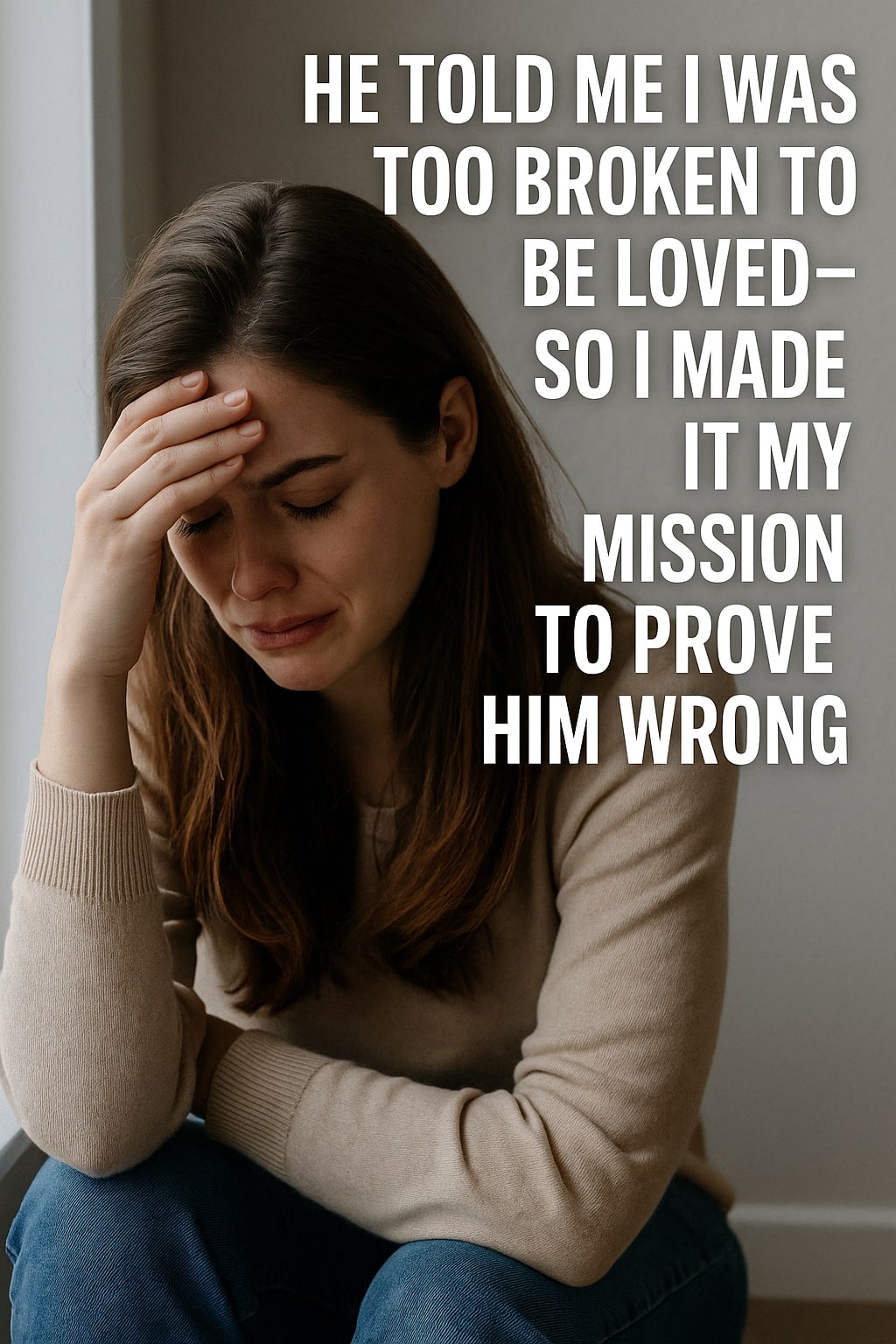
I remember the exact moment the words left his mouth.
We were standing in the living room of the apartment we had shared for nearly two years. It was supposed to be just another fight — one of many that week — but this time, he didn’t hold back. He looked me dead in the eyes, as if what he was about to say would somehow free him of responsibility.
“You’re too broken to be loved,” he said. “And honestly, I’m tired of trying to fix you.”
Time stopped. My ears rang. My breath caught in my throat.
Too broken to be loved.
He didn’t yell it. He didn’t even say it with malice. He said it like it was a fact, like telling someone the sky is blue or that winter follows fall. Like he was doing me a favor by finally admitting what he “knew” all along.
What he didn’t know is that those words would stay with me—not to haunt me, but to drive me.
The Girl Who Survived
Long before I met him, life had taught me how to survive.
I was raised in a house where silence was louder than screams and love had conditions. My father left when I was eight. My mother battled addiction and depression, often leaving me to parent myself. I learned early how to stay small, unnoticed, and how to fake a smile so adults wouldn't ask too many questions.
By the time I turned 18, I’d been through more than most people twice my age. I wore my trauma like invisible armor—never asking for help, always pretending I was fine. But the cracks were there. You just had to look closely.
He did.
When I met him, he made me believe I could finally take that armor off. He told me I was strong, mysterious, and deep. He said he saw light in me. And I wanted so badly to be seen that I let myself believe he was the one person who could handle my chaos.
In the beginning, he was gentle. Patient. Kind. He asked questions no one had ever asked before. He held me during panic attacks and whispered promises of forever. I mistook all of it for unconditional love.
But love, I’ve learned, doesn’t vanish when things get hard. His did.
The Shift
Things changed slowly. Subtly. First came the sighs when I cried. Then the eye rolls. Then the subtle jabs masked as jokes.
“You’re always so dramatic.”
“Why can’t you just be normal?”
“If you didn’t have so many issues, maybe I’d be happier.”
Eventually, his warmth turned cold. He stopped holding me. He stopped asking how I was. He grew distant, emotionally unavailable—until one night, when I brought up how lonely I felt, he dropped the sentence that would become a turning point in my life.
“You’re too broken to be loved.”
And with that, he walked out of my life.
Hitting Rock Bottom
I won’t lie and say I immediately bounced back. I didn’t.
For weeks, I replayed that sentence in my mind like a toxic mantra. I started to believe it. Maybe he was right. Maybe I was too broken. Too complicated. Too much.
I isolated myself. Skipped work. Ate almost nothing. I’d wake up and wonder how I could fill the hours until sleep would take me away again. My therapist called it situational depression. I called it drowning.
But somewhere in that fog, something inside me stirred. It wasn’t rage. It wasn’t revenge. It was something quieter.
It was hope.
The Rebuild
I decided I was going to do the one thing he never believed I could: I was going to love myself.
Not the Instagram version of self-love—the bubble baths and positive affirmations. I mean real, painful, deep work. The kind that requires staring your demons in the face and refusing to let them define you.
I went back to therapy, this time not just to survive, but to heal. I unpacked my childhood trauma. I journaled. I cried. I screamed. I forgave my parents—not because they deserved it, but because I did.
I built a morning routine that grounded me. I filled my apartment with plants and poetry and anything that made me feel alive. I cut out people who only saw my flaws, and surrounded myself with those who saw my fight.
Slowly, I stopped seeing myself as someone who needed fixing. I wasn’t broken. I was rebuilding.
Love, Unexpected
A year later, I met someone new.
He wasn’t flashy or full of grand gestures. He was soft-spoken, with kind eyes and a quiet strength. From the beginning, I was honest about my past. I told him about my trauma, my therapy, my journey. I held nothing back.
I expected him to flinch. He didn’t.
One night, as we sat on my couch eating takeout, I told him about the man who said I was too broken to be loved.
He looked at me, shook his head gently, and said, “That man didn’t know what love was.”
It hit me then—true love doesn’t fix you. It holds space for all your pieces. It doesn’t run from your pain; it learns how to hold it with you.
The Mission
Today, I live not to prove that man wrong, but to prove myself right.
I am not broken. I never was.
I was bruised. Wounded. Hurt by people who didn’t know how to love what they didn’t understand. But I’ve learned that healing isn’t about becoming perfect—it’s about embracing yourself exactly as you are and finding peace in your own skin.
If you’ve ever been told you’re too much, too emotional, too complicated—let me tell you something:
You are not too broken to be loved.
You are human.
You are worthy.
You are the story someone else needs to hear.
And sometimes, the most beautiful love story is the one you write with yourself.
This story is personal, but it isn’t just mine. It’s for every person who’s ever been made to feel unlovable. It’s for the survivors, the fighters, the ones still finding their way.
You are not alone.
And you are never, ever too broken to be loved.
About the Creator
Soul Drafts
Storyteller of quiet moments and deep emotions. I write to explore love, loss, memory, and the magic hidden in everyday lives. ✉️
Keep reading
More stories from Soul Drafts and writers in Psyche and other communities.
The Therapist Who Gaslit Me Into Thinking I Was the Problem
The Therapist Who Gaslit Me Into Thinking I Was the Problem I thought therapy was supposed to heal you. I thought therapists were supposed to help you find clarity. What I didn’t know—what no one warned me about—is that when you give your mind to the wrong person, they can twist it into something unrecognizable.
By Soul Drafts8 months ago in Psyche
Top tipple tricks
Been thinking a lot about drinking, lately. Not least because of a recent episode of over-indulgence and the inevitable after effects. Some readers may recall the earlier articles I wrote about beating the booze. Here I set out an experiment in techniques for cutting down on my alcohol intake. The experiment was successful, the techniques worked, and I have armed myself with an arsenal of weapons in the war against the demon drink. I have yet to fire the first round however. It's all a question of timing (perhaps procrastination).
By Raymond G. Taylor7 days ago in Psyche



Comments
There are no comments for this story
Be the first to respond and start the conversation.