
Escaping the Matrix
A practical look at breaking out of routine and reclaiming your life
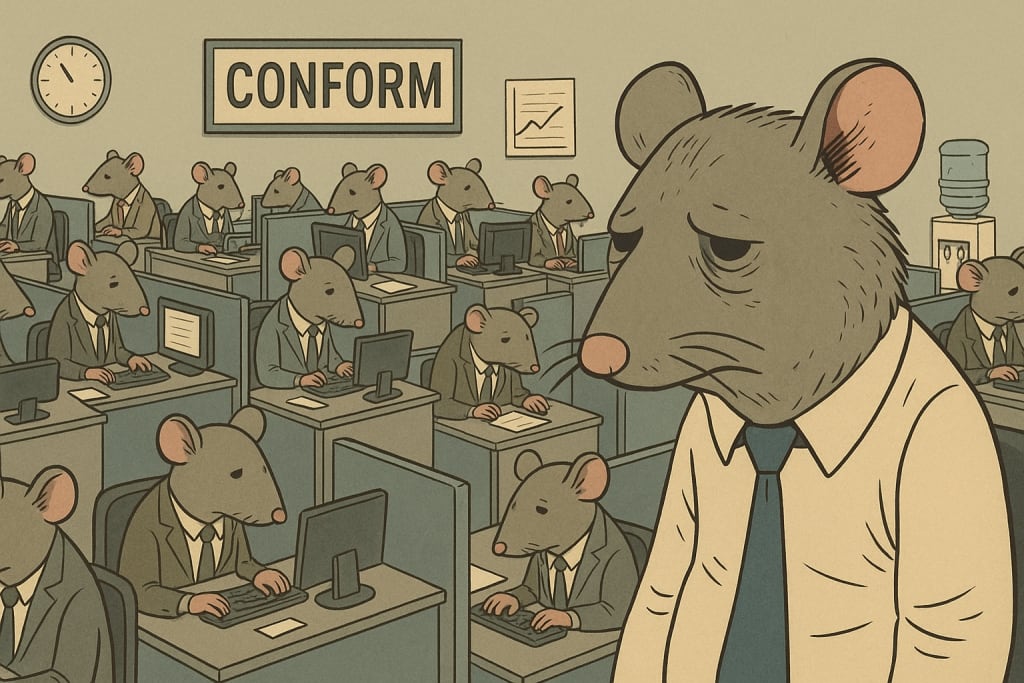
We’ve all heard it: go to school, get a degree, land a good job, work hard for a few decades, and then retire in peace. That’s the blueprint. That’s what success is supposed to look like.
But when you actually live it, something feels off.
You start school at a young age. From the beginning, you're taught to memorize, not question. They teach you to obey blindly, memorize and regurgitate. Follow instructions, stay in line, and don’t challenge authority. Creativity and curiosity slowly get sidelined, and then you graduate with promise, only to be told, “Ab apna time ayega.”
You enter the job market, full of hope. They ask of 10-15 yrs of experience for a position that's barely mid-level. And sometimes even for entry level jobs. For instance, there are jobs in finance, that literally involves basic bookkeeping and journal entries, and they want someone who basically lived and died in the field just to be considered. Not to mention, a lot of those tasks are automated nowadays. Half the job is just clicking the buttons on a software which someone else wrote. There’s barely any room to use your own brain. You aren't solving problems. You aren’t building something new. You're just running on autopilot. And you’re expected to be grateful for it.
They will sell you a dream; work hard in your 20s and 30s so you can live comfortably in your 60s. But by then your joints hurt, your parents are probably gone, and you are too exhausted to enjoy and appreciate the life at that point. What's the point of being rich in your 70s when you can't even walk without a stick.
In short: the system is evolving, but not necessarily in your favor. If your role can be done with a few clicks or algorithms, you're expendable. And the replacements don’t care about your creative friction or soul, because it’s not profitable.
In the process you trade you soul and authenticity. You bury the things that make you feel alive, your hobbies, your creativity, your curiosity and the purpose of life. You are constantly anxious and depressed. You are always tired. Your weekends work as recovery zones instead of freedom. And even during those days, most people are too tired to do anything meaningful.
This is what the rat race looks like. And more and more people are realizing they don’t want to be in it anymore.
Not Everyone Fits This Mold
Then there’s another truth: the rat race rewards extroverts. Some people are genuinely built for this kind of structure. They love being around others. They attend festivals and social gatherings. They enjoy teamwork, office parties, networking, deadlines, and the daily hustle. And that’s great. The world needs these kinds of people.
But what about the rest?
Introverts (who represent roughly 30–50% of the population) are often overlooked. These are people who are wired differently. They think deeply, feel intensely, and don’t find joy in small talk or forced collaboration. They aren’t antisocial. They’re just built for stillness, solitude, and thoughtful work. These people are often more analytical, introspective, observant, and spiritually sensitive. They notice things that others don’t. They feel everything: the cracks in the system, the unfairness, the noise, and the weight of modern life.
Sadly, the latter is the most oppressed class of the society. Most of them are being pushed into the same 9-to-5 treadmill. Office full of noise, distractions, forced teamwork and robotic routines. The system isn’t made for them. In fact, it almost works against them. From school to the workplace, everything is designed to reward loudness, speed, and extroversion. If you’re quiet, you’re told to “speak up more.” If you don’t enjoy group work, you’re told to “get out of your shell.” If you find networking draining, you’re told to “just fake it till you make it.”
The result? These people burn out early. They’re tired, anxious, depressed, emotionally lonely and stuck in jobs that make them feel useless. They end up surviving instead of thriving. And the worst part is, their potential goes completely unnoticed and wasted.
Most of these people are never gotten to tap into their real strengths. Because they were too busy to survive in a system that were never built for them in the first place. And ironically, majority of these people are capable of doing extraordinary things. Give them autonomy, time and space, and they will solve the most complex problems, build the most creative ideas, or build tools that can change lives of millions. They can design better systems. They can write, build, teach, invent, and create in ways that are far more meaningful than what's being offered in the current system. But instead, they’re told to just “fit in.”
What Some of Us Really Want
Not everyone dreams of luxury apartments, fast cars, or closed offices. Some of us just want peace.
They want to live in quiet places. Maybe in the mountains. Maybe somewhere rainy and cold. Somewhere calm and still. They want to grow their own food, raise some livestock, and cook their own meals. They want time to read and learn. They want to study architecture, permaculture, philosophy, ethics, religion and whatnot: not in a performative way, not for grades, not for careers, but out of curiosity. They want to share what they learn with others for free. Because they believe in free education for everyone. Not just basic education but the most privileged one. Build something that helps others live better. Create a system where no one is left without food, shelter, or dignity. A system where everyone matters, and not just those who are loudest or most connected, socially.
But none of that is possible unless we first step out of the current loop, the matrix.
It’s Time to Rethink the Blueprint
It’s important to remember that life isn’t one-size-fits-all. Just because something works for the majority doesn’t mean it’s right for you.
The traditional idea of success; climb the ladder, retire at 65, and then finally start living; doesn’t work for everyone. And if it doesn’t work for you; you’re not the problem; the system is.
And if you feel like you belong to the second group; the quieter, deeper thinking one; you’re not alone. In fact, there are millions like you. People who want something different. People who are tired of pretending. People who want to live, not just survive.
What Can We Change?
1.Design work around autonomy
Not everyone needs meetings or group tasks. Let people work in focused cycles, with optional collaboration.
2. Measure impact beyond visibility
Stop promoting the loudest. Reward thoughtful solutions, quiet leadership, and long-term vision. Harvard Business Review even highlights cases where introverted leaders outperform extroverts in complex environments.
3. Create hybrid spaces
Offices should include quiet zones; like Susan Cain’s “Quiet Spaces”; so, introverts can recharge and thrive alongside more social colleagues.
4. Reimagine success
Move away from the myth of working yourself to dust in your 20s and 30s. Let’s value balanced lives. Deloitte found 94% of Gen Z and 92% of millennials see purpose as more important than salary alone.
The Escape Route
Escaping the rat race isn’t about impulsively quitting your job or running off into the forest overnight. That’s romantic, but it’s not a plan. It starts with small, conscious choices built over time.
Start by reclaiming your attention. Turn down the noise, even if just for an hour a day. Spend time doing something that excites you without needing to justify it with productivity. Read deeply. Think slowly. Learn something just because you want to. That’s how curiosity is rebuilt.
Then, audit your life. Where does your time go? Who benefits from your exhaustion? What part of your daily routine aligns with the life you actually want and what doesn’t?
If the long-term dream is autonomy, map backwards. Want to live off-grid someday? Learn a little gardening or basic carpentry. Want to teach freely? Start writing or recording small lessons online. Bit by bit, build systems around you that depend less on institutions and more on your own mind and hands.
And find your people. Especially if you belong to the quieter, sensitive, analytical tribe (the ones modern society often sidelines). Remember that you’re not alone. There’s a global undercurrent of people quietly crafting different lives: minimalists, Perma culturists, solo entrepreneurs, researchers, thinkers. You don’t need millions to find freedom. Sometimes, you just need less noise.
Eventually, escaping the rat race isn't about rejecting all structure or work. It’s about designing a life that fits your values instead of squeezing into one that doesn’t.
It doesn’t happen in a week; but it begins the moment you stop outsourcing your direction to the world and start living like your time actually belongs to you.
Thanks for taking the time to read. If you found it meaningful, share it with people you care about.
About the Creator
Keep reading
More stories from writers in Psyche and other communities.
How to Succeed at the Benson Directory®
Congratulations and welcome to the Benson Directory® employee #22391! As our newest call handler, you will have the privilege of speaking with dozens of unique and interesting people on a daily basis as well as the opportunity to earn bonuses for high performance. Contained within this handbook you will find a set of ease to follow instructions designed to help you settle in to your new role and begin paving the way to success.
By S. A. Crawford3 days ago in Fiction




Comments
There are no comments for this story
Be the first to respond and start the conversation.