
Effort Isn’t a Feeling. It’s a System.
Reframing inconsistency as a structural issue through Cognitive Drive Architecture


You sit at your desk. You know what needs to be done. You care. You’re committed.
Still, nothing moves. Minutes pass. The tension builds. Maybe you scroll. Maybe you spiral. Maybe you start something else that feels easier, cleaner, and safer.
- This isn’t laziness.
- It’s not self-sabotage.
- It’s not a lack of ambition.
It’s a failure of configuration.
What if we stopped treating stuckness as a motivational gap and started treating it as a systemic misalignment?
That’s the premise behind Cognitive Drive Architecture (CDA), a structural field in cognitive psychology that treats effort as an emergent system state, not an emotional one.
At its core is a theory called Lagunian Dynamics. It doesn’t describe effort in terms of feelings or traits. It explains, through real-time mechanics, how internal variables must align for action to initiate, sustain, and adapt.
The Myth of the “Unmotivated” Mind
Most people assume that if you’re not acting, you must not want it enough. That assumption has been baked into self-help advice, therapy strategies, and even educational systems.
But consider this:
- Have you ever desperately wanted to start something and still didn’t?
- Have you started strong and then inexplicably fizzled out?
- Have you repeated a simple task on different days with wildly different outcomes?
These aren’t mysteries of willpower. They’re signals from a system that was aligned once and isn’t now.
CDA proposes that Drive is not something you feel. It’s something your mind constructs. Or doesn’t.
Six Moving Parts Behind Every Moment of Effort
According to Lagunian Dynamics, every act of effort is the result of six internal variables operating together, moment to moment. These aren’t abstract ideas. They’re functional parts of a real-time system that governs what we experience as momentum, procrastination, or collapse.
Here’s the breakdown:
1. Ignition Domain: The start mechanism
- Primode: The ignition switch. If it’s off, nothing begins, no matter how much you care.
- CAP (Cognitive Activation Potential): The power source. Emotional urgency, inner voltage. If it's low, even a ready Primode flickers.
2. Tension Domain: The stabilizer
- Flexion: Can the task fit your current cognitive shape? If yes, it flows. If not, it resists.
- Anchory: Your ability to stay mentally tethered to the task.
- Grain: Internal drag. Doubts. Overwhelm. Emotional resistance. Friction that makes simple things hard.
3. Flux Domain: The destabilizer
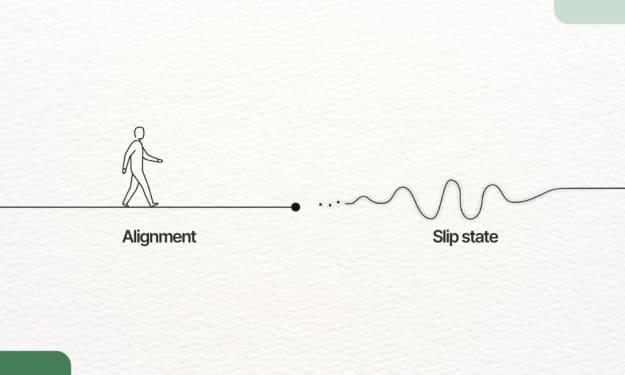
- Slip: The background entropy of the system. Noise. Disruption. The reason why even “good days” wobble.
Each variable contributes to the architecture of engagement. When aligned, you move. When misaligned, you stall, stall, stall, until the system forces a shift.
The Equation Behind the Experience
Lagunian Dynamics formalizes all of this into a working model:

This equation might look like math. But what it describes is incredibly human:
- If Primode is off, nothing starts.
- If CAP is high but Primode is zero, you feel tension with no outlet.
- If Flexion is low, the task feels impossible, even if it's not.
- If Grain overtakes Anchory, your focus disintegrates.
- If Slip spikes, you're unpredictable, even to yourself.
It’s not a motivational graph. It’s a live system map of why effort works and why it sometimes doesn’t.
Rewriting the Breakdown
When you understand effort structurally, failure stops feeling personal. It becomes legible.
Here are just a few configurations that the CDA model explains:
- “I can’t start.” → Primode is off. CAP might be high. Still, nothing can ignite.
- “I start, then fizzle out.” → Flexion is low or Grain rises mid-task.
- “I’m working but getting nowhere.” → Anchory is stable, but Flexion is absent, false focus.
- “Some days I’m on, others I’m lost.” → High Slip. System instability, not inconsistency of character.
Each breakdown tells you something. You don’t need to try harder, you need to listen better.
Intervention Means Reconfiguration
If Drive is a product of alignment, then support strategies must shift from pushing the self to tuning the system.
Some examples:
- Primode missing? → Try micro-starts, environment shifts, or binary cues (e.g., countdowns).
- CAP low? → Reconnect emotionally. Remind yourself why this matters now, not later.
- Low Flexion? → Modify the task structure. Simplify. Reformat.
- Grain high? → Reduce ambiguity. Offload emotion. Use external clarity to quiet internal drag.
- Anchory dropping? → Introduce time constraints. Eliminate open loops (tabs, notifications, interruptions).
- Slip spiking? → Don’t force stability. Switch modes. Use lower-bandwidth tasks until the system calms.
These aren’t tricks. They’re structural corrections. You’re not “overcoming” resistance. You’re rebalancing the machine.
A New Field, Not a New Framework
Cognitive Drive Architecture isn’t just another take on productivity. It’s a paradigm shift in cognitive science. It doesn’t replace motivation theory or cognitive control; it provides the structural substrate they operate within.
Other models explain why people act. CDA explains when they can.
And Lagunian Dynamics is the theory that finally answers what has gone unexplained for too long:
Why do capable, committed people still fail to act?
Answer: Their internal Drive system wasn’t aligned at that moment. And that’s not a flaw; it’s a solvable state.
Final Reframe: Effort Isn’t a Virtue. It’s a Configuration.
You're not failing because you lack strength. You're misfiring because a variable is out of range.
Once you stop seeing your effort as an identity, you can start seeing it as a system.
- Every stall is a pattern.
- Every collapse is a code.
- Every spike is a signal.
You’re not inconsistent. You’re structured, and that structure can change.
Because once the system is in sync,
The work flows.
About the Creator
Keep reading
More stories from Nikesh Lagun and writers in Psyche and other communities.
Slip and the Foundations of Cognitive Drive Architecture
In cognitive science and psychology, fluctuations in mental performance are often attributed to motivation, distraction, or emotional state. While these factors undoubtedly play a role, a newly proposed structural field—Cognitive Drive Architecture (CDA)—suggests that the story of effort variability is more mechanically complex. CDA introduces a system-level theory for understanding how cognitive effort emerges, stabilizes, or fails, based on internal configuration rather than external conditions or surface-level traits.
By Nikesh Lagun9 months ago in Psyche
Steam Machine Price Leak Sparks Hope and Skepticism Among Gamers
Rumors travel fast in the gaming world, but some hit harder than others. When talk of a steam machine price leak began circulating, it stirred a familiar mix of excitement and doubt. For years, gamers have waited for hardware that could bridge the gap between console simplicity and PC freedom. Steam Machines once promised that dream, then quietly faded away. Now, whispers of a return, tied closely to a leaked price point, have reopened old conversations. Is this finally a realistic option for everyday players, or just another idea that looks good on paper? To understand why this leak matters, we need to look at the past, the present mood of gamers, and what price truly means in this space.
By Muqadas khan4 days ago in Psyche



Comments
There are no comments for this story
Be the first to respond and start the conversation.