
Depression in the United States is steadily increasing
Since 2020, depression rates have doubled. Here's why.


In the United States, depression and anxiety rates have steadily increased and one of the reasons may be linked to the Covid-19 pandemic, says US Surgeon General Dr. Vivek H. Murthy. The pandemic has added a lot of stress and trauma into most people’s lives, impacting everything from loved ones, jobs, and social interaction.
As part of Yahoo Finance’s All Markets Summit, Murthy had this to say, “We were struggling with high rates of anxiety and depression and suicide, including among young people, long before COVID-19 came. And the question is, what are we going to do about it, recognizing that for many people the crisis of COVID-19 has actually increased rates of depression and anxiety.”
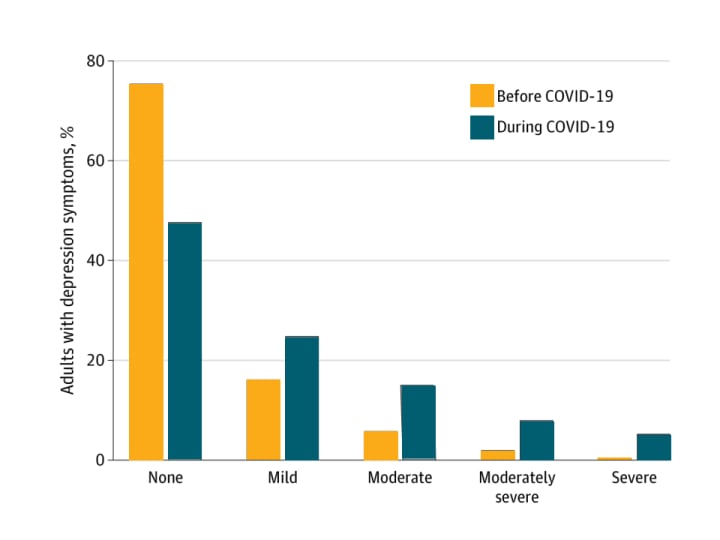
As you can see from this chart done by the CDC, the number of adults with depressive symptoms has increased in every category during Covid-19. The number of adults with mild depressive symptoms has gone over 20% and the number of adults showing no signs of depressive symptoms has gone down to roughly 45%.
It’s not uncommon for people to experience elevated levels of depression after a traumatic event, terrorist attacks, natural disasters, or a pandemic, says Dr. Sandro Galea, the dean of Boston University’s School of Public Health. The thing that Dr. Galea finds alarming is that usually depression rates rise during the event and then gradually level out but, that’s not happening with Covid.
“It is unusual to see sustained levels of depression 12 months into a traumatic experience,” Galea says to CNBC. Considering the pandemic’s ongoing nature, that is most likely the reason to why heightened levels of depression haven’t gone down.
A big area that Covid-19 has affected is jobs. Unemployment during the pandemic reached record-breaking numbers, rising to 14.7% in April of 2020. It has since gone down to 4.6%, but that’s still higher than where the U.S. was pre-pandemic. Not only did Covid affect unemployment, but it also changed the way some people view their jobs. According to recent surveys, some employees don’t want to return to work. The reasons include lack of job opportunity, poor work-life balance, and toxic work environments. US Surgeon General Dr. Murthy believes some feel a lack of support for these issues at work.
“That highlights to me something that I was studying and thinking about, actually, in the years preceding the pandemic, which is that loneliness and isolation in our workplaces is actually quite high. And it comes with the consequence for retention, for productivity, for creativity in the workplace,” Dr. Murthy says.
There are still many people out there who feel a sense of shame when they admit they may be struggling with their mental health. Part of the solution will be to create a new culture at work, one that focuses on the mental health of employees.
In conclusion, depression rates during the pandemic have increased in large part to Covid-19 itself. We've been through a lot, a pandemic, job struggles, social distancing, etc. It may be a while until things get back to normal, but there is still hope. Catherine Ettman, the chief of staff and director of strategic initiatives in the Office of the Dean at BU’s School of Public Health, believes that “addressing stressors such as job loss, challenges accessing child care, and difficulties paying rent, will help to improve population mental health and reduce inequities that have deepened during the pandemic.”
If you liked this article, be sure to subscribe for much more like it. You can also find me on Medium and Newsbreak, which I use a lot more often. As always, thanks for reading!
About the Creator
Joe Mertens
Filmmaker - Writer - Enjoyer of Life - Officially the same height as Tom Cruise.
Keep reading
More stories from Joe Mertens and writers in Psyche and other communities.
The Cabin on Devil's Lake
I stare out at the familiar grey water as our car moves along the dirt road. Every summer as a kid my family and I would drive up to stay at our cabin by Devil's Lake. It was always so pretty in the summer. But now, with November looming, it looked ugly. The leaves on the trees were gone, leaving nothing but pointy branches.
By Joe Mertens4 years ago in Horror
The BAFTA Awards
By now, in a stunning departure from recent years, most of the world is aware of what happened at the BAFTA film awards. Social Media Headlines will tell you the bare bones: that John Davidson, a Tourette's Syndrome advocate, shouted a racial slur at two Actors of Colour, Michael B Jordan and Delroy Lindo.
By Natasja Rose6 days ago in Psyche
International Women’s Day: the freedom not to be perfect
Today is International Women’s Day, and I’m writing this from the dining table while listening to Radio 3 Unwind. I’m sitting down with my laptop and a going-cold cup of tea, after Virginia Woolf’s famous essay A Room of One’s Own popped into my head. In it, she reflects that for a woman to write fiction, she needed two things: money and a room of her own (ideally with a door that closes). What she really meant, perhaps, was time to think and the freedom to exist inside her own mind.
By Chelsea Brancha day ago in Psyche




Comments
There are no comments for this story
Be the first to respond and start the conversation.