
Can Week-Old Pizza Cause Hallucinations? Exploring Intuition, Psychology, and the Science Behind Human Behavior
How Research and Scientific Methods Help Us See Beyond Common Sense and Intuition
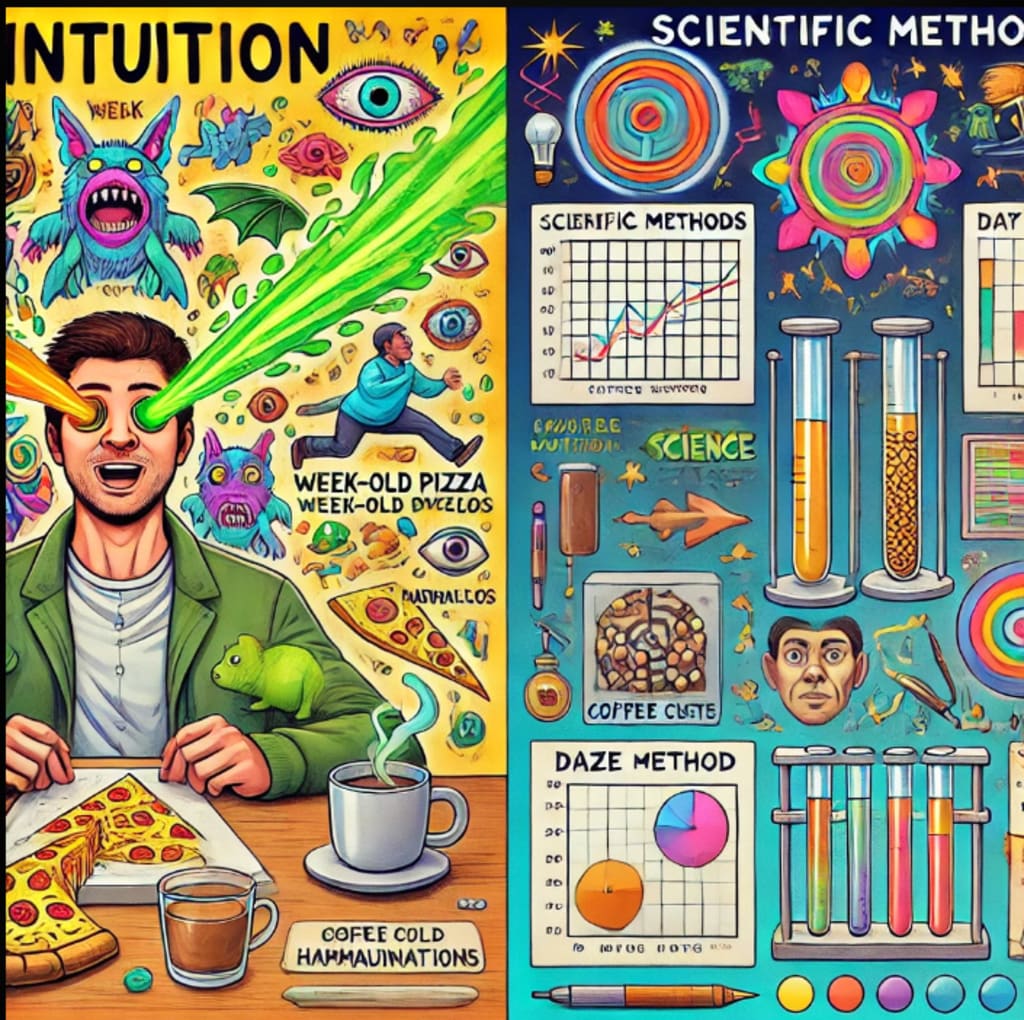
We often rely on our intuition to make sense of people and the world around us. But can we always trust it? Spoiler alert: intuition is often wrong. Let's explore how psychological research goes beyond common sense and tackles important questions—like whether week-old pizza can cause hallucinations or if coffee actually makes you smarter.
### 1. **The Trouble with Intuition**
As human beings, we love to think we're good at predicting behavior. After all, we're surrounded by people all the time, and our gut feeling should be a reliable guide, right? Well, not exactly.
Intuition often leads to **hindsight bias**, also known as the "I-knew-it-all-along" phenomenon. This happens when we think we predicted something after it happens. Imagine your friend Bob eats that old deep-dish pizza from the back of the fridge and starts to "wig out." You think, "I told him so!" But if Bob eats the pizza and nothing happens, you'll probably forget about the whole thing. This bias reinforces our faith in intuition, but it’s unreliable.
### 2. **The Danger of Overconfidence**
Another reason intuition can be faulty is **overconfidence**. Sometimes we really believe we know what’s happening when, in fact, we don’t. We've all misjudged situations or people before, but confidence in our instincts can blind us to the facts.
We also have a tendency to see **patterns in random events**. Take flipping a coin: it’s just as likely to land five times in a row on tails as it is to alternate between heads and tails. Yet when we see that streak of tails, we instinctively think something unusual is going on when, in reality, it’s just chance.
These cognitive biases can mislead us, but fortunately, psychological research exists to bring clarity.
### 3. **The Science of Psychology: Getting Past Our Biases**
Psychological research is essential for overcoming these biases. The scientific method allows researchers to move past mere intuition, using experimentation, observation, and analysis to uncover truths about human behavior.
Let’s break down the steps of psychological research:
- **Theories and Hypotheses**: Research begins with a theory—a broad explanation of how things work. From the theory, scientists create a hypothesis, a specific, testable prediction.
- **Operationalization**: Researchers then define how they will measure their variables. For example, if you hypothesize that coffee improves thinking, you need to define exactly what you mean by "thinking better." This helps others replicate your experiment.
### 4. **Case Studies and Naturalistic Observation**
One way psychologists study behavior is through **case studies**. These involve deep dives into individual cases, which can reveal fascinating insights but are limited because they can't be replicated. Case studies show us what *can* happen, but not necessarily what *will* happen in most cases.
Another approach is **naturalistic observation**, where researchers observe subjects in their natural environments without interference. This can provide valuable data on behavior but doesn't offer explanations for why those behaviors occur.
### 5. **Surveys: Navigating Human Opinion**
Surveys are a common tool in psychology, used to collect data on attitudes and beliefs. Researchers like Alfred Kinsey used surveys to explore human sexuality, gathering information that was both groundbreaking and controversial.
However, surveys must be carefully designed. The phrasing of questions can dramatically affect responses. For example, asking someone if they believe in "space aliens" is very different from asking if they believe in "intelligent life elsewhere in the universe." Both questions are similar, but the wording can sway answers.
### 6. **The Power of Random Sampling**
Surveys are only useful if they avoid **sampling bias**. To get a truly representative understanding of a population, researchers must randomly select participants. If you only ask a group of pacifists about arms control, for instance, the results won’t represent the general population’s views.
### 7. **Correlation Isn’t Causation**
Psychologists also study how different traits or behaviors are related, a concept called **correlation**. For example, if Bob eats moldy pizza and then hallucinates, we might assume the pizza caused the hallucination. But there could be other factors at play—maybe Bob was already sleep-deprived or stressed, and the hallucinations had nothing to do with the pizza.
This illustrates a critical point in psychology: **correlation does not imply causation**. Just because two events occur together doesn't mean one causes the other.
### 8. **The Gold Standard: Experimentation**
The most reliable way to determine cause and effect is through **experiments**. In an experiment, researchers manipulate one variable (the independent variable) while keeping all other variables constant. Participants are randomly assigned to different groups to minimize bias, and the results are compared to find patterns.
For example, let’s say Bernice believes coffee makes her smarter. You could design an experiment where one group of people drinks regular coffee, another group drinks decaf (the control group), and a third group drinks a high dose of caffeine. If the caffeinated group solves problems faster, Bernice’s hypothesis holds up.
### 9. **The Placebo Effect and Double-Blind Procedures**
To further reduce bias, many experiments use **placebos** (inactive substances) and **double-blind procedures**. In these experiments, neither the participants nor the researchers know who is in the experimental group and who is in the control group. This prevents any unintentional influence on the outcome.
### Conclusion: Science Over Intuition
Psychological research is a powerful tool that helps us understand human behavior in ways intuition alone cannot. While your gut feeling may tell you that pizza left in the fridge for a week will cause hallucinations or that coffee makes you smarter, these claims need to be tested scientifically.
Psychology, like all science, depends on rigorous methods that allow us to uncover real insights and avoid the traps of our own overconfidence and biases. So next time you feel sure about something, remember: science is here to help us separate fact from fiction.
---
By applying these methods and safeguards, psychologists ensure that they’re uncovering meaningful patterns of behavior, rather than relying on false intuition. So whether you’re questioning the power of caffeine or the dangers of moldy pizza, it’s always better to trust the science than your gut!
About the Creator
THiNK
Think - Your go-to destination for exploring captivating mysteries, insightful psychology, intriguing facts, and the latest news. Our mission is to spark curiosity and inspire learning. Join us as we uncover the unknown!
Staying sane in the insane world.
”It is no measure of health to be well adjusted to a profoundly sick society.” Jiddu Krishnamurti This quote has been one of my favourites since the moment I first laid my eyes on it. To me, it cuts right through the fog of the illusion of normality that permeates our lives. And since I am someone who has never felt (well) adjusted to this society, Krishnamurti’s words gifted me with the realisation that there isn’t anything inherently wrong with me.
By Eva Smitte7 days ago in Humans



Comments
There are no comments for this story
Be the first to respond and start the conversation.