
Astrological Psychology: How the Zodiac Connects with Jung
Discover how astrology and Jungian psychology intersect. Explore archetypes, the collective unconscious, and how the zodiac can serve as a symbolic map of the psyche.

Astrology and psychology are often placed on opposite sides of the spectrum—one dismissed as mystical, the other praised as scientific. Yet Carl Gustav Jung, one of the most influential thinkers of the last century, did not see them as enemies. Instead, he noticed they shared a symbolic language.
For Jung, symbols mattered deeply. He believed dreams, myths, and recurring patterns were not random but expressions of a hidden order within the psyche: the collective unconscious. When we look at astrology through that lens, the zodiac no longer feels like superstition. It becomes a map of symbols, each sign and planet carrying an image that speaks to the human mind.
This essay explores the parallels between Jung’s psychological ideas and the zodiac. It is less about prediction and more about reflection—about how we can use archetypes, synchronicities, and cycles to understand ourselves in a deeper way.
Archetypes: Jung’s Bridge to Astrology
Jung introduced the idea of archetypes—primordial images that show up everywhere: in myths, fairy tales, religions, and even in our dreams. The Hero, the Great Mother, the Trickster, the Wise Old Man—these figures belong not to any single culture but to the shared imagination of humanity.
Astrology speaks a similar language. Each zodiac sign reflects an archetype: Aries as the Warrior, Libra as the Lover, Capricorn as the Elder. Planets, too, have their roles—Saturn as the stern teacher, Venus as the principle of love and attraction, Mars as raw energy.
This is why Jung once described astrology as a “psychological fact.” He did not claim the planets caused our behavior, but he recognized that astrological symbols mirrored the same patterns his patients were wrestling with in dreams and fantasies.
The Zodiac as a Mandala of Experience
One of Jung’s favorite tools in therapy was the mandala, a circular image representing wholeness. If we look at the zodiac wheel, it functions in much the same way. Twelve archetypal energies form a complete circle of human experience:
- Aries opens the cycle with initiative and risk.
- Taurus grounds it in stability and the body.
- Gemini brings curiosity and dialogue.
- Cancer roots us in home and belonging.
- Leo seeks creative self-expression.
- Virgo searches for order and meaning in service.
- Libra balances with justice and connection.
- Scorpio confronts the shadow and transforms it.
- Sagittarius ventures into truth and exploration.
- Capricorn builds structure and legacy.
- Aquarius challenges norms and envisions the future.
- Pisces dissolves boundaries in compassion and transcendence.
Read as a whole, the zodiac resembles the full journey of individuation: the process of becoming complete by integrating all aspects of the self.
Synchronicity and the Stars
Jung is also remembered for his concept of synchronicity—the experience of meaningful coincidences. Astrology, in his view, worked through this principle. The planets at the time of birth do not “cause” personality traits; rather, they mirror them in a symbolic correspondence.
To read a chart, then, is not to see destiny written in the heavens but to hold up a mirror that reflects the patterns already within us. The chart becomes a symbolic compass, helping us name what might otherwise remain unconscious.
Astrology as a Path of Individuation
For Jung, the central task of life was individuation—the integration of the conscious self with the unconscious. Astrology can be a useful tool in this process.
- The Sun points to the conscious ego and life direction.
- The Moon carries the emotional body and instincts.
- The Ascendant reflects the persona, the face shown to the world.
- Saturn marks the challenges that demand maturity.
- Pluto signals the deep transformations of the soul.
A chart, in this light, is less about fortune-telling and more about psychological orientation. It shows both the resources we can rely on and the tensions we must face if we are to grow into wholeness.
The Shadow and the Zodiac
Jung insisted that true growth requires facing the Shadow—the parts of ourselves we deny or repress. Every zodiac sign has a light side and a shadow side. Aries may act courageously but can also fall into selfishness. Libra seeks harmony yet risks losing authenticity. Scorpio can transform powerfully, but also manipulate or control.
Working with the zodiac is a way of bringing the shadow to consciousness. It forces us to ask: which parts of myself am I projecting onto others? Which qualities do I avoid but secretly need to integrate?
Generational Archetypes: The Outer Planets
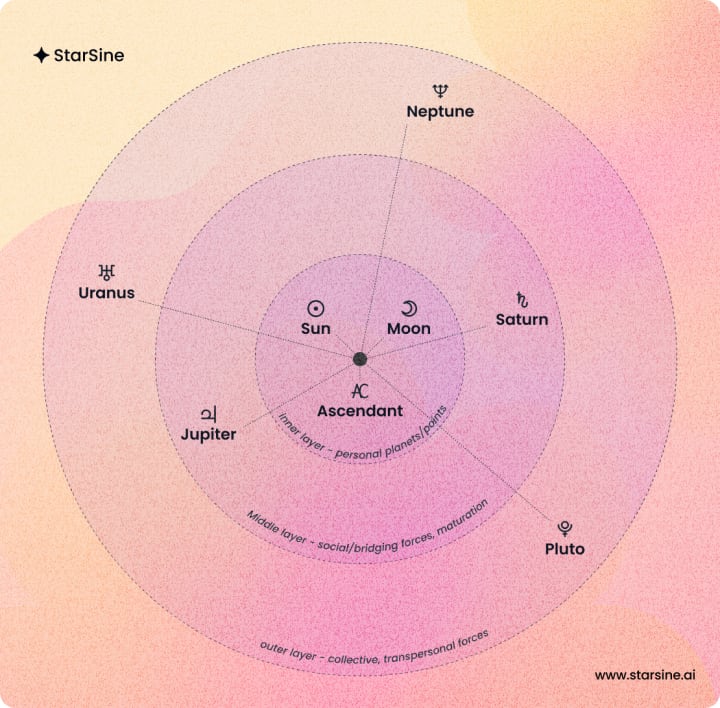
While the personal planets (Sun through Mars) describe individual psychology, the outer planets align with Jung’s idea of the collective unconscious.
- Uranus reflects upheaval, rebellion, and sudden shifts in culture.
- Neptune dissolves illusions, shaping spiritual longings and collective dreams.
- Pluto embodies death and rebirth on a mass scale, marking eras of transformation.
When these planets move through signs, they leave generational imprints. Your chart contains not just a personal story but also the mark of the time you were born into.
Dreams, Symbols, and Astrological Reflection
Jung often used dream interpretation as a way into the unconscious. Astrology can enrich that process. A dream of fire, for example, might echo themes of Aries or Leo. A dream of water could resonate with Cancer or Pisces. Saturn may show up as an authority figure; Venus as a lover or a symbol of beauty.
Astrology doesn’t replace psychology—it offers another symbolic vocabulary. Together, they allow us to trace the personal myths unfolding in our lives.
Why It Matters Today
We live in a time when traditional systems of meaning have weakened. Many people feel lost, anxious, or unmoored. Astrology’s resurgence in popular culture isn’t simply a fad—it reflects a hunger for symbolic orientation.
Jungian psychology and astrology, when combined, provide more than entertainment. They encourage reflection, integration, and a deeper recognition that our struggles are not random. They are archetypal patterns, repeated across history, yet uniquely lived by each of us.
Conclusion: Two Mirrors, One Self
Astrology and Jungian psychology may seem like separate traditions—one ancient, one modern—but they share the same goal: self-knowledge. The zodiac offers archetypal stories. Jung gives us a framework for integrating them. Together, they remind us that our lives are not accidents but meaningful patterns waiting to be recognized.
For those who feel drawn to explore this connection more personally, StarSine offers resources that bridge astrology with psychology in a way that is both practical and soulful. It’s one more path toward seeing your chart not just as a horoscope, but as a living mandala of the psyche—a guide toward wholeness.
About the Creator
StarSine
StarSine is a digital astrology platform bringing zodiac insights, playlists, and modern interpretations of the birth chart to curious readers around the world. You can see my website: starsine.ai
Do You have a Support Network?
Life is harder when you’re on your own. Human beings are social creatures, and we usually feel better when we have support from a strong social network around us. For most people, it’s our families that hold us together like glue.
By Elizabeth Woodsabout 18 hours ago in Psyche



Comments
There are no comments for this story
Be the first to respond and start the conversation.