
6 Words I Borrowed from Mathew McConaughey to Re-Build My Confidence
And help me overcome anxiety


Entering the final few years of my 20's, I realised that I was still that shy, scared shitless little kid that I was always was growing up but that I had just found more convincing ways to hide it.
Self-confidence was always something other people had I used to think. And although I'd always known that my heart would thump, my hands would sweat, my throat would squeeze, and my brain would fog, I always thought that anxiety was only something other people had.
It was only once it had been properly seen and acknowledged could I try and understand it better.
Somewhere in the middle of all that was Mathew McConaughey. He popped up on my newsfeed one day and said six words that quickly became my mantra:
"Become less impressed and more engaged"
It's hard to imagine that from Hollywood man that's made more romcoms in his lifetime than most actors combined - I think only Hugh Grant comes close? - that such a wise sage could have been born. However, that's what Mathew McConaughey seems to have turned into.
His six words that day struck a chord in me as soon as I heard them but it wasn't until I began to embody them did I see their power.
That took a few years but what I come to find after tracking anxiety in my body for long enough was that it rarely ever belongs to something that is happening in the present moment but rather from something that has happened in the past or from something that might happen in the future.
"Holy Sh*t!" I remember thinking.
Become less impressed and more engaged
Before hearing these fabulous six words, I used to put people on pedestals and I worked very hard at being the most accommodating, kind, happy, and understanding one.
This was my way of surviving in the world but I'd cleverly masked it as my way of making the world a better place. But who was I serving, really? Definitely, not me.
So, after seeing the painful irony that I had created for myself, I went on a discovery on how to live with anxiety more healthily. One of those ways has been through living what Mathew McConaughey said wonderfully said but another way has been through my connection to the breath.
For the past few years now, the breath has become my most trusted ally, companion, and teacher. So, next, I'd like to talk about breathwork.
Breathwork
As I mentioned above, anxiety either exists in the past or in the future but rarely in the present moment. So, a tool I use to keep me anchored in the present moment is the breath.
After all, what's more present than the breath? Plus, it comes with us through every situation, scenario, relationship, event, and action we ever do, so it's extremely reliable and trustworthy.
Also, we don't have to go anywhere to find it, buy it, grow it, source it, persuade it, convince it, bribe it, use any special equipment for it, take any substance, earn a certain amount of money, live in a particular place, or believe in any God(s), deities, religious systems, or doctrines, the breath will breathe us regardless.
The breath/heart/brain connection
As we breathe in our diaphragm flattens and our heart contracts. This sends an incredibly speedy message up to the brain that then sends an incredibly speedy message back to the heart that says, 'you must speed up', so it does. Then as we breathe out the reverse is true. Our diaphragm lifts and our heart opens up. This sends an incredibly speedy message up to the brain that then sends an incredibly speedy message back to the heart that says, 'you must slow down', so it does.
Whatever messages are sent thereafter create the thoughts that we think, the emotions that we feel, and the behavioural patterns we act out. This is how the heart and brain communicate through the breath.
The two sides of the nervous system
The autonomic nervous system is made up of two parts: The sympathetic nervous system and the parasympathetic nervous system. Each side controls different parts of the human body but what's interesting is that both get activated when we breathe.
The sympathetic nervous system gets activated when we inhale. The parasympathetic nervous system gets activated when we exhale. That's the beautiful balancing act the nervous system performs every time that we breathe.
The sympathetic nervous system
The sympathetic nervous system controls our stress response, better known as the fight or flight response and it gets activated when we inhale. It also monitors the body's temperature, controls saliva levels, inhibits digestion, accelerates our heart rate, dilates pupils, constricts blood vessels, raises blood pressure & perspiration (heat and sweat), creates goose pimples, and basically makes the body highly alert, sharp, and focused. It is also associated with the masculine and cognitive and analytical thinking.
The parasympathetic nervous system
The parasympathetic nervous system, better known for initiating our rest and digest response gets activated when we exhale. It also helps to restore balance, slows and stabilises a resting heart rate, slows and stabilises the breath, promotes digestion, improves recovery/healing time, produces saliva, constricts pupils, boosts the immune, digestive, and cardiovascular systems, and generally balances out all the hard work that the sympathetic nervous system does. It is also associated with the feminine and creativity and intuition.
A very simple way to access the parasympathetic nervous system is to breathe out longer than you breathe in. That's the golden rule. For example, if you inhale for 2 seconds, exhale for 4 seconds. If you inhale for 4 seconds, exhale for 6 seconds.
This is a very simple yet profound breathing exercise for overcoming anxiety when it matters most - right in the moment when it's happening.
The number of breaths we breathe per minute
There's a strong correlation between the number of breaths we breathe per minute to the level of stress/anxiety we experience in our bodies. As stress and anxiety levels are on the rise, learning how to take fewer breaths per minute could be a saving grace in a world that's only getting faster.
Take a moment to review the table below. In it, there are four different examples of the number of breaths we can breathe per minute and what the side effects are.
20 breaths per minute
Effect: High, consistent stress levels in all areas of life.
Location: Upper chest/throat
Nose or mouth: Typically mouth breathing (may partially alternate)
Possible side effects: anxiety, burnout, poor sleep, skin conditions, excessive behaviour/addiction (overly talkative, binge eating, smoking etc…)
15 breaths per minute
Effect: Medium levels of stress consistently throughout each day.
Location: Chest/throat
Nose or mouth: Both (may alternate)
Possible side effects: Alert, sharp mind. Anxious. Excessive behaviour/addiction (overly talkative, binge eating, smoking etc…)
10 breaths per minute
Effect: Calm, collective, peaceful, balanced. Stronger resistance from emotional and mental stressors.
Location: Belly/chest
Nose or mouth: Nose
Possible side effects: N/A
5 breaths per minute
Effect: Consistent meditative mind, optimal awareness.
Location: Belly/chest
Nose or mouth: Nose
Possible side effects: N/A
How many breaths are you breathing per minute on average?
This table is based on your day-to-day routine life. Exercising, eating, talking, lovemaking, and other daily activities naturally fluctuate the breath but on average, it's how many breaths we are breathing most consistently throughout the day which is the important thing to pay attention to here.
This table demonstrates how we can breathe stress into our lives but also how to breathe it out.
To go one step further here is an example of how to make that possible:
- 1 minute = 60 seconds
- 60 seconds divided by 10 (breaths) = 6
- 6 breaths divided by 2 (inhale & exhale) = 3
- Inhale - 3 seconds
- Exhale - 3 seconds
That's very doable!
Where we breathe in the body - belly, chest, throat
If a full breath could be split up into three parts, roughly 30% comes into the belly, 60% comes into the chest/lung region and 10% comes into the throat.
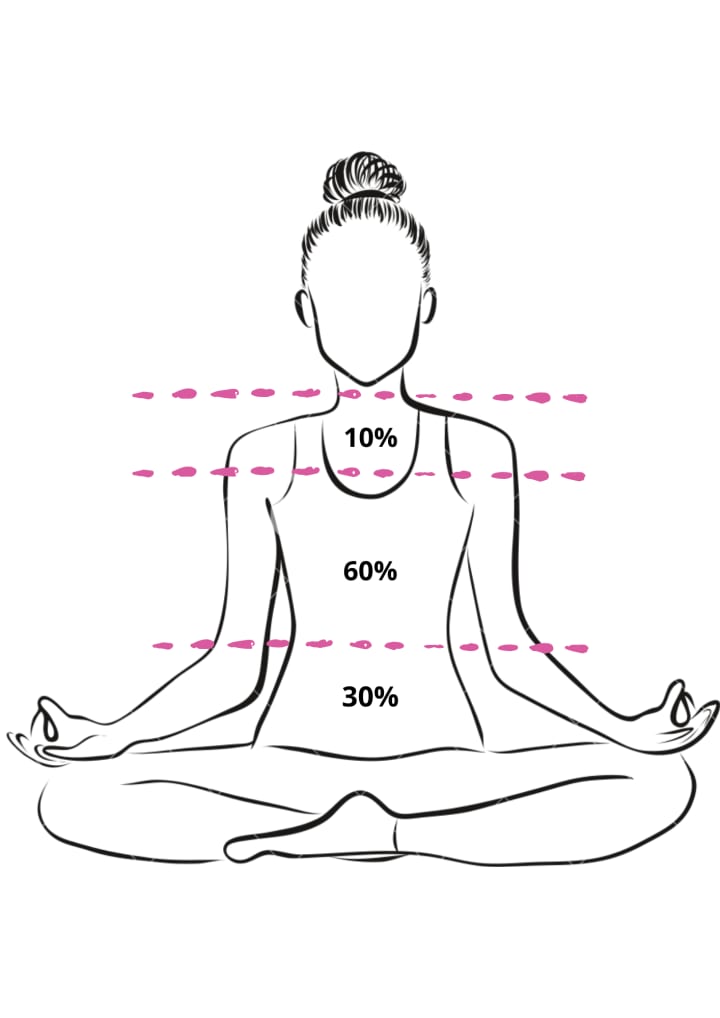
Which part of the body we breathe into most has a tremendous relationship with how our heart, mind, nervous system, and vital organs communicate. And how they communicate affects everything.
High levels of anxiety, for example, live in the final 10% of the breath, right there in the throat region. Whereas a person who is content and peaceful with have typically has softer breaths that come into the belly region.
Because the body and the breath never lie, when we're feeling stressed, anxious, scared, aroused, excited, joyful, peaceful, angry, happy, sad, up, down, and everything in between, the breath will reflect whatever emotion is present in the body.
That's how we can use the body and the breath to better navigate ourselves through our emotional body on a moment-to-moment basis by specific breathing exercises. If we do, we can actively change our emotional well-being and take back control if things ever become unbalanced.
Closing thoughts
The breath has saved my ass on so many occasions that it's hard to imagine what I did before it.
Nowadays, I track my breath throughout the day so whenever anxiety arises, instead of reacting to the intense sensations I respond to the subtler ones first. This helps me monitor anxiety and curb it before it becomes too overwhelming. It's like a little hidden superpower that I carry with me wherever I go.
If you've been inspired by the breath and would like to learn more, discover my favourite breathwork technique here
Or try a free online masterclass here
~ May you become less impressed and more engaged and may your breath set you free ~
About the Creator
Andy Murphy
Writer & Soma Breath faciliatator
Keep reading
More stories from Andy Murphy and writers in Psyche and other communities.



Comments
There are no comments for this story
Be the first to respond and start the conversation.