
The Self-Surgery
Dr. Rogozov’s Fight for Life in Antarctica

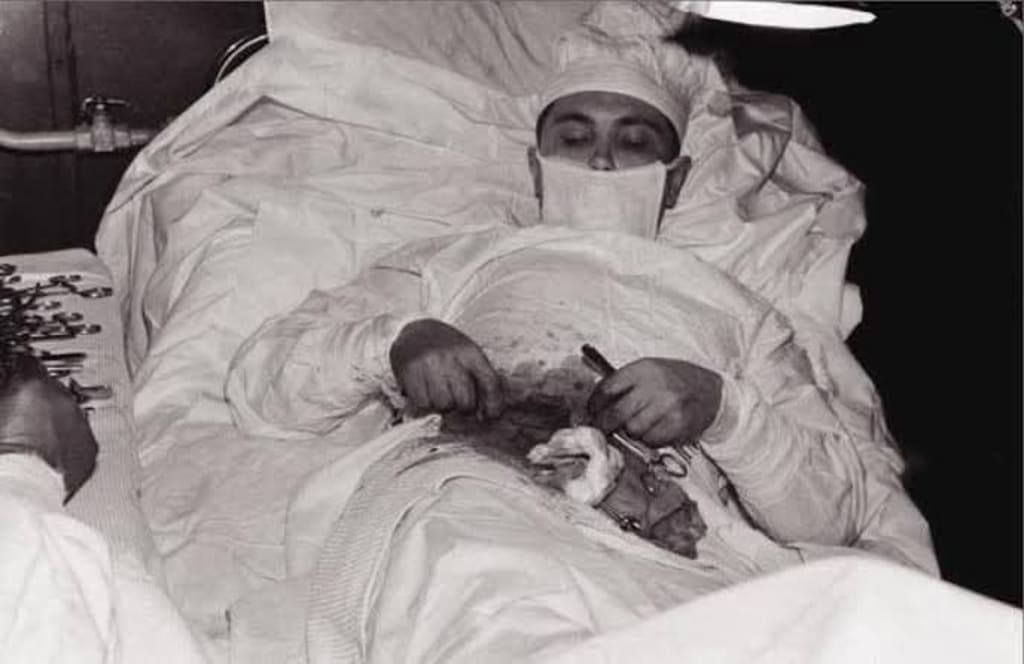
The Doctor Who Operated on Himself – The Incredible Story of Dr. Leonid Ivanovich Rogozov
> When we fall ill or suffer from any ailment, our first step is always to visit a doctor. But imagine, what if the doctor himself becomes ill and there is no other medical professional available to treat him? Ordinary treatment might still be possible, but if a surgeon had to operate on himself to save his life, it would sound like the plot of a madman’s tale.
> Yet history records one such incident, when a courageous surgeon with extraordinary mental strength performed a feat in the icy hell of Antarctica that forever earned a place in medical history. This is the story of Dr. Leonid Ivanovich Rogozov, who in 1961 performed his own appendectomy and took human determination to a new height.
---
Early Life and Education
> Leonid Ivanovich Rogozov was born on March 14, 1934, in the village of Dauriya, Chita Oblast, Soviet Union. He graduated from Saint Petersburg State Pediatric Medical University and began his professional career as a general practitioner and surgeon. Thanks to his exceptional skill and professional ability, he was selected in 1960 as a member of the Sixth Soviet Antarctic Expedition.
---
The Antarctic Mission
From September 1960 to October 1962, Rogozov served as the only doctor for a 13-member team at the Novolazarevskaya Station in Antarctica. Established in January 1961, the station’s mission was to conduct scientific research in one of the harshest climates on Earth. Temperatures could plunge to –50°C, and contact with the outside world was possible only through very limited communication.
---
The Onset of Illness
On the morning of April 29, 1961, Rogozov began feeling fatigued, nauseous, and feverish. Soon after, he developed sharp pain in the lower right side of his abdomen. As an experienced surgeon, he quickly diagnosed himself with appendicitis. Without timely surgery, the appendix could rupture, leading to life-threatening complications.
The nearest Soviet station, Mirny, was over a thousand miles away. Other Antarctic stations had no aircraft, and blizzards made any kind of air rescue impossible. Time was running out.
---
A Race Against Time
By April 30, his condition had worsened. Signs of peritonitis had appeared, meaning the appendix could rupture at any moment. There was only one option left — to operate on himself.
---
An Unbelievable Decision
This was an ultimate test of human willpower and professional skill. Rogozov chose two colleagues to assist him: a meteorologist and a mechanic. Neither had any medical training, so he gave them simple instructions — hold instruments, provide light, and keep the area clean of blood.
He placed a mirror to view the inside of his abdomen. General anesthesia was impossible, so he injected himself with Novocain for local anesthesia.
---
Life or Death Surgery
At 2:00 a.m. on May 1, 1961, the surgery began. Lying slightly on his left side, he made a 10–12 cm incision. While opening the peritoneum, he accidentally cut the cecum but quickly stitched it up. The base of the appendix showed a dark spot, indicating it was close to bursting.
Despite intense pain and weakness, he paused for short breaks to avoid fainting. The mirror’s reversed image made every movement twice as difficult. But finally, he removed the appendix and applied antibiotics inside the abdomen. By 4:00 a.m., the surgery was complete.
---
Recovery
After closing the incision, his fever and peritonitis symptoms began to fade within a few days. By the fifth day, the fever was gone; by the seventh, the stitches were removed. Within two weeks, he was back to work.
---
Recognition and Impact
In 1961, for his extraordinary bravery, Rogozov was awarded the Order of the Red Banner of Labour. Following this incident, the Soviet government made thorough medical examinations mandatory for all personnel headed to Antarctica to prevent such emergencies.
---
Later Life and Legacy
Rogozov returned to the Soviet Union, continuing his career as a surgeon and professor. In 1966, he published significant research titled Resection of the Esophagus for Treating Esophageal Cancer. On September 21, 2000, he passed away in Saint Petersburg at the age of 66.
---
The Message
The story of Dr. Leonid Rogozov is not just a surgical case; it is a testament to human determination, skill, and self-belief. He proved that when life reaches its most critical point, courage and intelligence can turn the impossible into reality. His achievement will forever remain a golden chapter in history.
About the Creator
Muhammad Tayyab
I am Muhammad Tayyab, a storyteller who believes that memories are treasures and words are bridges to hearts. Through my writing, I capture what time often leaves behind."
Keep reading
More stories from Muhammad Tayyab and writers in Proof and other communities.
Bitcoin
Bitcoin is the first and most widely recognized cryptocurrency in the world. It was created to offer a new way of handling money—digitally, securely, and without the need for a central authority like a bank or government. The idea was introduced in October 2008, when a person or group using the pseudonym Satoshi Nakamoto published a whitepaper titled "Bitcoin: A Peer-to-Peer Electronic Cash System." Then, on January 3, 2009, the Bitcoin network officially launched when Satoshi mined the first block of the blockchain, called the Genesis Block. Interestingly, embedded in that block was a message referencing a newspaper headline about bank bailouts, which showed the creator’s motivation to build a currency outside of traditional banking systems.
By Muhammad Tayyab 6 months ago in The Chain
Rainy Day Cocktails: Cozy Drinks to Brighten Your Stormy Evenings
Non-judgmental awareness is a gentle way of paying attention to your present experience without labeling it as good or bad. It invites you to notice thoughts, feelings, and sensations as they arise, simply as they are. This practice helps create space between you and your reactions, allowing calm and clarity to grow.
By Anna Walker7 days ago in Proof
Cultivating Awareness of Thoughts for Inner Clarity
Our minds are often busy, filled with a stream of thoughts that can feel overwhelming or distracting. Cultivating awareness of thoughts is a gentle practice that helps us observe our mental activity without getting caught up in it. This mindful approach creates space for clarity, calm, and choice.
By Garold One6 days ago in Proof



Comments
There are no comments for this story
Be the first to respond and start the conversation.