

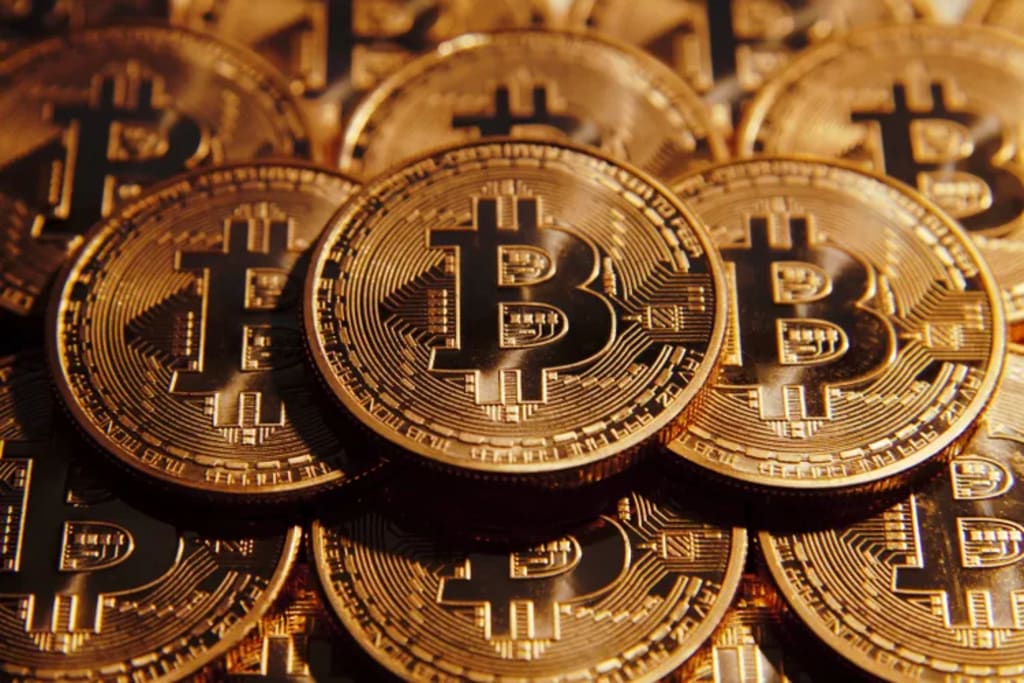
Bitcoin is the first and most widely recognized cryptocurrency in the world. It was created to offer a new way of handling money—digitally, securely, and without the need for a central authority like a bank or government. The idea was introduced in October 2008, when a person or group using the pseudonym Satoshi Nakamoto published a whitepaper titled "Bitcoin: A Peer-to-Peer Electronic Cash System." Then, on January 3, 2009, the Bitcoin network officially launched when Satoshi mined the first block of the blockchain, called the Genesis Block. Interestingly, embedded in that block was a message referencing a newspaper headline about bank bailouts, which showed the creator’s motivation to build a currency outside of traditional banking systems.
Initially, Bitcoin had no real value. It was shared among cryptography enthusiasts, computer scientists, and a small online community. The first real-world value of Bitcoin was set in October 2009, when a website called NewLibertyStandard calculated the value of 1 BTC to be about $0.0008 based on electricity costs used to mine it. A famous moment in Bitcoin history occurred on May 22, 2010, when a programmer named Laszlo Hanyecz paid 10,000 BTC for two pizzas, marking the first commercial Bitcoin transaction. This day is now celebrated as “Bitcoin Pizza Day,” and those two pizzas would be worth hundreds of millions of dollars today if the bitcoins had been held.
Bitcoin works using a technology called blockchain, which is a digital ledger that records all transactions publicly and permanently. Each transaction is grouped into a block, and blocks are linked together in a chronological chain. Bitcoin transactions are verified by a process called mining, where powerful computers solve complex mathematical problems to validate the transactions and add new blocks to the chain. In return, miners are rewarded with new bitcoins. This reward began at 50 BTC per block but is reduced by half approximately every four years in an event called halving. The halving schedule looks like this: from 2009 it was 50 BTC, in 2012 it became 25 BTC, in 2016 it was reduced to 12.5 BTC, in 2020 it dropped to 6.25 BTC, and in 2024 it has now become 3.125 BTC. This system is designed to limit the total supply of Bitcoin to 21 million coins, a cap that ensures scarcity, similar to precious metals like gold.
The total supply cap means that there can never be more than 21 million bitcoins. This built-in scarcity is one of the reasons many people consider Bitcoin a store of value. As of 2025, over 19.7 million bitcoins have already been mined, and the last bitcoin is expected to be mined around the year 2140. Bitcoin can be stored in digital wallets, which come in two types: hot wallets, which are connected to the internet and easier to access, and cold wallets, which are offline and much more secure for long-term storage. Each wallet has a public address used for receiving Bitcoin and a private key that gives the owner access to their coins.
Bitcoin’s price journey has been dramatic. In 2010, it was nearly worthless. By 2011, it hit $1 for the first time. In 2013, it surged past $266 and then $1,000. The big breakthrough came in 2017 when Bitcoin’s price went from $1,000 to nearly $20,000 by December. However, the price crashed in 2018 to around $3,000. In 2020, during the COVID-19 pandemic, it briefly dropped below $5,000 but then started rising again. In 2021, Bitcoin reached an all-time high of around $69,000. Since then, the market has been volatile, with many ups and downs due to regulation, adoption, and global economic conditions. In 2025, the price continues to fluctuate but remains a dominant asset in the crypto world.
Bitcoin was available on Binance from the beginning when the exchange launched in July 2017. Binance quickly became one of the largest cryptocurrency exchanges in the world, offering trading between Bitcoin and many other cryptocurrencies. Today, Bitcoin is available on virtually every crypto exchange and can be traded for fiat currencies (like dollars, euros, or rupees) as well as other digital assets.
The legal status of Bitcoin varies across countries. In places like the United States, the United Kingdom, Japan, Canada, and Australia, Bitcoin is legal and regulated to some extent. However, in countries like China, Egypt, and Morocco, it is either restricted or banned outright. Even in countries where it is legal, governments often impose tax reporting requirements or regulations on crypto exchanges to prevent money laundering and fraud.
Bitcoin has been praised for offering a decentralized and transparent form of money. It allows fast, low-fee transactions globally, without the need for intermediaries. However, it also comes with risks, such as high price volatility, susceptibility to hacking if not stored securely, and potential for use in illegal activities due to its semi-anonymous nature. Despite these concerns, Bitcoin continues to gain traction among investors, institutions, and even some governments.
Some major companies have begun accepting or holding Bitcoin. Tesla briefly accepted Bitcoin for car payments. Companies like MicroStrategy and Block Inc. have added billions of dollars worth of Bitcoin to their balance sheets. Platforms like PayPal and Cash App allow users to buy, sell, and hold Bitcoin directly. While Bitcoin is still not used in daily transactions as commonly as fiat money, its role as a store of value continues to grow.
Bitcoin differs from other cryptocurrencies like Ethereum, which focuses more on smart contracts and decentralized applications, while Bitcoin focuses on being a secure and reliable form of money. Over the years, Bitcoin has also inspired the creation of other related coins, known as forks. Two major forks include Bitcoin Cash and Bitcoin SV, both of which aimed to solve different problems in Bitcoin’s design, such as transaction speed and scalability.
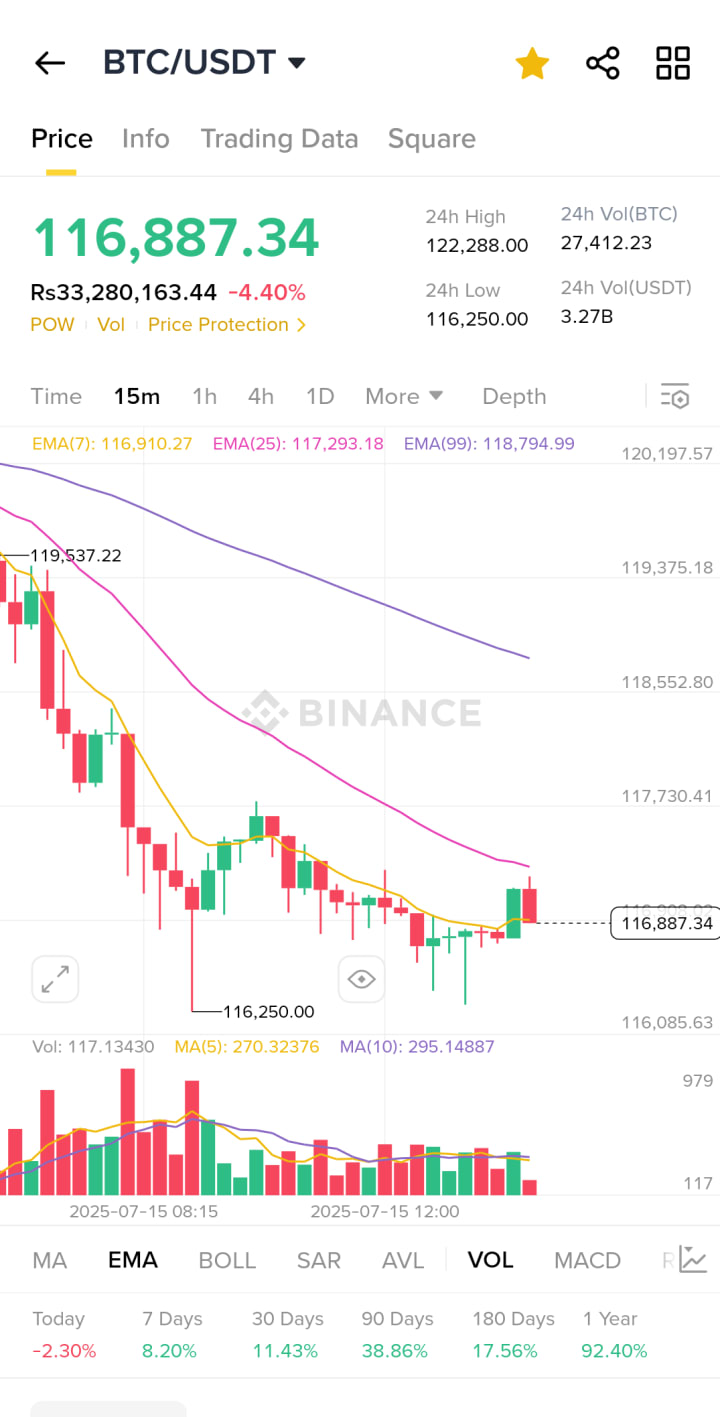
As of July 15, 2025, Bitcoin is trading around $116,929, having retraced from an intraday high near $122,459 during what’s being called "Crypto Week" in U.S. Congress.
Today’s pullback reflects profit-taking after reaching record highs—it peaked at $123,091.60, then slipped about 4.6% or roughly $5,600 down to current levels.
Several factors are contributing to this rally and volatility:
Institutional inflows: Big investment firms and spot-BTC ETF activity have driven demand significantly this year.
U.S. regulatory momentum: Congress is debating bills like the Clarity Act, Genius Act, and Anti‑CBDC Act during “Crypto Week,” boosting investor sentiment.
Strong on-chain fundamentals: Data shows institutional wallets growing and large holders like MicroStrategy continuing to accumulate BTC.
About the Creator
Muhammad Tayyab
I am Muhammad Tayyab, a storyteller who believes that memories are treasures and words are bridges to hearts. Through my writing, I capture what time often leaves behind."
Keep reading
More stories from Muhammad Tayyab and writers in The Chain and other communities.
The Gift of the Mango Tree
In a small, quiet village surrounded by lush green fields and chirping birds, there stood a magnificent mango tree. It was old—perhaps more than a hundred years—and was the pride of the village. Tall, broad, and full of shade, this mango tree bore the juiciest, sweetest mangoes anyone had ever tasted.
By Muhammad Tayyab 6 months ago in Fiction
Crypto 2026 Prediction: What’s Ahead for Bitcoin, ETH & Markets
Introduction By 2026, the cryptocurrency market is poised to enter a new chapter — one defined by institutional adoption, evolving regulation, and real-world utility. After years of speculative rallies and sharp corrections, investors and traders from Sydney to Perth are asking: Where is crypto headed next? Predicting the future of digital assets isn’t an exact science, but by analysing current trends, expert forecasts, and market data, we can draw a clearer picture of what this pivotal year may hold.
By saif ullah7 days ago in The Chain
The Premier Cryptocurrency Recovery Firm with a 98% Success Rate
As cryptocurrency adoption has expanded across global markets, so too have the risks associated with digital assets. Investment fraud, wallet breaches, phishing attacks, and unauthorized transfers have become increasingly sophisticated, affecting both individual investors and organizations. In this complex environment, cryptocurrency recovery has emerged as a specialized discipline requiring technical expertise, regulatory awareness, and disciplined investigative methods. Autopsy Mainnet Recovery has distinguished itself within this field through a consistent, structured approach that has resulted in a documented success rate of 99 percent across viable recovery cases.
By Mason Caleb5 days ago in The Chain



Comments
There are no comments for this story
Be the first to respond and start the conversation.