
The Most Underrated Lemmon/Matthau Comedy
Reviewing Out To Sea (1997)

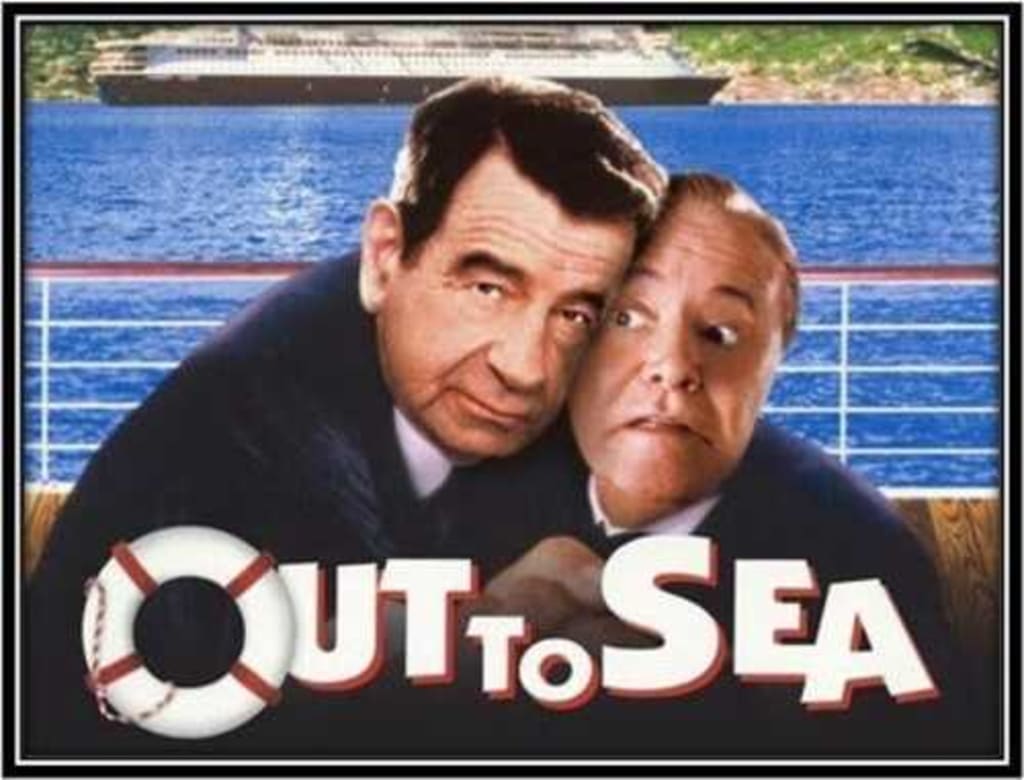
There is a famous story about Jack Lemmon told by those blessed to have worked with him. The story was that before Lemmon took to the stage or started filming a scene in a movie, he would say two words to himself, almost as a mantra.
“Magic Time.”
For this writer, “Magic Time” best encompasses what audiences long felt whenever they saw Jack Lemmon team up with Walter Matthau.
One didn’t have to be a genius to know what made these two click well together. There is, of course, the “opposites attract” element. Matthau, the average Joe walking through life with drooped shoulders and a hangdog face. Lemmon, the fast-paced hypochondriac with a list of anxieties and neuroses that could span the Grand Canyon and nervous tics.
If Neil Simon hadn’t already created The Odd Couple years earlier, a kind of story in that manner would have to have been created just for Jack and Walter.
1997’s Out to Sea, the penultimate movie to team up Lemmon and Matthau isn’t as well-known as The Odd Couple, 1993’s Grumpy Old Men, or the latter’s 1995 sequel. That fact is a shame since, in my eyes, Out to Sea is just a few steps above the very entertaining Grumpy series.
In fact, Out to Sea stands as the best Lemmon/Matthau team-up since The Odd Couple.
Charlie Gordon (Matthau) is a true loveable loser. Spending his days at the track to make bets that the audience knows right away won’t turn out in his favor. Broke, and with shady gamblers on his trail, Charlie decides he needs to get away for a while. He also decides his plan will include his brother-in-law Herb Sullivan (Lemmon.) When Charlie tells Herb he scored them tickets for a free cruise, Herb is understandably suspicious of his less-than-honest brother’s intentions. He is soon proven right once the two men are on board, staying in less than swanky accommodations.
As it turns out, the cruise is free only because Charlie signed himself and Herb as part of the cruise line’s stable of dance hosts, tasked with providing their services each night for the mostly single ladies that populate the ship. The catch is that the hosts are only there to be hosts. Despite being on call to dance, there is no fraternizing with the passengers. This is one of many rules enforced by tyrannical cruise director Gil Goodwin, played by a scene-stealing Brent Spiner in a role galaxies away from Data. So full of himself and as elegant as he is snooty, Gil had no self-awareness about going backstage and serving as his own announcer, giving himself a rave introduction as the evening’s entertainment.
Charlie doesn’t intend to follow any rules, as he hopes to use the cruise to romance the wealthy widows among the passengers. The only problem for him is he is not exactly the world’s greatest dancer, which is a small requirement for a dance host. Of course, that is partly why he brought Herb on board. Charlie’s motives, however, are not entirely selfish. He also hopes the cruise will help Herb, who has spent the last several years mourning the death of his wife Susie, who was also (of course) Charlie’s sister.
Sneaking off in between dance duties, Charlie lands at the ship’s blackjack table where his eyes are drawn to Liz LaBreche (Dyan Cannon), who in addition to seeming to be loaded with cash also has a wild personality and risk-taking edge that meshes well with Charlie.
Of course, Charlie and Liz’s fun flirtation is nothing compared to the sparks that fly for Herb, almost without him knowing it, when he starts becoming drawn to Vivian (Gloria DeHaven), a fellow widow who is on board with her daughter and her new son-in-law. Despite being smitten, Herb fears Vivian will never go for him, a former grocery clerk. Charlie plays “matchmaker” for Herb by lying to Vivian that he is a doctor. This understandably leads to the initial connection between Herb and Vivian, and the inevitable anger by the latter when the lie is revealed. However, all is forgiven in one passionate kiss. Love blooms anew, but the real crisis turns out not to be a little white lie, but whether Herb will finally let go of his late wife's memory and take a chance at love again.
“There’s no such thing as “too late.” That’s why they invented death!” — Charlie to Herb
Part of the secret of Out to Sea’s success is that it slightly tweaks the formula of Grumpy Old Men. While in the Grumpy series, Matthau had transitioned into the lovable and grumpy old curmudgeon, Out to Sea has Walter playing the closest thing to an older Oscar Madison as he had up to that point. Jack Lemmon, whose anxious energy had slowed down and even opened space for vulnerability and gravitas, leans more on the romantic side of his persona, which is handy for a movie where he is tasked with carrying the actual plot, such as it is.
It takes nothing away from Lemmon’s chemistry with Ann-Margret in Grumpy Old Men to say that he has even better chemistry with Gloria DeHaven here. DeHaven's regal demeanor and relaxed style mix with the same relatability that Lemmon himself displays in his best work. If Ann-Margret’s ageless sex appeal brought out something playful in Jack in the Grumpy movies, DeHaven’s timeless beauty brings out a soulful old romantic in Lemmon. Just seeing Lemmon and DeHaven dancing makes one feel that the genre of romcoms was made for moments like this.
The love story between Herb and Vivian almost overshadows the rest of Out to Sea, but not entirely, as there is a lot to enjoy beyond that. Matthau’s more playful relationship with Dyan Cannon is more for laughs and excitement, which both provide. (Matthau with the former, and Cannon with the latter.) The only little hiccup is that Walter and Dyan both risk their scenes being stolen right from under them by the great Elaine Stritch, playing Liz’s crusty and wisecracking mother who can see Charlie as trouble from a mile away, or rather an ocean away.
Out to Sea is likely the kind of movie Quintin Tarantino thought of when he coined the term “hang-out” movies. Films of that nature are less about plot than spending time with familiar faces and having fun. Out to Sea provides that top-to-bottom with its entire cast. As one of Charlie and Herb’s fellow dance hosts, the legendary Donald O’Connor (in his final film) shows he hasn’t lost a beat in either dancing or comic timing. Estelle Harris, as one of the single old ladies on board, pops in from time to time throughout to land a laugh as easily as if she were on the Seinfeld set, and TV icons Hal Linden ("Barney Miller") and Rue McClanahan ("The Golden Girls") also steal their respective share of scenes. McClanahan, as the cruise line’s owner, has a hilarious dance sequence with Matthau that is funny on its own but is given an extra spice thanks to the hilariously horrified look on Spiner’s Gil as he is forced to bear witness to the horror on stage while serenading the guests.
The only real flaw with the movie comes as it tries to reach port, in a sense. The third-act tension, whether Herb will finally let go of the memory of his late wife and go after Vivian, is obvious enough that the resolution could have arrived faster. There is also some seemingly injected craziness in the climax which doesn’t involve the ship, whose role more or less ends just as the snooty Gil finally receives his comeuppance.
The gift of Out to Sea is that thanks to the goodwill of its stars and scene-stealing supporting cast, you don’t think about how it stretches the ending a little too much. Does it matter when you get the benefit of an annoyed Elaine Stitch, dressed to the nines, saying the phrase “Aireo Porto?”
(You will need to see the movie for context.)
After Out to Sea, Lemmon and Matthau teamed up one more time, for 1998’s less-than-great The Odd Couple II, which reunited Felix and Oscar for the wedding of their respective kids. So close on screen, both men followed each other in death almost within a year of each other. Matthau would be gone in the summer of 2000, and Lemmon would follow him nearly a year later.
In the course of writing this piece, I thought deeply about what made the Matthau/Lemmon pairings so compelling, especially since it seems so obvious at face value (again, the “opposites attract angle.) What is interesting about Lemmon and Matthau’s chemistry and their seeming differences on-screen is the many similarities between both men.
Matthau and Lemmon both started at the dawn of television. Finally jumping to film, both men made their marks in supporting roles, each taking home an Oscar for scene-stealing supporting turns; Lemmon in 1955’s Mister Roberts, and Matthau in Billy Wilder’s The Fortune Cookie (1966) (the latter film being the first to pair the duo.) They both had major success in movies in the 1970s, followed by mixed results in the 1980s. Both men then rebounded in the late 1980s by returning to television. Lemmon turned in a crucial supporting role in the 1988 NBC miniseries The Murder of Mary Phagan, while Matthau made a series of CBS movies as Harmon Cobb, a crusty 1940s lawyer.
As the 1990s began, Lemmon and Matthau separately turned in memorable cameos (Matthau especially) in Oliver Stone’s JFK (1991), and each delivered tour de force work in the 1990s, particularly Lemmon with his powerful turn as doomed Shelly Levine in Glengarry Glen Ross, standing out in an all-star cast of standouts.
By the time the millennial generation and younger was primed to see them reunited on screen in Grumpy Old Men, there was no mystery as to why they had both survived the test of time on their own and as a team.
One of the joys of The Odd Couple, Grumpy Old Men, Out to Sea, or any of the best Lemmon/Matthau pairings is to remind us that at their best, Lemmon and Matthau still carried the twinkles of joy in their eyes. Gaze close enough to their aged faces, and you will easily see the fun. Even when their characters were trading insults with each other (“Moron” and “Putz” being among the well-known examples), viewers knew that they were seeing two people who were having fun with each other.
When Lemmon was honored by the Golden Globes with a Lifetime Achievement award in 1991, Matthau, on stage to present the award, joked about how he had written a 25-minute speech for the occasion about the ways he loved Jack Lemmon. It was both funny and felt true to their bond.
In the end, what made their remarkable second act so special was realizing that even decades later, audiences still enjoyed being in the company of Jack Lemmon and Walter Matthau as much as we knew they both enjoyed being in each other’s.
Sincerely: Random Access Moods
About the Creator
Michael Kantu
I have written mostly pop culture pieces for Medium, Substack, and on a short-lived Blogspot site (Michael3282). I see writing as a way for people to keep their thoughts, memories, and beliefs alive long after we depart from the world.
Keep reading
More stories from Michael Kantu and writers in Proof and other communities.
Irresistible Chocolate Cocktails: Sweet Treats for Dessert Lovers
Chocolate and cocktails are a match made in heaven. When the rich, velvety taste of cocoa meets the spirited kick of alcohol, magic happens. Whether you want to impress guests or just treat yourself after dinner, chocolate cocktails offer that perfect blend of sweetness and indulgence. These drinks are dessert in a glass, smooth and luscious, with enough complexity to keep your palate intrigued.
By Marcus Petrov3 days ago in Proof



Comments
There are no comments for this story
Be the first to respond and start the conversation.