
The Alchemy of Time: How Three Days in Marrakech's Medina Changed My Perspective
A Journey Through Morocco's Walled City Where Past and Present Coexist

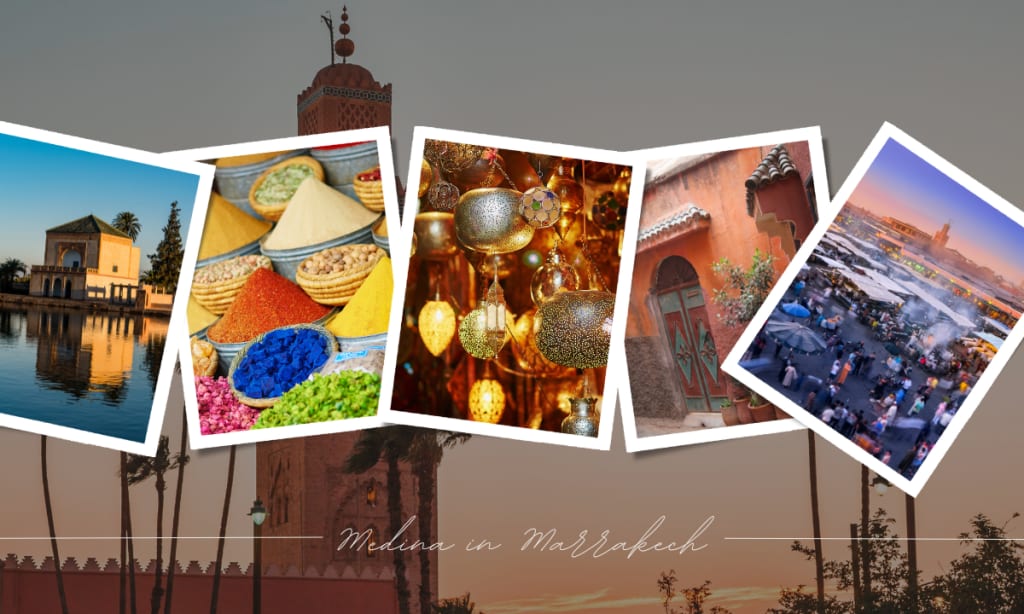
The muezzin's call to prayer floated through the pre-dawn darkness, layering atop itself as it echoed from dozens of minarets across Marrakech. I sat on the rooftop of my riad, wrapped in a borrowed Moroccan blanket against the surprising chill of a Moroccan spring night, watching as the ancient medina city slowly revealed itself in the growing light.
I had arrived just 72 hours earlier with a carefully plotted itinerary, a constellation of TripAdvisor-approved destinations, and the vague anxiety of someone who had read too many travel forums warning about scammers, aggressive vendors, and labyrinthine streets designed to confuse outsiders. Now, as the rose-colored walls caught the first rays of sunshine, I realized something had fundamentally shifted in my understanding of travel, time, and cultural immersion.
This is not a typical travel guide about Marrakech's medina. Instead, it's a reflection on how this 1,000-year-old walled city taught me to recalibrate my relationship with time and expectation—lessons that followed me home and changed how I move through the world.
Day One: The Surrender
"You are going the wrong way," said the young man confidently, materializing beside me as I consulted Google Maps in the narrow passage leading from Jemaa el-Fnaa Square toward what I believed was the spice market. "This area closed for prayer. I show you better way."
I knew about this redirect—the classic opening to one of Marrakech's most common tourist experiences. Having diligently researched, I responded with practiced phrases: "La, shukran. Ana arif tariqi." No thank you. I know my way.
He shrugged and melted back into the bustling souk. I continued forward, feeling a small surge of triumph at avoiding what I assumed was an attempt to lead me to commission-paying shops selling ornate tea accessories and decorative items to unsuspecting tourists.
Twenty minutes later, I stood confused at what appeared to be a dead end. My offline map insisted I should be standing in the middle of a major commercial thoroughfare. Instead, I faced a residential door adorned with a traditional hand-hammered knocker and a sleeping cat. Retracing my steps proved futile—the medina seemed to have rearranged itself around me, like a scene from Labyrinth.
It was then I remembered something I'd read in an old travel memoir: "In Morocco, the quickest route between two points is rarely a straight line. Sometimes the locals know better."
When I finally emerged into a familiar square an hour later, I made a decision that would transform my experience: I deleted my meticulously researched "must-see" list. I turned off my phone's mapping function. I surrendered to the medina itself.
The Alchemist's Workshop
That afternoon, aimlessly wandering down an unmarked alley barely wide enough for my shoulders, I heard rhythmic tapping from behind a small door. Curiosity pulled me toward the sound. Inside, an elderly craftsman sat cross-legged on a traditional leather pouf, delicately hammering intricate patterns into a brass tray. The workshop was smaller than my bathroom back home, yet contained an entire universe of craftsmanship.
He looked up, nodded at me sitting in the doorway, and continued working without interruption. No sales pitch. No pressure to buy. Simply a momentary acknowledgment of my presence before returning to work that required his complete attention.
I sat silently for nearly an hour, watching his weathered hands transform flat metal into dimensional art through thousands of precise strikes. We never exchanged a word—my Arabic was nonexistent, and he seemed content with the companionable silence. Eventually, I placed a few dirhams in a small dish near the door (which he acknowledged with the slightest nod) and continued my wandering.
That brief, wordless connection taught me more about Moroccan craftsmanship than any museum display or guided tour could have. I'd stumbled upon authenticity precisely because I'd abandoned my search for "authentic experiences."
The Temporal Paradox
By my second day, I noticed something peculiar about time in the medina. While the modern world outside the ancient walls raced forward, within them existed a temporal paradox where past and present coexisted without contradiction.
I watched a teenager in jeans and Nikes kneel beside his grandfather to perform traditional ablutions before prayer—both of them using water from a 14th-century fountain. A woman conducted an animated business call on her smartphone while expertly kneading dough for bread that would be baked in a communal wood-fired oven, as has been done for centuries. A craftsman used techniques unchanged since medieval times to create decorative lamp designs] specifically for electric bulbs.
The medina doesn't reject modernity; it simply refuses to be defined by linear time. Instead, it operates in what I began thinking of as "circular time"—where traditions, rather than becoming obsolete, simply incorporate new elements while maintaining their essential character.
This realization made me uncomfortably aware of my own culture's obsession with the new, the next, the updated. We discard functioning objects for marginally improved versions. We abandon traditions as outmoded. We chase novelty and call it progress.
The Market's Treasures
Later that day, I found myself in a small shop filled with handcrafted leather bags in every imaginable color. The proprietor, noticing my interest in a particular shoulder bag with intricate stitching, began explaining the vegetable tanning process unique to Morocco.
"This technique," he said, gesturing to the supple leather between us, "my grandfather taught my father, who taught me. The color comes from natural materials—saffron, indigo, pomegranate." He pointed to a collection of natural beauty products made with argan oil and rosewater displayed near the counter. "Same plants, different purposes. Nothing is wasted."
I left with both the bag and a small vial of argan oil, but more importantly, with a newfound appreciation for how traditional production methods inherently embrace sustainability principles that the West is only now rediscovering.
The Night Market Revelation
That evening, I found myself in the sensory whirlwind of Jemaa el-Fnaa as it transformed from daytime plaza to nighttime food market. Steam rose from dozens of cooking stations, traditional musicians competed for attention, storytellers gathered crowds despite most tourists not understanding their words.
I settled at food stall #32, recommended by an American expat I'd met that morning. The vendor grinned as I requested a mixed plate in my elementary French. "English? American?" he asked.
"American," I confirmed.
He nodded thoughtfully. "Many Americans come. They eat quickly. Always checking phone. Always next place to go." He tapped his wrist where a watch would be, then pointed to his eyes and around the square. "Better to be here. Really here."
As if to illustrate his point, at the next table sat four tourists frantically documenting their meals for social media, discussing tomorrow's itinerary while barely tasting today's food.
I put my phone away and committed to being fully present for the meal—the smoky eggplant zaalouk served in a beautiful hand-painted ceramic dish, the fragrant lamb tagine, the sweet mint tea poured from dramatic height into ornate Moroccan tea glasses. I watched the square's elaborate human theater unfold around me. For perhaps the first time in my hyper-connected life, I experienced the profound pleasure of being exactly where I was, precisely when I was there.
Day Three: The Tea Ceremony
My final morning brought an unexpected invitation. The riad's elderly caretaker, who had silently maintained the courtyard garden each day, gestured for me to join him for tea before beginning his work.
He carefully arranged an exquisite Moroccan tea set on a small hammered brass tray, meticulously preparing the mint tea with a practiced ritual of steeping, pouring, and re-pouring to achieve the perfect flavor and temperature.
Over the next hour, through a combination of broken French, rudimentary Arabic, and expressive gestures, Hassan shared fragments of his life story. He had worked in the same riad for 42 years. His father had been a water seller in Jemaa el-Fnaa. His grandfather had carved some of the cedar panels in the Ben Youssef Madrasa. His children lived in Casablanca and Paris.
"But you stay here," I observed. "Why not go to the city with your children?"
He looked momentarily confused by what seemed to him an obvious question. "This is my place," he said simply, gesturing to encompass not just the riad but the medina beyond its walls. "Time passes differently here. We do not fear it as you do in America."
Lessons in Self-Care
Before leaving, I spent a morning at a traditional hammam, where a woman with strong, confident hands scrubbed away layers of dead skin with a rough kessa glove and black soap made from olives. After the bathing ritual, she applied pure argan oil to my skin and hair, explaining through gestures how Moroccan women have used these natural beauty products for centuries.
The experience was far from the luxury spa treatments I was accustomed to at home, yet infinitely more effective and authentic. I emerged feeling renewed, my skin glowing with the benefits of these simple, natural treatments that required no elaborate packaging or marketing campaigns—just generations of wisdom about what truly nourishes the body.
The Departure Epiphany
As my airport taxi navigated the modern avenues of Gueliz, Marrakech's French-built new town with its international brands and familiar urban rhythm, I felt as though I were traveling forward in time, returning to the world of deadlines, productivity metrics, and relentless progress.
Yet something had fundamentally changed in my perception. The medina had shown me that time need not be experienced as a straight line rushing toward some imagined future. It could instead be circular, seasonal, even recursive—allowing tradition and innovation to coexist, permitting past and present to inform each other.
I realized that my initial frustration with the medina—its seeming disorganization, its resistance to efficient navigation, its indifference to my carefully planned itinerary—stemmed from my attempt to impose linear time on a place that fundamentally operates according to different temporal rules.
The anxiety I'd felt upon arrival came from a lifetime of conditioning that values optimization, productivity, and forward momentum above all else. My "fear of missing out" had nearly caused me to miss everything.
The Lesson I Carried Home
In the weeks after returning home, I found myself making subtle changes to my daily patterns. I started taking meandering walks without a destination. I turned off notifications on my devices. I began cooking dishes that required hours of slow preparation in traditional Moroccan cookware I'd brought back. I practiced being fully present with friends rather than mentally plotting my next task.
I rearranged my living space, incorporating pieces that reminded me of the medina's timeless aesthetic—a handwoven throw with geometric patterns draped over my sofa, brass lanterns] casting patterned shadows across my walls in the evening, a small leather pouf that invited spontaneous conversations at floor level rather than formal seating arrangements.
These weren't conscious decisions to "live more mindfully" or any other self-help platitude. They were simply the natural continuation of what the medina had begun teaching me—that time is more malleable than we acknowledge, that efficiency is not the only measure of value, and that sometimes the most profound experiences come when we abandon our careful plans.
This is not to romanticize challenges that real Marrakchis face, nor to suggest that the medina exists as some mystical alternative to modern life. It faces real pressures from tourism, development, and economic necessity. But within its rose-colored walls, I found a different way of experiencing time—one that has quietly transformed my relationship with the world.
The greatest souvenir I brought home wasn't the hand-hammered brass lamp that now sits in my living room, but rather the understanding that sometimes, the most valuable thing we can do is put away the map, silence the phone, and allow ourselves to be fully present in the delicious complexity of the moment we're in.
I went to Marrakech's medina seeking exotic experiences to document and share. I left having learned how to better experience my own life.
*What destination has unexpectedly changed your perspective? Share your transformative travel experiences in the comments.
---
Sources:
Marrakeche Crafts, UNESCO World Heritage Centre, The Unconventional Route, TripSavvy
About the Creator
Mohamed B
Always fascinated by the skill and creativity of the hands that make the Moroccan product, I devote myself to the work of art. I try to convey on all continents my knowledge, my full knowledge of the Berbers.
Crafting the Perfect Personalized Cocktail
Creating a personalized cocktail is like painting your own masterpiece in a glass. It’s about mixing flavors that speak to your unique taste, mood, and occasion. Whether you prefer something sweet, sour, bitter, or a little spicy, a personalized cocktail is all about you. It’s the art of balancing ingredients to make a drink that feels tailor-made.
By Aisha Patel4 days ago in Proof
Acceptance Meditation: Embracing the Present Moment
Acceptance meditation is a gentle practice that helps us welcome our present experience without judgment. It invites us to open to what is, even if it feels difficult or uncomfortable. This openness creates space for peace and clarity.
By Garold One6 days ago in Proof
Miss Persephone's Manual to a Seemingly Ordinary Life
Miss Persephone was found at the dining table, her blue eyes swollen, her tears arriving and retreating like the tides of the ocean. Earlier that day, her family had visited her in the retirement home where she had lived for eight years. It was her eightieth birthday.
By Imola Tóth3 days ago in Fiction


Comments (1)
Your description of 'circular time' resonates deeply. Western culture could learn so much from these ancient spaces where past and present dance together instead of competing. Lovely perspective.