
Green Alchemy: My Journey to Morocco's Ancient Pottery Village
Discovering the Centuries-Old Secrets of Tamegroute's Emerald Pottery in the Shadow of the Sahara

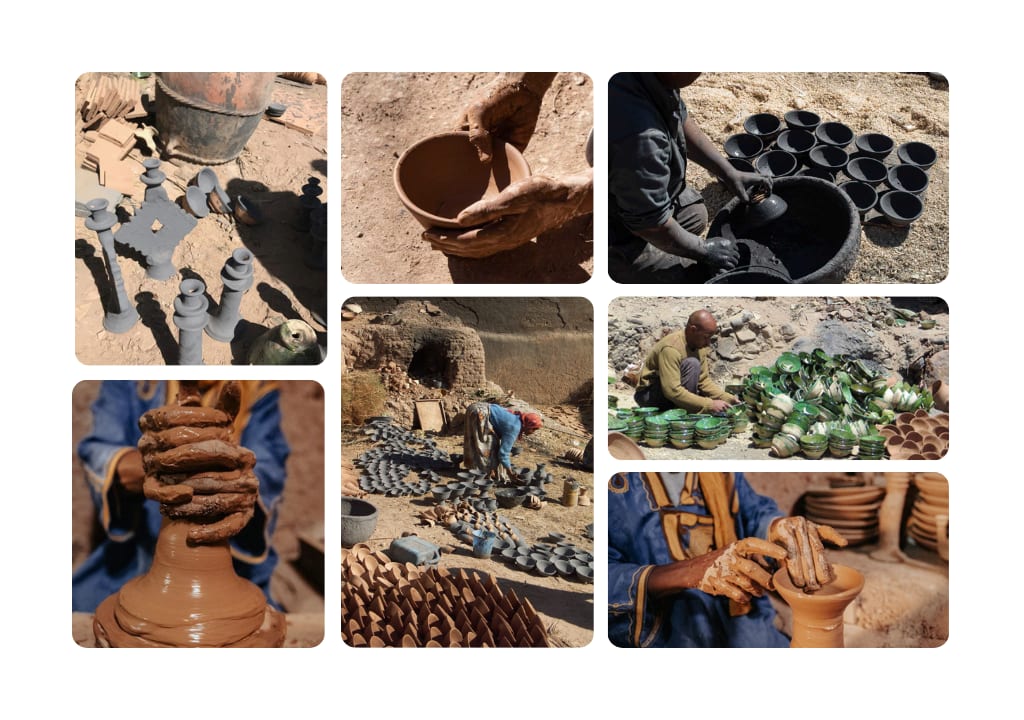
The road to Tamegroute stretches like a ribbon of sunbaked earth, winding through landscapes that transition from rocky plains to the golden dunes of the Sahara. As my driver navigates the final stretch toward this small village just south of Zagora, Morocco, the morning sun casts long shadows across the ancient kasbahs that line our route.
"There," says Hassan, my guide, pointing to a cluster of earthen structures ahead, "that's where the magic happens."
The First Encounter
The morning air carries the scent of smoke and clay as we arrive. Children play between workshops while men in dusty djellabahs carry unfired pottery to sun-dry on rooftops. There's a timelessness here that immediately captivates me.
I've traveled thousands of miles in search of Tamegroute's legendary green pottery—a centuries-old tradition dating back to 1687 that has bewitched collectors and designers worldwide. What I discover will forever change how I view the relationship between craft, culture, and community.
Outside a modest workshop entrance, I meet Brahim, a sixth-generation potter whose family has shaped this tradition since its beginnings.
"Welcome," he says with a smile that crinkles the sun-weathered corners of his eyes. "You've come to see how earth becomes art?"
Secrets Beneath the Surface
The first revelation comes immediately: Tamegroute's exceptional pottery begins not at the wheel, but ten meters underground.
"Our clay is special," Brahim explains as he leads me to a deep pit at the village edge. "Not like other pottery. We dig deep—sometimes ten meters—to find the perfect material."
I peer down into what resembles a mining operation more than a pottery supply. Men emerge from the depths carrying baskets of grayish clay on their shoulders.
"Many have tried to copy our pottery," Brahim continues with pride in his voice. "They buy our pieces, take them to laboratories, analyze the materials. But they always fail. Why? Because the secret is not just in what we use, but in how we use it."
The clay, I learn, must rest for a week—wrapped and aged like fine cheese—before it's ready for the potter's hands.
The Dance of Creation
Inside Brahim's workshop, the air is cool and damp. Three men sit at ground-level wheels, their feet pumping wooden platforms that spin the wheels in a hypnotic rhythm. Their hands move with practiced precision, transforming lumps of clay into vessels with graceful contours.
"My grandfather taught my father, who taught me," says Brahim. "When my sons were five years old, they began to learn. Not with real pottery—with mud and play. By twelve, they could make simple bowls. By twenty, they became masters."
I watch, mesmerized, as an elderly artisan shapes a tagine cooking pot, his fingers barely seeming to touch the clay as it rises and takes form. There's something meditative about this process—no electric wheels, no modern shortcuts, just hands and clay engaged in a conversation that's continued for centuries.
The Alchemy of Green
But it's the next stage that truly reveals Tamegroute's uniqueness. In a corner of the workshop, Brahim shows me their closely guarded treasure: the glaze mixture that creates their signature green.
"This," he says with reverence, "is our family's secret."
The mixture contains manganese, silica, cobalt, copper oxide, barley flour, and special rocks from local mines. Each family maintains slight variations in their recipe, creating subtle differences that experts can identify by sight.
"The green was chosen centuries ago because it's the color of Islam, of paradise," Brahim explains. "But the special green—our green—comes from the firing."
We walk to a traditional dome-shaped kiln where pottery awaits transformation. Unlike modern kilns with precise temperature controls, these traditional ovens use palm leaves, dry thorns, and wood chips as fuel, reaching temperatures of 1000°C through methods unchanged for generations.
"Modern kilns make one green—always the same," Brahim says, shaking his head. "Our kilns make many greens in one piece. Every piece different, every firing a surprise."
The Revelation
The following morning, Brahim invites me to witness the opening of the kiln—a moment of truth in the pottery process. Artisans carefully remove still-warm pieces, revealing the alchemical transformation that has occurred overnight.
What emerges takes my breath away: a collection of pottery in varying shades of green—from deep emerald to soft sage, with subtle variations across each surface. No two pieces are identical, each bearing the unique signature of flame and glaze.
"This is why people come from around the world," Brahim says, handing me a small bowl. "Feel it."
The piece is substantial in my hands, its glaze smooth yet alive with subtle texture. I'm struck by the thought that I'm holding more than pottery—this is history, culture, and generations of knowledge manifested in tangible form.
Beyond Tradition: Innovation in Ancient Craft
Later that day, I meet Ibrahim, Brahim's eldest son. At 28, he represents the new generation of Tamegroute artisans—one foot firmly planted in tradition, the other stepping cautiously toward the future.
"We must protect our heritage while finding new ways to survive," Ibrahim tells me as he shows me a workshop where artisans are creating decorative tiles and modern lighting fixtures alongside traditional tagines and bowls.
"Now we make pieces for designers in Europe and America. They want our green for modern homes," he explains. "And we've started using the henna technique for decoration." He shows me pottery adorned with intricate patterns applied using the same methods women use for traditional henna body art.
I learn that the government has built new facilities with improved working conditions, including electric wheels and solar-powered kilns. Yet the traditional firing methods remain, protected by artisans who understand that their distinctive glaze cannot be replicated with modern technology.
The Village That Clay Built
During my week in Tamegroute, I discover that pottery isn't just a craft here—it's the foundation of the entire community's economy and identity.
Eleven families maintain the tradition, their workshops supporting extended networks of relatives. Children grow up in the rhythms of pottery production, absorbing techniques through observation long before formal training begins.
"Without pottery, there is no Tamegroute," says Mohammed, head of the local pottery cooperative. "It connects us to our ancestors and provides for our children."
I witness how this ancient craft adapts to modern markets. International dealers visit regularly, placing orders for high-end boutiques in Europe and North America. A German distributor requires pieces to be signed "Handmade since 1687," acknowledging the historical value of these items.
The Parting Gift
On my final evening, Brahim invites me to his home for dinner. His family serves a fragrant tagine cooked in one of their own pottery vessels. The meal is served on Tamegroute plates, the mint tea poured from a Tamegroute teapot.
"You see?" Brahim says with a smile. "The pottery is not just for selling. It is for living."
After dinner, he presents me with a small green bowl. It fits perfectly in my palm, its surface a mesmerizing swirl of emerald and olive tones.
"This one spoke your name during firing," he says. "Every piece chooses its owner."
Whether this is true or simply a gracious gesture, the sentiment touches me deeply. I realize what makes Tamegroute pottery truly special isn't just its distinctive glaze or ancient techniques—it's the unbroken human connection that flows through every piece.
The Journey Home
Months later, that small green bowl sits on my desk, holding paper clips instead of Moroccan olives. Daily, it reminds me of the desert village where earth becomes art through processes unchanged for centuries.
In a world increasingly dominated by mass production and digital perfection, Tamegroute's pottery stands as testament to the enduring value of human touch, generational knowledge, and the beautiful imperfections that make handcrafted items irreplaceable.
Every time I hold a piece of this distinctive green pottery, I'm transported back to that small village at the edge of the Sahara, where artisans still transform earth into living art, keeping an ancient tradition vibrant in the modern world.
*If you're intrigued by Tamegroute pottery, you can explore authentic pieces through Marrakeche Crafts, where traditional Moroccan artisanal work is available worldwide. Their collection includes both traditional and contemporary Tamegroute pieces, with each item supporting the artisan families who maintain this remarkable tradition.*
About the Creator
Mohamed B
Always fascinated by the skill and creativity of the hands that make the Moroccan product, I devote myself to the work of art. I try to convey on all continents my knowledge, my full knowledge of the Berbers.
What is abstract sculpture?
Abstract art often feels mysterious because it does not rely on recognizable figures, realistic animals, or a clear narrative. Abstract sculpture follows the same principle. Rather than imitating the real world, it uses form, line, surface, volume, and space to convey ideas, movement, or emotion.
By Shenzhen Ruiheng Crafts4 days ago in Art
How Tattoo Parlours in Cape Town Help Clients Feel Comfortable and Informed
Walking into a tattoo parlour in cape town for the first time can feel strange. You are trusting someone with your skin, your story, and a design you might wear for life. It is normal to feel excited and scared at the same time.
By Tools of Trade Studiosa day ago in Art


Comments
There are no comments for this story
Be the first to respond and start the conversation.