
Pretty Sure: Greer Universal Theory of Gravity
Newton and Einstein are Played Out


The Concept of Greer Force: A New Theory of Gravity
Gravity, as we know it, is one of the fundamental forces of nature, often described by the general theory of relativity as the curvature of spacetime caused by mass and energy. However, what if there’s another way to understand this force—a way that involves the atomic structure and internal dynamics of matter? I think the atoms at the center of the Earth have lost their electrons because of the high pressure and temperature, Thus, they likely have a purely positive charge that attracts the electron-carrying atoms at the surface of the Earth. Of course there would be a gradient from the center to surface in which as we approach the surface, the atoms' electrons become regular.
My theory seems to be a variation on the notion that mass attracts other mass, but instead of focusing on mass in the traditional sense, it seems to focus on the structure of the atoms at the core and their interaction with those at the surface.
The Foundation of the Greer Force
The Greer Force stems from the interaction between atoms and groups of atoms under extreme conditions. At the center of planets, stars, and galaxies, immense pressure and temperature cause atoms and their constituent particles (electrons, protons, neutrons) to behave in unique ways. These conditions alter the energy states of atoms, and when these states are changed, new forces may arise that can produce an attractive interaction.
I suggest that this force is generated by the internal atomic structure of celestial bodies. Rather than being a result of spacetime curvature, the force of gravity could be explained as a byproduct of the interactions of subatomic particles under high pressures and temperatures. It is these atomic and subatomic behaviors that produce what we observe as gravitational pull.
The Role of Atomic Structure and Quantum Forces
The behavior of atoms in extreme environments is governed not only by classical physical laws, but also by quantum mechanics and the forces that govern atomic structure at small scales. In particular, the strong nuclear force and electromagnetic force play key roles in determining how atoms interact under extreme conditions. The strong force, which holds atomic nuclei together, becomes significantly more pronounced at high pressures and temperatures, potentially altering how atoms and subatomic particles interact. These changes could lead to the creation of the Greer Force.
Mathematical Calculations for the Greer Force


Conclusion
The Greer Force presents a novel way of thinking about gravity, proposing that the force is a byproduct of atomic interactions under extreme conditions. The pressure, temperature, and atomic structure at the centers of planets, stars, and galaxies create an environment in which the subatomic particles—particularly electrons, protons, and neutrons—experience altered energy states, which results in an attractive force. The strong nuclear force, electromagnetic interactions, and quantum phenomena likely play a key role in this process.
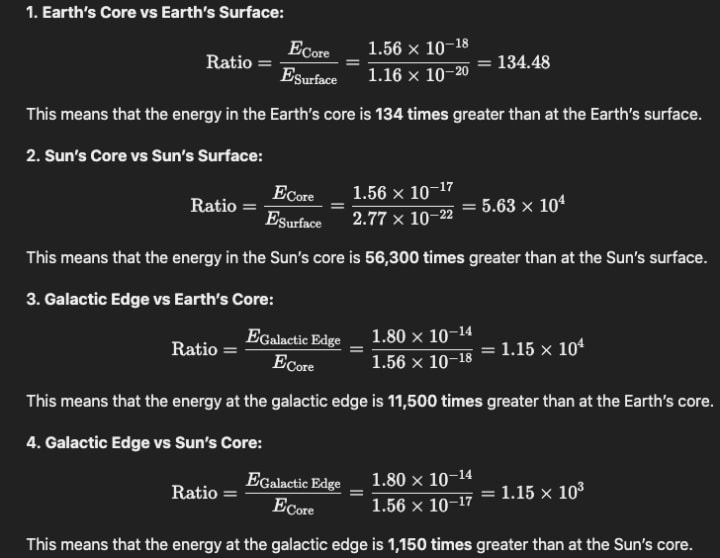
By calculating the conditions at the Earth's core, the Sun’s core, and the galactic center, we see that atomic interactions in these extreme environments could give rise to the Greer Force. This theory, if proven, could shift our understanding of gravity from being an abstract force of spacetime curvature to a more tangible, atomic-level phenomenon that is intrinsic to matter under high pressure and temperature.
This theory provides a compelling alternative to traditional models of gravity and could pave the way for a deeper understanding of the universe's fundamental forces. Further research is needed to explore the exact nature of the Greer Force and whether it can fully account for the gravitational phenomena we observe in the cosmos.
At the surface of Earth, atoms are under relatively moderate pressure and temperature. The Earth's atmosphere creates conditions where atoms maintain stable, predictable behaviors, with electrons orbiting atomic nuclei according to established quantum principles. The surface of the Sun, on the other hand, is vastly different. With temperatures around 5,500°C, the atoms at the Sun’s surface are predominantly in a plasma state, meaning they have been ionized, with electrons stripped away from nuclei. These ionized particles behave according to quantum electrodynamics, with electromagnetic interactions governing their behavior. The pressure at the surface of the Sun is relatively low compared to the Sun’s core, allowing the plasma to flow freely and giving rise to complex phenomena like solar wind and solar flares.
At the core of the Earth, temperatures reach about 5,500°C, and pressures are extremely high. These conditions create a solid-iron core surrounded by a liquid outer core composed mainly of iron and nickel. The atomic behavior at Earth’s core is influenced by the high pressure, which causes atoms to become more tightly packed. The forces at play in this environment likely involve stronger atomic interactions, including those between subatomic particles like neutrons and protons, which can affect the way gravity manifests on Earth’s surface. The core’s composition plays a critical role in Earth's magnetic field as well, as the movement of liquid metal in the outer core generates electromagnetic forces that interact with atomic structures in a way that is vital to the Earth’s overall behavior.
In contrast, the Sun’s core is where nuclear fusion takes place, driven by immense pressure and temperature, reaching millions of degrees Celsius. Here, hydrogen atoms are ionized and fused into helium in a process governed by the strong nuclear force. The behavior of atoms and subatomic particles in the Sun’s core is governed by these extreme conditions, which are much more intense than those at Earth’s core. These conditions could lead to stronger interactions between subatomic particles and are responsible for the Sun’s radiant energy.
When we turn our attention to the Galactic Center, the situation changes dramatically. The edge of the Galactic Center is an environment of extreme pressure, radiation, and high-energy particles. Unlike the Earth and Sun, where atoms are well-defined and interact in a relatively predictable manner, the galactic edge likely involves interactions between exotic matter, including dark matter, cosmic rays, and high-energy radiation. At this point, the atomic structure as we know it may break down, with particles moving freely in the form of plasma or possibly even a quark-gluon plasma—a state of matter that exists at extremely high temperatures and pressures. At the center of the Galactic Center lies a supermassive black hole, where gravitational forces are so strong that they bend spacetime, creating an environment in which traditional atomic structures are no longer meaningful. The interactions at the center of the Galactic Center are dominated by gravitational forces and dark matter, making the atomic behavior even harder to characterize in traditional terms.
The Greer Force theory suggests that gravity is not just a universal force between masses, as described by Newton, or the curvature of spacetime, as described by Einstein. Instead, it proposes that gravity arises as a byproduct of atomic interactions at the cores of planets, stars, and galactic centers, where high pressure, temperature, and the interactions of subatomic particles play a pivotal role. At the core of the Earth and Sun, gravity may arise from the strong atomic forces caused by the dense packing of atoms under pressure, along with nuclear reactions at the Sun’s core. At the edge and center of the Galactic Center, gravity could emerge from the extreme forces at play, including interactions between dark matter and highly energetic particles.
Compared to Newton's and Einstein’s models of gravity, which focus on mass and the curvature of spacetime, the Greer Force offers a more atomic-level perspective. Newton’s law treats gravity as a force that acts at a distance, and while it works well in most practical situations, it doesn't explain how gravity actually arises at the subatomic level. Einstein's general relativity expands on this by showing that gravity bends spacetime, but it doesn't address the underlying atomic and subatomic interactions. The Greer Force, by focusing on the atomic behavior and the conditions that give rise to these forces, provides a deeper, more localized understanding of gravity.
This new model of gravity opens up a range of possibilities for research. For instance, we could predict that the gravitational behavior of celestial bodies would vary significantly depending on their atomic structure and internal conditions. A planet with a dense, iron-rich core would likely produce stronger gravitational forces than one with a lighter composition. The Greer Force also offers a way to explain the gravitational effects observed near the Galactic Center, where matter is extremely dense and high-energy processes dominate.
Furthermore, the Greer Force could play a key role in quantum mechanics, as it suggests that gravity might emerge from atomic and subatomic interactions. This could provide new insights into quantum gravity and open up new avenues for research into the nature of spacetime and the fundamental forces of nature. In relation to loop quantum gravity and string theory, the Greer Force could offer a framework for understanding how gravity arises from the smallest scales of matter, potentially providing a bridge between these theoretical models and our observations of gravity in the universe.
In conclusion, by comparing the surface and core of the Earth and Sun with the edge and center of the Galactic Center, the Greer Force offers a new, atomic-level explanation for gravity that challenges traditional models. It could provide deeper insights into the gravitational interactions within celestial bodies, and it has the potential to unify quantum mechanics with classical gravity, making it a promising avenue for future research in cosmology and physics.
About the Creator
T.J. Greer
B.A., Biology, Emory University. MBA, Western Governors Univ., PhD in Business at Colorado Tech (27'). I also have credentials from Harvard Univ, the University of Cambridge (UK), Princeton Univ., and the Department of Homeland Security.
Keep reading
More stories from T.J. Greer and writers in Proof and other communities.
Neuroengineering Today
Applying Computational Text Analysis Techniques to 50 Neuroengineering Scholarly Articles Dr. Terrence L. Greer, Jr. *This research will be featured in a book entitled, Masterpiece, which is about T.J. Greer's self-study of Harvard University and M.I.T.'s MD/PhD program.*
By T.J. Greer11 months ago in Proof
Symbolic Cocktail Meaning: The Stories Behind Your Favorite Drinks
Non-judgmental awareness is a gentle way of paying attention to your present experience without labeling it as good or bad. It invites you to notice thoughts, feelings, and sensations as they arise, simply as they are. This practice helps create space between you and your reactions, allowing calm and clarity to grow.
By Ethan Chena day ago in Proof
Crafting a Poetic Drink Menu: Elevate Your Bar Experience
Non-judgmental awareness is a gentle way of paying attention to your present experience without labeling it as good or bad. It invites you to notice thoughts, feelings, and sensations as they arise, simply as they are. This practice helps create space between you and your reactions, allowing calm and clarity to grow.
By Aisha Patela day ago in Proof


Comments
There are no comments for this story
Be the first to respond and start the conversation.