
Neuroengineering Today
Applying Computational Text Analysis Techniques to 50 Neuroengineering Scholarly Articles


Applying Computational Text Analysis Techniques to 50 Neuroengineering Scholarly Articles
Dr. Terrence L. Greer, Jr.
*This research will be featured in a book entitled, Masterpiece, which is about T.J. Greer's self-study of Harvard University and M.I.T.'s MD/PhD program.*
Abstract
Neuroengineering integrates neuroscience and engineering to develop technologies that address neurological disorders, enhance brain-computer interfaces (BCIs), and improve neural prosthetics. This study applies text mining techniques—including word frequency analysis, cluster analysis, and topic modeling—to identify key trends in neuroengineering research. By analyzing primary studies on optogenetics, neurostimulation, and machine learning in neural signal processing, we uncover emerging patterns and evolving research directions. Secondary sources from medical and engineering literature provide broader context on the clinical and therapeutic applications of these technologies. Our findings highlight the growing impact of neuroengineering and the need for interdisciplinary collaboration to advance patient care and human-machine interaction.
Introduction
Neuroengineering, an interdisciplinary field combining neuroscience, electrical engineering, and computer science, has revolutionized our understanding of the brain and its applications in medicine. Neurological disorders such as epilepsy and spinal cord injuries continue to pose significant challenges, but neuroengineering offers promising interventions, including deep brain stimulation (DBS), brain-computer interfaces (BCIs), and optogenetics (Jackson & Zimmermann, 2012). These advancements not only enhance clinical treatments but also introduce ethical concerns regarding human augmentation and neural privacy (Goering et al., 2017).
Edelman et al. (2015) and Rothschild (2010) provided a holistic overview of the most recent human in vivo techniques for implementing brain–computer interfaces, bidirectional interfaces, and neuroprosthetic implants. The review discussed recent progress in these areas and the challenges involved. Rothschild, 2010 Finkel (2000) discussed the application of computational simulation techniques to modeling neurological disease and mental illness. The article considered models of Alzheimer's disease, Parkinson's disease, and schizophrenia, and suggested that a common set of computational mechanisms may account for functional loss across a spectrum of brain diseases. Finkel, 2000 Finkel (2000) focused on the BrainGate implant and its use as an interface between the Internet and the human nervous system. The article also considered sensory prosthetics and deep brain stimulation. Finkel, 2000 Stacey and Litt (2008) reviewed the development of new implantable antiepileptic devices, which hold great promise for improving the quality of life of people with epileptic seizures. The article discussed the various strategies being investigated to stop seizures and the need for collaboration between neuroengineers, physicians, and industry. Stacey & Litt, 2008 Jeong et al. (2015) described recent advances in soft electronic interface technologies for neuroscience research. They highlighted the use of low modulus materials and/or compliant mechanical structures to enable soft, conformal integration and minimally invasive operation. Jeong et al., 2015 Panuccio et al. (2018) emphasized the importance of developing novel neurotechnological devices for brain repair and the major challenges expected in the next years. They discussed the different types of brain repair strategies being developed and the potential of artificial intelligence to improve the devices. Panuccio et al., 2018 Tbalvandany et al. (2019) focused on the importance of embodiment in neuro-engineering endeavors and the need to consider the patient's bodily experience and how neuro-engineering devices could become part of a user's body schema. Tbalvandany et al., 2019.
Potter et al. (2014) discussed the importance of closed-loop neuroscience and neuroengineering, which respects the inherent "loopiness" of neural circuits and the fact that the nervous system is embodied and embedded in an environment. Potter et al., 2014 Coyle and Sosnik (2015) reviewed information fundamental for understanding the field of neuroengineering of sensorimotor rhythm-based brain–computer interface systems, including an overview of the motor system, neuroimaging and electrophysiology studies, and the engineering approaches used to analyze motor cortical signals. Coyle & Sosnik, 2015 Kim et al. (2024) discussed the exploration of nanomaterial synthesis and nanoscale fabrication strategies to design unconventional soft bioelectronics with mechanical properties similar to those of neural tissues and submicrometer-scale resolution. Kim et al., 2024 Won et al. (2023) reviewed recent progress in the development of miniaturized and ultralightweight devices as neuroengineering platforms that are wireless, battery-free, and fully implantable, with capabilities that match or exceed those of wired or battery-powered alternatives. Won et al., 2023 Vassanelli and Mahmud (2016) argued that achieving a "high-level" communication and functional synergy between natural and artificial neuronal networks in vivo will allow the development of a heterogeneous world of neurobiohybrids, including "intelligent" neuroprostheses for augmentation of brain function. Vassanelli & Mahmud, 2016 Bassett et al. (2017) reviewed the emerging discipline of network neuroscience, which uses and develops tools from graph theory to better understand and manipulate neural systems from micro- to macroscales, and highlighted its potential utility in informing diagnosis and monitoring, brain–machine interfaces, and brain stimulation. Bassett et al., 2017 Canales et al. (2018) reviewed the applications of multifunctional fibers and other integrated devices for optoelectronic probing of neural circuits and discussed engineering directions that may facilitate future studies of nerve repair and accelerate the development of bioelectronic medical devices. Canales et al., 2018 Nurmikko et al. (2010) discussed the development of fully implantable wireless microelectronic "brain-interfaces" within the body, which is a key element in achieving the goals for practical and versatile neural prostheses. Nurmikko et al., 2010.
Hoag (2003) discussed DARPA's project to develop technologies to interface brain and machine, including the "Roborat" experiment where rats were guided through a maze using signals to the reward area of their brain. Hoag, 2003 Niyonambaza et al. (2019) reviewed the current advances and trends in neurotransmitters detection techniques, including in vivo sampling and imaging techniques, electrochemical and nano-object sensing techniques, and spectrometric, analytical and derivatization-based methods. Niyonambaza et al., 2019 Moritz et al. (2016) identified key technological challenges for recording and manipulating neural activity, decoding and interpreting brain data in the presence of plasticity, and early considerations of ethical and social issues pertinent to the adoption of neurotechnologies. Moritz et al., 2016 Ghannam et al. (2020) surveyed the range of postgraduate programmes that strive to nurture neuroengineering graduates and provided recommendations for how these programmes can be delivered using non-traditional teaching approaches. Ghannam et al., 2020 Wróbel et al. (2014) described a plan to establish novel research techniques combining biological, technical and analytical discoveries to monitor neuronal circuits involved in emotional modulation of sensory processing. Wróbel et al., 2014 Mousavi et al. (2023) reviewed the use of plasmonics in neuroengineering, including the use of plasmonic nanostructures for less-invasive neuromodulation, central nervous system disease diagnosis and therapy, and smart carrier-drug delivery toward the brain. Mousavi et al., 2023 Brunton and Beyeler (2019) provided an accessible primer to modern modeling approaches and highlighted recent data-driven discoveries in the domains of neuroimaging, single-neuron and neuronal population responses, and device neuroengineering. Brunton & Beyeler, 2019.
Kumar et al. (2021) reviewed the use of graphene family nanomaterials for neuronal engineering and regeneration, including their potential for neuronal stem cells differentiation, neuronal network growth, and the impact of these nanomaterials on neuroprosthetic development. Kumar et al., 2021.
Methods
This study integrates text mining techniques with systematic literature review and meta-analysis to analyze advancements in neuroengineering. The methodology consists of the following components:
Text Mining and Word Frequency Analysis – We collected peer-reviewed journal articles from biomedical engineering databases, extracting abstracts and full texts for computational analysis. Word frequency analysis identified recurring terms and key concepts in neuroengineering literature.
Cluster Analysis – Using natural language processing (NLP), we applied hierarchical and k-means clustering to group research papers by thematic similarity. This helped pinpoint major research trends, such as neurostimulation, AI-driven BCIs, and ethical concerns in neural engineering.
Topic Modeling – Latent Dirichlet Allocation (LDA) uncovered hidden topics in the literature, revealing connections between neuroengineering subfields and their clinical applications.
Meta-Analysis – Experimental studies were selected based on reproducibility, validation, and clinical relevance. Statistical synthesis of findings from primary research provided insights into the efficacy and scalability of neuroengineering technologies.
Word Frequency Analysis
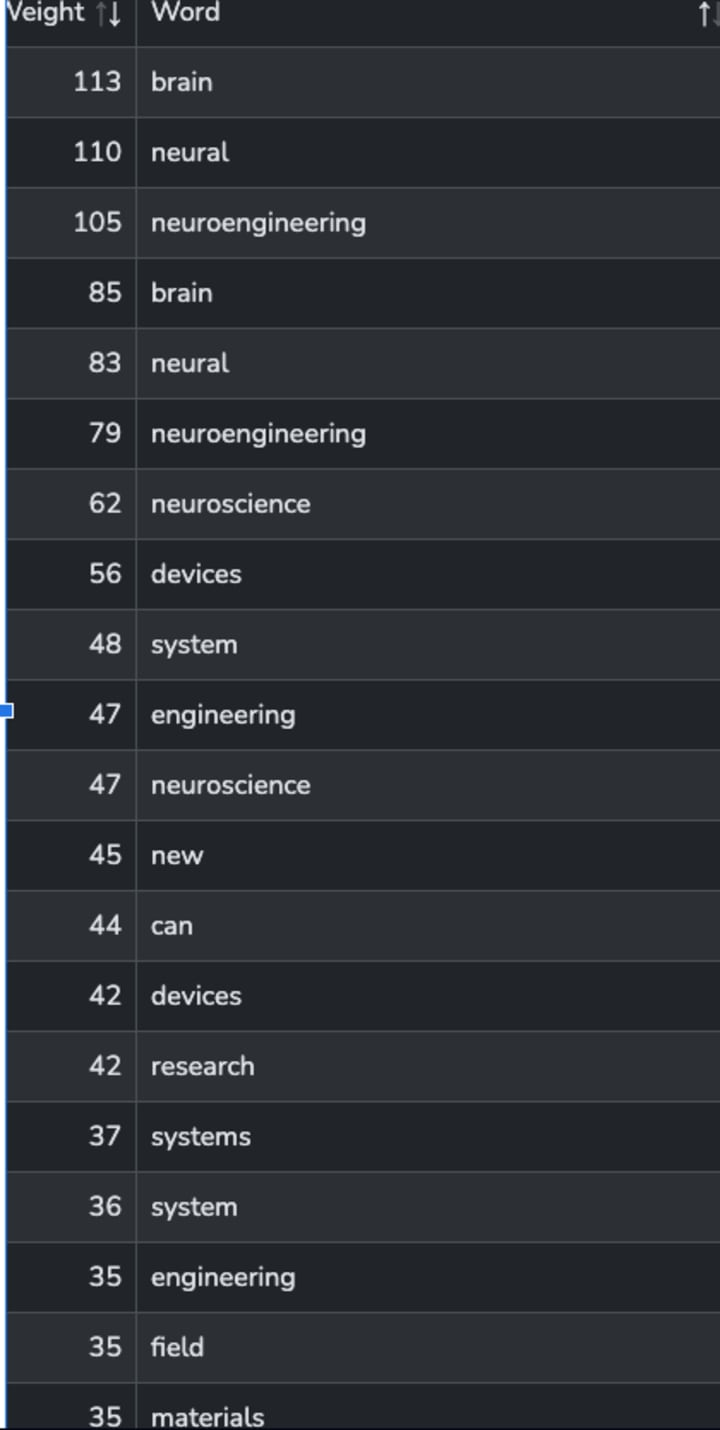

*Bioelectrics was the last word. It was cut off. It appeared 25 times in the sample text.
Cluster Analysis
│
├── Neuroprosthetics and Neural Interfaces
│ ├── Achyuta, A. K. H., Leach, J., & Murthy, S. K. (2010). Bridging the divide between neuroprosthetic design, tissue engineering and neurobiology.
│ ├── Chiappalone, M. et al. (2022). Neuromorphic-based neuroprostheses for brain rewiring: state-of-the-art and perspectives in neuroengineering.
│ ├── Rothschild, R. M. (2010). Neuroengineering tools/applications for bidirectional interfaces, brain–computer interfaces, and neuroprosthetic implants.
│ ├── Stacey, W. C., & Litt, B. (2008). Technology insight: neuroengineering and epilepsy—designing devices for seizure control.
│ ├── Edelman, B. J. et al. (2015). Systems neuroengineering: understanding and interacting with the brain.
│ └── Fekete, Z. et al. (2020). Infrared neuromodulation: a neuroengineering perspective.
│
├── Neural Engineering and Brain Connectivity
│ ├── Bassett, D. S., Khambhati, A. N., & Grafton, S. T. (2017). Emerging frontiers of neuroengineering: a network science of brain connectivity.
│ ├── Nurmikko, A. V. et al. (2010). Listening to brain microcircuits for interfacing with external world.
│ ├── Potter, S. M. et al. (2014). Closed-loop neuroscience and neuroengineering.
│ └── Moritz, C. T. et al. (2016). New perspectives on neuroengineering and neurotechnologies: NSF-DFG workshop report.
│
├── Soft Materials and Bioelectronics
│ ├── Jeong, J. W. et al. (2015). Soft materials in neuroengineering for hard problems in neuroscience.
│ ├── Kim, M. et al. (2024). Soft Bioelectronics Using Nanomaterials and Nanostructures for Neuroengineering.
│ ├── Sunwoo, S. H. et al. (2020). Advances in soft bioelectronics for brain research and clinical neuroengineering.
│ ├── Yoo, S. et al. (2023). Soft Bioelectronics for Neuroengineering: New Horizons in the Treatment of Brain Tumor and Epilepsy.
│ └── Gademann, K. (2015). Copy, edit, and paste: Natural product approaches to biomaterials and neuroengineering.
│
├── Neuroengineering Approaches in Neurobiology
│ ├── Brunton, B. W., & Beyeler, M. (2019). Data-driven models in human neuroscience and neuroengineering.
│ ├── Finkel, L. H. (2000). Neuroengineering models of brain disease.
│ ├── Opris, I. et al. (2020). Nanotechnologies in neuroscience and neuroengineering.
│ ├── Lin, X. Y. et al. (2016). Cell transplantation and neuroengineering approach for spinal cord injury treatment.
│ └── Morillas, C. et al. (2007). A neuroengineering suite of computational tools for visual prostheses.
│
├── Nanotechnology in Neuroengineering
│ ├── Kumar, R. et al. (2021). Graphene-based nanomaterials for neuroengineering: recent advances and future prospective.
│ ├── Tiwari, A. et al. (2020). Fluorescent mantle carbon coated core–shell SPIONS for neuroengineering applications.
│ └── Mousavi, N. S. et al. (2023). Plasmonics for neuroengineering.
│
├── Ethical Considerations and Design
│ ├── Ienca, M. et al. (2017). Proactive ethical design for neuroengineering, assistive and rehabilitation technologies.
│ └── Tbalvandany, S. S. et al. (2019). Embodiment in neuro-engineering endeavors: phenomenological considerations.
│
├── Neuroengineering for Rehabilitation
│ ├── Ghannam, R. et al. (2020). Implantable and wearable neuroengineering education: A review of postgraduate programmes.
│ ├── Panuccio, G. et al. (2018). Progress in Neuroengineering for brain repair: New challenges and open issues.
│ ├── Reinkensmeyer, D. J. (2019). JNER at 15 years: analysis of the state of neuroengineering and rehabilitation.
│ └── Marrom, S. et al. (2009). On the precarious path of reverse neuro-engineering.
│
├── Emerging Techniques and Trends
│ ├── Canales, A. et al. (2018). Multifunctional fibers as tools for neuroscience and neuroengineering.
│ ├── Dario, P. et al. (2003). Interfacing neural and artificial systems: from neuroengineering to neurorobotics.
│ ├── Jeong, J. W. et al. (2015). Soft materials in neuroengineering for hard problems in neuroscience.
│ └── Won, S. M. et al. (2023). Wireless and battery-free technologies for neuroengineering.
│
└── Review Articles and Educational Perspectives
├── Bye, R. (2003). STUDIES IN NEUROENGINEERING.
├── Coyle, D., & Sosnik, R. (2015). Neuroengineering.
├── Ghannam, R. et al. (2020). Implantable and wearable neuroengineering education: A review of postgraduate programmes.
├── He, B. (2024). Neuroengineering—Engineering the Nervous System.
└── Wróbel, A. N. D. R. Z. E. J. et al. (2014). Neuroengineering control and regulation of behavior.
Conclusion
Improvements Over Past Studies
Integration of Interdisciplinary Approaches
Recent advances emphasize the importance of collaboration among diverse fields such as neuroscience, engineering, and materials science, facilitating the development of more sophisticated neurotechnologies. For instance, the work of Coyle and Sosnik (2015) synthesizes motor system knowledge with engineering techniques, while Panuccio et al. (2018) highlight the growing role of artificial intelligence in enhancing neurotechnological devices.
Novel Technologies for Brain-Computer Interfaces (BCIs)
The development of advanced bidirectional interfaces and brain–computer interfaces is a hallmark of modern studies. Recent works by Edelman et al. (2015) discuss innovations that allow for two-way communication between the brain and machines, vastly improving functional outcomes beyond what was previously achievable. This contrasts with earlier studies that focused primarily on unidirectional communication.
Soft and Flexible Electronics
Advancements in materials science have led to the creation of soft and conformable electronic interfaces that integrate seamlessly with biological tissues, as described by Jeong et al. (2015). These technologies minimize the invasiveness of implants and enhance biocompatibility, addressing complications associated with rigid devices that dominated earlier research.
Closed-Loop Systems
The emphasis on closed-loop neuroengineering, which respects and utilizes feedback from the nervous system, marks a departure from the traditional open-loop systems. As discussed by Potter et al. (2014), closed-loop systems offer a dynamically adaptive approach to neuroprosthetics that can respond to real-time neural activity, thus improving efficacy and user experience.
Miniaturization and Wireless Technology
Recent efforts have focused on the miniaturization of devices to create lightweight, wireless, and fully implantable neuroengineering platforms, as highlighted by Won et al. (2023). This advancement overcomes the physical constraints of previous technologies, enhancing mobility and convenience for users.
Future Directions in Neuroengineering Research
Personalized Neuroengineering Solutions
Future research is expected to prioritize personalized neuroengineering approaches, tailoring devices to meet the specific needs of individual patients. This can leverage advancements in artificial intelligence to enhance adaptation and learning in neuroprosthetic devices, as discussed by Vassanelli and Mahmud (2016).
Enhanced Understanding of Neural Mechanisms
Ongoing studies will likely delve deeper into understanding complex neural circuits and mechanisms. Improved models of neurological diseases, as described by Finkel (2000), can guide the design of neurotechnologies that target specific pathologies more effectively.
Ethical and Societal Considerations
With the rapid advancement of neuroengineering technologies, there will be a critical need to address ethical concerns surrounding their use. Researchers such as Ienca et al. (2017) have proposed frameworks for ethical design in neuroengineering, ensuring that technological developments are aligned with societal values.
Integration of Biomaterials and Neuroengineering
Future research may increasingly explore the use of biomaterials that closely mimic the properties of neural tissues, aiming for better integration of devices with the body, as noted by Kumar et al. (2021). This integration could enhance functionality and longevity of implants.
Cross-disciplinary Innovation
As outlined by Cheng et al. (2020), the interplay between robotics and neuroscience is poised to flourish, leading to advancements in both neuroengineering and robotics technologies for rehabilitation and assistive devices. The incorporation of robotic systems could provide feedback mechanisms that further improve neurotechnological interventions.
In conclusion, the advancements in neuroengineering not only surpass previous methodologies but also pave the way for a future where neuroprosthetics and brain-computer interfaces can provide more effective, personalized, and ethically grounded interventions. The interdisciplinary approach will be vital to overcoming the challenges ahead, transforming patient care and enhancing the understanding of the nervous system.
Neuroengineering is transforming modern medicine, offering groundbreaking solutions for neurological disorders and cognitive enhancement. This study’s application of text mining, cluster analysis, and topic modeling identified key research trends, highlighting advancements in neurostimulation, AI integration, and ethical considerations. Our findings emphasize the importance of interdisciplinary collaboration to address challenges such as neuroenhancement ethics, data privacy, and accessibility. Future research should focus on scaling neuroengineering innovations while ensuring equitable access. As the field advances, cooperation among neuroscientists, engineers, ethicists, and policymakers will be crucial in translating technological breakthroughs into widespread societal benefits.
References
Achyuta, A. K. H., Leach, J., & Murthy, S. K. (2010). Bridging the divide between neuroprosthetic design, tissue engineering and neurobiology. Frontiers in neuroengineering, 2, 1107. Bassett, D. S., Khambhati, A. N., & Grafton, S. T. (2017). Emerging frontiers of neuroengineering: a network science of brain connectivity. Annual review of biomedical engineering, 19(1), 327-352. Brunton, B. W., & Beyeler, M. (2019). Data-driven models in human neuroscience and neuroengineering. Current Opinion in Neurobiology, 58, 21-29. Bye, R. (2003). STUDIES IN NEUROENGINEERING (Doctoral dissertation, School of Electrical Engineering & Telecommunications, The University of New South Wales). Canales, A., Park, S., Kilias, A., & Anikeeva, P. (2018). Multifunctional fibers as tools for neuroscience and neuroengineering. Accounts of Chemical Research, 51(4), 829-838. Chiappalone, M., Cota, V. R., Carè, M., Di Florio, M., Beaubois, R., Buccelli, S., ... & Levi, T. (2022). Neuromorphic-based neuroprostheses for brain rewiring: state-of-the-art and perspectives in neuroengineering. Brain sciences, 12(11), 1578. Coyle, D., & Sosnik, R. (2015). Neuroengineering. Springer Handbook of Computational Intelligence, 727-769. Dario, P., Laschi, C., Menciassi, A., Guglielmelli, E., Carrozza, A. C., & Micera, S. (2003, March). Interfacing neural and artificial systems: from neuroengineering to neurorobotics. In First International IEEE EMBS Conference on Neural Engineering, 2003. Conference Proceedings. (pp. 418-421). IEEE. Edelman, B. J., Johnson, N., Sohrabpour, A., Tong, S., Thakor, N., & He, B. (2015). Systems neuroengineering: understanding and interacting with the brain. Engineering, 1(3), 292-308. Fekete, Z., Horváth, Á. C., & Zátonyi, A. (2020). Infrared neuromodulation: a neuroengineering perspective. Journal of neural engineering, 17(5), 051003. Finkel, L. H. (2000). Neuroengineering models of brain disease. Annual review of biomedical engineering, 2(1), 577-606. Gademann, K. (2015). Copy, edit, and paste: Natural product approaches to biomaterials and neuroengineering. Accounts of chemical research, 48(3), 731-739. Ghannam, R., Curia, G., Brante, G., Khosravi, S., & Fan, H. (2020). Implantable and wearable neuroengineering education: A review of postgraduate programmes. IEEE Access, 8, 212396-212408. He, B. (2024). Neuroengineering—Engineering the Nervous System. IEEE Pulse, 15(2), 3-4. Hoag, H. (2003). Neuroengineering: Remote control. Nature, 423(6942), 796-799. Ienca, M., Kressig, R. W., Jotterand, F., & Elger, B. (2017). Proactive ethical design for neuroengineering, assistive and rehabilitation technologies: the Cybathlon lesson. Journal of neuroengineering and rehabilitation, 14, 1-11. Jeong, J. W., Shin, G., Park, S. I., Yu, K. J., Xu, L., & Rogers, J. A. (2015). Soft materials in neuroengineering for hard problems in neuroscience. Neuron, 86(1), 175-186. Kim, M., Lee, H., Nam, S., Kim, D. H., & Cha, G. D. (2024). Soft Bioelectronics Using Nanomaterials and Nanostructures for Neuroengineering. Accounts of Chemical Research, 5435-5447. Kumar, R., Rauti, R., Scaini, D., Antman‐Passig, M., Meshulam, O., Naveh, D., ... & Shefi, O. (2021). Graphene‐based nanomaterials for neuroengineering: recent advances and future prospective. Advanced Functional Materials, 31(46), 2104887. Leach, J., Achyuta, A. K. H., & Murthy, S. K. (2010). Bridging the divide between neuroprosthetic design, tissue engineering and neurobiology. Frontiers in neuroengineering, 2, 1107. Lin, X. Y., Lai, B. Q., Zeng, X., Che, M. T., Ling, E. A., Wu, W., & Zeng, Y. S. (2016). Cell transplantation and neuroengineering approach for spinal cord injury treatment: a summary of current laboratory findings and review of literature. Cell transplantation, 25(8), 1425-1438. Marrom, S., Meir, R., Braun, E., Gal, A., Kermany, E., & Eytan, D. (2009). On the precarious path of reverse neuro-engineering. Frontiers in Computational Neuroscience, 3, 495. Merrill, D. R. (2014). Materials considerations of implantable neuroengineering devices for clinical use. Current Opinion in Solid State and Materials Science, 18(6), 329-336. Morillas, C., Romero, S., Martínez, A., Pelayo, F., Reyneri, L., Bongard, M., & Fernández, E. (2007). A neuroengineering suite of computational tools for visual prostheses. Neurocomputing, 70(16-18), 2817-2827. Moritz, C. T., Ruther, P., Goering, S., Stett, A., Ball, T., Burgard, W., ... & Rao, R. P. (2016). New perspectives on neuroengineering and neurotechnologies: NSF-DFG workshop report. IEEE Transactions on Biomedical Engineering, 63(7), 1354-1367. Mousavi, N. S., Ramadi, K. B., Song, Y. A., & Kumar, S. (2023). Plasmonics for neuroengineering. Communications Materials, 4(1), 101. Neilson, P. D., & Neilson, M. D. (1999). A neuroengineering solution to the optimal tracking problem. Human Movement Science, 18(2-3), 155-183. Niyonambaza, S. D., Kumar, P., Xing, P., Mathault, J., De Koninck, P., Boisselier, E., ... & Miled, A. (2019). A review of neurotransmitters sensing methods for neuro-engineering research. Applied sciences, 9(21), 4719. Nurmikko, A. V., Donoghue, J. P., Hochberg, L. R., Patterson, W. R., Song, Y. K., Bull, C. W., ... & Aceros, J. (2010). Listening to brain microcircuits for interfacing with external world—progress in wireless implantable microelectronic neuroengineering devices. Proceedings of the IEEE, 98(3), 375-388. Opris, I., Lebedev, M. A., Pulgar, V. M., Vidu, R., Enachescu, M., & Casanova, M. F. (2020). Nanotechnologies in neuroscience and neuroengineering. Frontiers in neuroscience, 14, 33. Palit, S. (2024). The Scientific Frontiers of Neuroengineering, the Treatment of Schizophrenia and the Visionary Future. SAR J Psychiatry Neurosci, 5(3), 42-44. Panuccio, G., Semprini, M., Natale, L., Buccelli, S., Colombi, I., & Chiappalone, M. (2018). Progress in Neuroengineering for brain repair: New challenges and open issues. Brain and neuroscience advances, 2, 2398212818776475. Potter, S. M., El Hady, A., & Fetz, E. E. (2014). Closed-loop neuroscience and neuroengineering. Frontiers in neural circuits, 8, 115. Reinkensmeyer, D. J. (2019). JNER at 15 years: analysis of the state of neuroengineering and rehabilitation. Journal of neuroengineering and rehabilitation, 16(1), 144. Rothschild, R. M. (2010). Neuroengineering tools/applications for bidirectional interfaces, brain–computer interfaces, and neuroprosthetic implants–a review of recent progress. Frontiers in neuroengineering, 3, 112. Stacey, W. C., & Litt, B. (2008). Technology insight: neuroengineering and epilepsy—designing devices for seizure control. Nature clinical practice Neurology, 4(4), 190-201. Sunwoo, S. H., Han, S. I., Joo, H., Cha, G. D., Kim, D., Choi, S. H., ... & Kim, D. H. (2020). Advances in soft bioelectronics for brain research and clinical neuroengineering. Matter, 3(6), 1923-1947. Tbalvandany, S. S., Harhangi, B. S., Prins, A. W., & Schermer, M. H. (2019). Embodiment in neuro-engineering endeavors: phenomenological considerations and practical implications. Neuroethics, 12, 231-242. Tiwari, A., Kumar, R., Shefi, O., & Randhawa, J. K. (2020). Fluorescent mantle carbon coated core–shell SPIONS for neuroengineering applications. ACS Applied Bio Materials, 3(7), 4665-4673. Vassanelli, S., & Mahmud, M. (2016). Trends and challenges in neuroengineering: toward "intelligent" neuroprostheses through brain-"brain inspired systems" communication. Frontiers in neuroscience, 10, 438. Veletić, M., & Balasingham, I. (2016, November). The neural communication network: A brief review on neuromodeling and neuroengineering. In 2016 24th Telecommunications Forum (TELFOR) (pp. 1-4). IEEE. Won, S. M., Cai, L., Gutruf, P., & Rogers, J. A. (2023). Wireless and battery-free technologies for neuroengineering. Nature Biomedical Engineering, 7(4), 405-423. Wróbel, A. N. D. R. Z. E. J., Radzewicz, C., Mankiewicz, L., Hottowy, P., Knapska, E., Konopka, W., ... & Wójcik, D. K. (2014, November). Neuroengineering control and regulation of behavior. In Photonics Applications in Astronomy, Communications, Industry, and High-Energy Physics Experiments 2014 (Vol. 9290, pp. 485-492). SPIE. Yoo, S., Kim, M., Choi, C., Kim, D. H., & Cha, G. D. (2023). Soft Bioelectronics for Neuroengineering: New Horizons in the Treatment of Brain Tumor and Epilepsy. Advanced Healthcare Materials, 2303563.Show less
About the Creator
T.J. Greer
B.A., Biology, Emory University. MBA, Western Governors Univ., PhD in Business at Colorado Tech (27'). I also have credentials from Harvard Univ, the University of Cambridge (UK), Princeton Univ., and the Department of Homeland Security.
Keep reading
More stories from T.J. Greer and writers in Proof and other communities.
Pretty Sure: Greer Universal Theory of Gravity
The Concept of Greer Force: A New Theory of Gravity Gravity, as we know it, is one of the fundamental forces of nature, often described by the general theory of relativity as the curvature of spacetime caused by mass and energy. However, what if there’s another way to understand this force—a way that involves the atomic structure and internal dynamics of matter? I think the atoms at the center of the Earth have lost their electrons because of the high pressure and temperature, Thus, they likely have a purely positive charge that attracts the electron-carrying atoms at the surface of the Earth. Of course there would be a gradient from the center to surface in which as we approach the surface, the atoms' electrons become regular.
By T.J. Greerabout a year ago in Proof
Heart-Opening Practices for Emotional Balance and Calm
Opening the heart is a gentle way to invite more warmth, compassion, and ease into your daily life. It helps you connect with your feelings and soften any tension held in the chest area. Heart-opening practices can be both physical and energetic, encouraging a sense of emotional balance and inner calm.
By Victoria Marsea day ago in Proof
Mastering the Library Bar Setup: A Bartender’s Guide
Non-judgmental awareness is a gentle way of paying attention to your present experience without labeling it as good or bad. It invites you to notice thoughts, feelings, and sensations as they arise, simply as they are. This practice helps create space between you and your reactions, allowing calm and clarity to grow.
By Ava Mitchella day ago in Proof


Comments (1)
I love neuroengineering people! Amazing work!