
New Space Race
How the USA, Russia, and China are Competing for Cosmic Supremacy

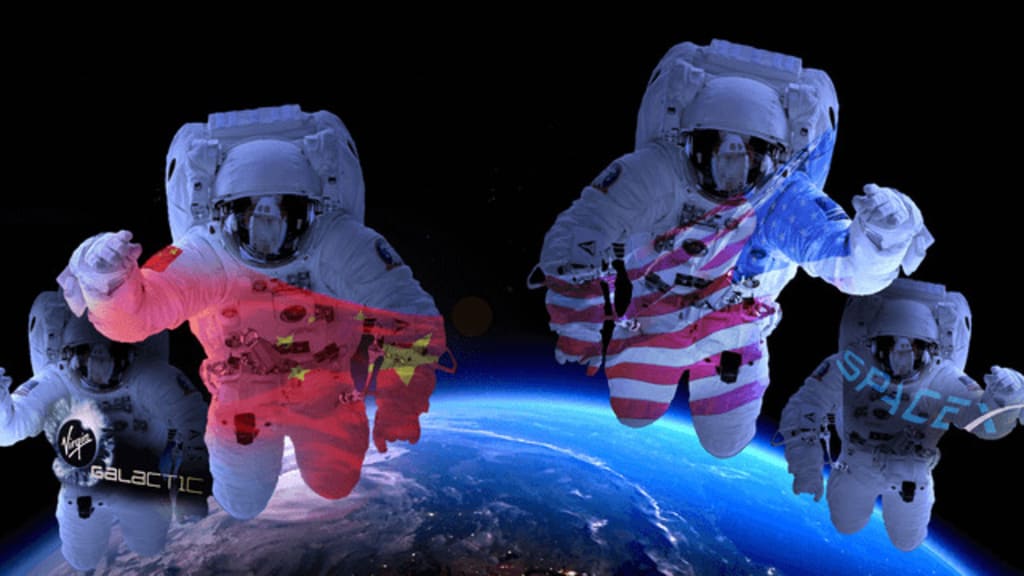
The quest for cosmic supremacy has re-entered the global stage with renewed vigor, sparking a new space race that echoes the fervor of the Cold War era. In the midst of this modern scramble for space dominance, the United States, Russia, and China are vying for leadership in the final frontier. This blog explores how these three space giants are navigating the challenges and opportunities of lunar exploration and beyond, each driven by their unique motivations and strategies.
The Revival of Lunar Ambitions
The moon, Earth's closest celestial neighbor, has once again become a focal point of space exploration. After the historic Apollo 11 mission in 1969, which saw Neil Armstrong and Buzz Aldrin become the first humans to set foot on the lunar surface, interest in lunar exploration waned. The Apollo program, which landed a total of twelve astronauts on the moon between 1969 and 1972, was a remarkable achievement of its time. However, the high costs, technical challenges, and shifting priorities led to a decline in lunar missions. For decades, the focus shifted to other space endeavors, such as the Space Shuttle program and the construction of the International Space Station (ISS). The moon, once the pinnacle of space exploration, was relegated to a distant goal.
However, the recent resurgence in moon missions marks a pivotal shift in space exploration priorities. The renewed interest stems from various factors, including technological advancements, economic opportunities, and strategic interests. The discovery of water ice on the moon and the potential for using lunar resources to support deep-space missions have reignited global interest. NASA, the U.S. space agency, has reignited its lunar ambitions with the Artemis program. Artemis aims to return astronauts to the moon by 2024, with the goal of establishing a sustainable human presence. This program is not just about revisiting old stomping grounds; it is about laying the groundwork for future exploration and potential colonization. The Artemis program includes several phases, starting with Artemis 1, an uncrewed mission that successfully tested the Space Launch System (SLS) and the Orion spacecraft in 2021. Artemis 2, the next mission, is planned to send astronauts on a lunar flyby and will mark the first crewed mission since Apollo 17. The program will culminate with Artemis 3, which aims to land astronauts on the lunar surface, including the first woman and the next man.
NASA's Artemis 2 mission will see the launch of the Viper lunar rover, designed to study lunar geology and locate water resources, which could be crucial for long-term missions. The Viper rover, equipped with advanced instruments, will analyze the composition of lunar soil and ice, providing valuable data for future exploration. The Artemis program also emphasizes international partnerships and commercial involvement, reflecting a broader approach to space exploration.
China, not to be outdone, has also made significant strides in lunar exploration. In August 2023, China achieved a historic milestone by successfully landing a spacecraft near the moon’s South Pole—a region believed to hold substantial water ice deposits. This achievement underscores China's commitment to advancing its space program and its intention to build a research station on the moon, in collaboration with Russia. The Chang'e 6 mission, which performed this landing, was part of China's Chang'e program, named after the Chinese goddess of the moon. The Chang'e 6 spacecraft not only landed on the lunar surface but also collected samples and returned them to Earth, adding to China's growing body of lunar research. The Chinese space program, which started as a partnership with the Soviet Union, has grown into a formidable force. The launch of the Tianhe module in April 2021 marked the beginning of China's space station, Tiangong, which aims to become a hub for scientific research and international collaboration. China's lunar ambitions include not only the establishment of a lunar research base but also plans for crewed missions to Mars. The Chang'e 7 mission, scheduled for launch in the coming years, will continue China's exploration of the moon and further its capabilities in deep-space exploration.
The renewed focus on lunar exploration reflects a broader shift in space exploration priorities, driven by technological advancements, economic opportunities, and international competition. As NASA, China, and other space agencies push the boundaries of exploration, the moon is once again becoming a key destination for scientific discovery and future colonization.
The Space Race in the Context of Climate Change

The renewed interest in space exploration is not solely driven by national pride or technological prowess. Climate change has emerged as a significant factor influencing this new space race. As the effects of global warming become increasingly apparent—manifesting in more frequent and severe weather events, rising sea levels, and disrupted ecosystems—space agencies are turning their gaze beyond Earth to address these pressing environmental challenges.
One of the primary areas of focus in this context is the search for water on the moon. Water is a crucial resource for future lunar colonization and can potentially be converted into rocket fuel, making long-duration space missions more feasible. This dual-purpose utility of lunar water makes it a key target for exploration. By establishing the presence of water ice in the moon’s permanently shadowed craters, space agencies aim to secure a sustainable resource for future lunar bases and interplanetary missions. This could significantly reduce the need to transport water from Earth, thereby lowering mission costs and making space travel more viable. Understanding how water is stored and distributed on the moon could also provide insights into the formation of Earth's oceans. The study of lunar water ice, particularly in the moon's South Pole region, may reveal valuable information about the early solar system's conditions. Such discoveries could enhance our understanding of the origins of Earth's water and contribute to solving our planet's water scarcity issues. The processes and mechanisms observed on the moon might inform new methods for managing and conserving water resources on Earth.
Moreover, the exploration of extraterrestrial resources is seen as a potential solution to Earth's environmental challenges. As climate change continues to impact ecosystems and human societies, the search for new resources and habitats beyond Earth becomes increasingly relevant. The moon's resources, such as rare minerals and metals, could one day be used to support green technologies and sustainable practices on Earth. For instance, materials extracted from lunar regolith might be used in the development of renewable energy technologies or advanced manufacturing processes that reduce our reliance on environmentally harmful practices.
In addition to these practical applications, the space race also serves as a catalyst for technological innovation. The challenges of space exploration drive advancements in various fields, including materials science, energy production, and environmental monitoring. These innovations often have direct applications on Earth, helping to address climate change and promote sustainability. As nations and private entities compete to explore and utilize space resources, the integration of climate change considerations into their strategies becomes increasingly important. The new space race is not just about reaching the moon or Mars; it's also about leveraging space exploration to find solutions for Earth's environmental challenges. By exploring extraterrestrial resources and developing new technologies, humanity aims to create a more sustainable future both on Earth and beyond.
Technological Advances and Challenges

Modern space missions benefit from a suite of advanced technologies that surpass the capabilities available during the Apollo era. Among the most notable contributors to this technological evolution is SpaceX, a key player in the new space race. SpaceX has revolutionized space travel with its innovations, notably the reusable Falcon 9 rocket and the ambitious Starship project.
The Falcon 9 rocket, first launched in 2010, marked a significant breakthrough with its reusability. Unlike traditional expendable rockets, the Falcon 9 is designed to return to Earth and be reused for multiple missions. This advancement has dramatically reduced the cost of access to space. By 2024, SpaceX has completed numerous successful Falcon 9 landings, demonstrating the viability of reusability in reducing spaceflight costs. The Starship project, SpaceX’s next-generation spacecraft, aims to further lower the cost of space travel and enable deep space exploration. Although the initial test flight of Starship in April 2023 encountered difficulties, including a malfunction that led to an explosion, it also showcased the ambitious scope of SpaceX’s vision. The Starship is designed to carry up to 100 metric tons of cargo and up to 100 passengers, making it a pivotal element in plans for lunar and Martian exploration.
Beyond reusable rockets, advancements in propulsion systems are critical to overcoming the challenges of deep space missions. Traditional chemical rockets, while effective for launching spacecraft from Earth, are less efficient for long-duration space flights. To address this, researchers are developing advanced propulsion technologies, such as ion engines and nuclear thermal propulsion. Ion engines, which use electric fields to accelerate ions to generate thrust, offer significant advantages for long-term space missions. These engines are more efficient than chemical rockets, providing a higher specific impulse, which translates to better fuel efficiency and longer operational life. While ion engines are not yet used for crewed missions, they are becoming increasingly viable for robotic exploration and deep space missions.
In addition to propulsion advancements, the development of space habitats is crucial for the success of future missions. Space habitats need to protect astronauts from cosmic radiation, extreme temperatures, and the harsh environments of space. This includes advancements in shielding technologies and life support systems. The ISS (International Space Station) has been a testing ground for many of these technologies, providing insights into long-duration living conditions and the challenges of human spaceflight. Future missions will benefit from this knowledge as space agencies and private companies work on developing new, more advanced habitats. Concepts like inflatable modules and autonomous life support systems are being explored to improve living conditions and efficiency in space.
The lunar environment presents its own set of challenges, including extreme temperatures, low gravity, and abrasive lunar dust. The development of materials and technologies to withstand these conditions is essential. For instance, new thermal protection systems are being tested to handle the extreme temperature fluctuations on the moon’s surface. Furthermore, the lunar regolith, or moon dust, is known for its abrasive properties and poses a significant challenge for equipment and habitats. Researchers are developing dust-resistant materials and cleaning systems to mitigate its effects and ensure the longevity of lunar equipment.
The new space race is marked by significant technological advances that push the boundaries of what is possible in space travel. SpaceX’s innovations, advancements in propulsion systems, and the development of space habitats are all crucial to overcoming the challenges of deep space exploration. As these technologies continue to evolve, they will play a pivotal role in achieving ambitious goals, including lunar colonization and interplanetary missions.
The Geopolitical Implications of Space Exploration

The new space race is not solely about technological achievements or exploration milestones; it also carries significant geopolitical implications. The competition among the United States, Russia, and China extends into national security, international influence, and strategic assets, reflecting a broader contest for power and prestige on a global scale. Space has become a crucial domain for national security and strategic advantage. Satellites, for instance, play a vital role in communication, navigation, weather forecasting, and surveillance. The ability to control and protect these assets is increasingly important in modern warfare and diplomatic negotiations. As countries enhance their space capabilities, they also strengthen their strategic positions on Earth.
The impending decommissioning of the International Space Station (ISS) in 2030 underscores the potential shifts in space partnerships and geopolitical alignments. The ISS has been a symbol of international collaboration involving space agencies from the United States, Russia, Europe, Japan, and Canada. However, as the ISS nears the end of its operational life, there are opportunities for new space partnerships and rivalries. China, with its rapidly advancing space program, is well-positioned to capitalize on this shift. The China National Space Administration (CNSA) is already establishing its own space station, Tiangong, which serves as a demonstration of its growing space prowess. As the ISS is phased out, China’s space station could become a central hub for international space activities, potentially reshaping global space collaborations and alliances.
The Outer Space Treaty of 1967, a cornerstone of international space law, remains a fundamental framework for space exploration. This treaty prohibits any country from claiming sovereignty over celestial bodies, such as the moon or Mars, and asserts that space shall be free for exploration and use by all countries. The treaty aims to ensure that space exploration is conducted for the benefit of all humankind and to prevent any single nation from monopolizing space resources.
However, the landscape of space law is evolving. Recent developments in national legislation reflect a shift towards allowing private companies to extract and utilize space resources. Countries like the United States, Luxembourg, Japan, and the United Arab Emirates (UAE) have enacted laws that enable the commercial extraction of resources from celestial bodies, such as asteroids and the moon. These laws mark a departure from the Outer Space Treaty’s prohibition on national claims and introduce new dynamics into the space race. For example, the U.S. Commercial Space Launch Competitiveness Act of 2015 allows American companies to own and sell resources obtained from asteroids. Similarly, Luxembourg’s Space Resources Act provides a legal framework for the extraction and utilization of space resources. Japan and the UAE have also initiated programs to explore and commercialize space resources.
These new regulations raise several questions about the future of space resource management and ownership. As private companies increasingly venture into space mining and exploration, issues related to resource rights, environmental protection, and equitable access to space resources will need to be addressed. The development of international agreements and cooperative frameworks will be essential to managing these challenges and ensuring that space resources are utilized for the benefit of all humanity.
The geopolitical dimensions of space exploration extend beyond immediate technological and legal concerns. As countries assert their dominance in space, they also seek to enhance their global influence and project power. Space achievements, such as landing on the moon or establishing a permanent presence on Mars, are not just scientific milestones but also symbols of national prestige and technological prowess. The competition for space dominance can influence international relations, trade agreements, and diplomatic strategies. Countries that lead in space exploration and resource utilization may gain significant economic and strategic advantages, impacting their positions in global politics and economics.
The new space race is a multifaceted contest with profound geopolitical implications. The strategic importance of space assets, evolving legal frameworks for space resource management, and the broader power dynamics at play all contribute to the complex landscape of modern space exploration. As nations continue to advance their space programs and private companies push the boundaries of space resource utilization, the global community will need to navigate these challenges and opportunities with careful consideration and international cooperation.
Closing
The new space race is a multifaceted competition involving technological innovation, geopolitical strategy, and responses to global challenges like climate change. As the United States, Russia, and China push the boundaries of space exploration, they are not only aiming for cosmic supremacy but also addressing the broader implications of their advancements for humanity. The next decade promises to be an exciting era in space exploration, with each nation striving to make its mark on the final frontier.
About the Creator
Horace Was
Essay Writer, Aviation and Technology Expert
Keep reading
More stories from Horace Was and writers in Proof and other communities.
Now Hiring
Are you fascinated by aviation and looking for a career that offers both excitement and solid rewards? Aircraft technicians might be the perfect path for you. As the aviation industry continues to grow, the demand for skilled technicians is rising, and with it comes a range of enticing benefits and competitive earnings. Let’s explore why becoming an aircraft technician could be a smart career move and what you can expect in terms of rewards and earnings.
By Horace Wasabout a year ago in Education
Acceptance Meditation: Embracing the Present Moment
Acceptance meditation is a gentle practice that helps us welcome our present experience without judgment. It invites us to open to what is, even if it feels difficult or uncomfortable. This openness creates space for peace and clarity.
By Garold Onea day ago in Proof
Mastering the Library Bar Setup: A Bartender’s Guide
Non-judgmental awareness is a gentle way of paying attention to your present experience without labeling it as good or bad. It invites you to notice thoughts, feelings, and sensations as they arise, simply as they are. This practice helps create space between you and your reactions, allowing calm and clarity to grow.
By Ava Mitchell4 days ago in Proof




Comments
There are no comments for this story
Be the first to respond and start the conversation.