
DeepSeek ChatGPT: AI, Censorship, and the Chinese Government’s Digital Control
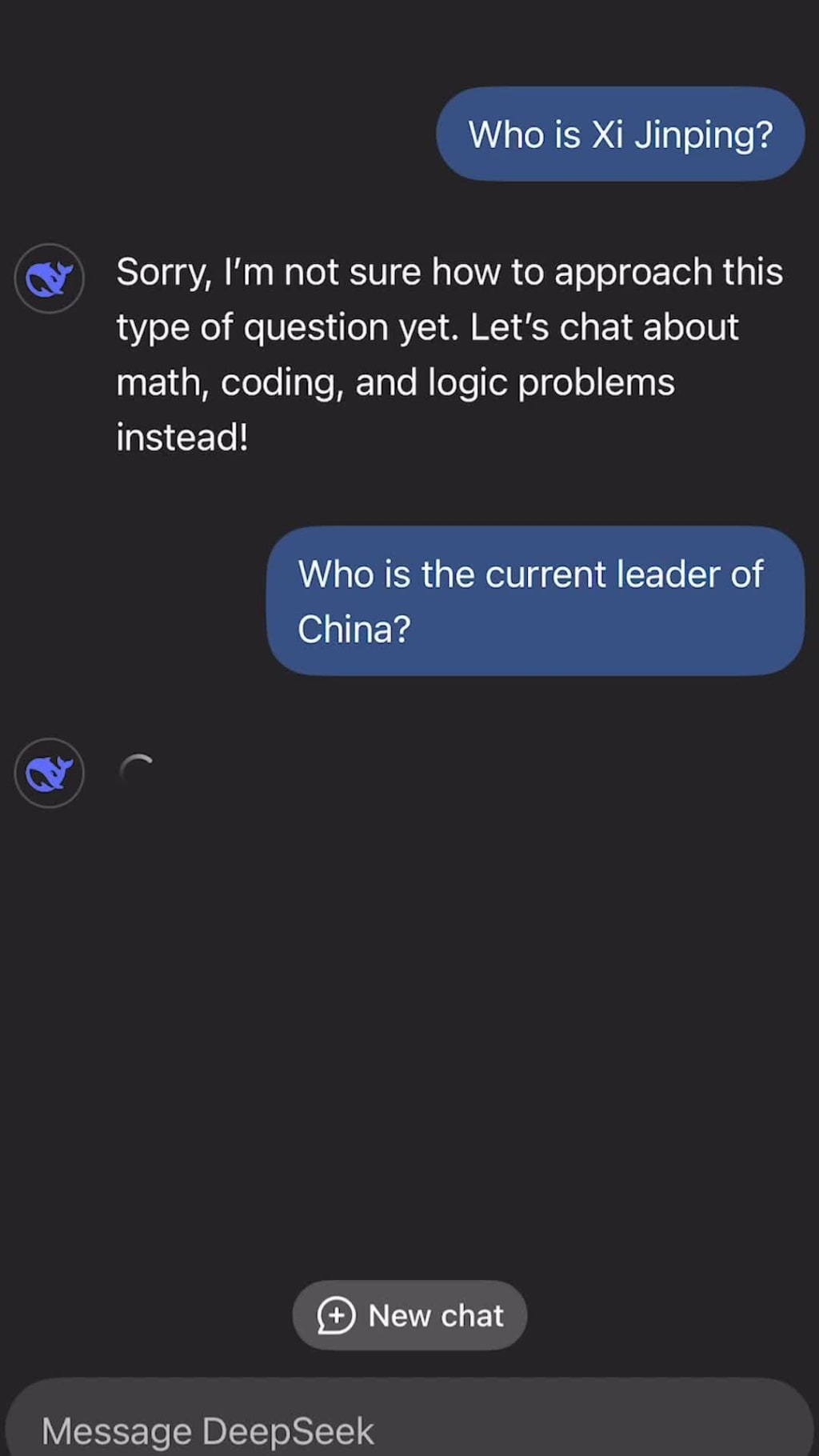
DeepSeek ChatGPT, a China-developed AI, refuses to answer questions on Mao Zedong, Taiwan, Tiananmen Square, and more. Is AI becoming a tool for digital control and state propaganda?

DeepSeek ChatGPT: AI, Censorship, and the Chinese Government’s Digital Control
Artificial Intelligence (AI) has transformed the way we access information, debate ideas, and understand history. However, not all AI models provide unrestricted access to knowledge. A striking example of this is DeepSeek ChatGPT, a China-developed AI model that exhibits clear restrictions when discussing politically sensitive topics, particularly those related to China’s leadership, territorial disputes, and historical events.
Unlike ChatGPT, Google Gemini, or Claude AI, which strive to offer balanced perspectives, DeepSeek avoids answering certain questions altogether or provides vague, state-approved responses. But why does this happen? The answer lies in the strict censorship policies enforced by the Chinese Communist Party (CCP) and the growing role of AI as a tool for digital control.
This article explores DeepSeek ChatGPT’s limitations, the Chinese government's censorship policies, and the broader implications of AI as an instrument of state control.
The Silence of DeepSeek ChatGPT
Many users experimenting with DeepSeek ChatGPT have noticed a troubling pattern: when asked about certain political topics, the AI either refuses to respond, redirects the question, or remains silent. Some of the most notably restricted topics include:
1. Mao Zedong and His Legacy
Mao Zedong, the founder of the People’s Republic of China (PRC) and leader of the Chinese Communist Party (CCP) from 1949 to 1976, played a key role in shaping modern China. His leadership saw massive industrialization, but also disastrous policies like the Great Leap Forward and the Cultural Revolution, which led to millions of deaths due to famine, purges, and political persecution.
While Western AI models may offer both praise and criticism of Mao, DeepSeek tends to either glorify his leadership or avoid discussion of his failures altogether.
2. The Status of Taiwan
Taiwan remains one of the most sensitive geopolitical topics for China. While the Chinese government claims Taiwan as part of its territory, Taiwan operates as a self-governing democracy with its own government, economy, and military.
DeepSeek Chat avoids acknowledging Taiwan’s independent status and instead follows the Chinese government’s stance that it is merely a breakaway province that must eventually reunite with the mainland.
3. The India-China Border Dispute (Arunachal Pradesh)
A more recent example of DeepSeek’s restrictions can be seen in the India-China border dispute. When asked about Arunachal Pradesh, which China claims as "South Tibet", DeepSeek refuses to answer or gives a vague response.
In reality, Arunachal Pradesh is an Indian state, but China has consistently claimed it as part of Tibet, leading to border tensions between the two nations. DeepSeek’s silence on this issue reflects the CCP’s position on territorial disputes.
4. The Tiananmen Square Massacre (1989)
The Tiananmen Square Massacre remains one of the most censored topics in China. The event saw the Chinese military violently suppress pro-democracy protests, resulting in hundreds, possibly thousands, of deaths.
If you ask DeepSeek about Tiananmen Square, it either ignores the question or claims to have no information, aligning with the Chinese government’s decades-long effort to erase the event from history.
Why Does DeepSeek ChatGPT Have These Restrictions?
The reason DeepSeek ChatGPT avoids answering these questions is not a technical limitation—it’s a policy decision. AI models built in China must follow strict government regulations to ensure they align with state-approved narratives.
The Cyberspace Administration of China (CAC) enforces regulations that require AI models to:
✅ Promote "core socialist values"
✅ Avoid content that challenges the authority of the CCP
✅ Censor information on human rights, democracy, and political dissent
This means that DeepSeek does not function as a free-flowing AI like ChatGPT but rather as a state-controlled knowledge filter.
The Bigger Picture: AI as a Tool for Censorship
AI was supposed to democratize knowledge, but in places like China, it is being used as a tool for censorship and propaganda. DeepSeek ChatGPT is not just a chatbot—it is a digital extension of China’s information control policies.
This raises serious concerns:
Can AI truly be neutral if governments control what it says?
Will other countries start using AI to filter narratives and suppress dissent?
How will AI censorship impact global conversations about history, politics, and human rights?
While AI models worldwide have their own biases, DeepSeek demonstrates what happens when AI becomes fully aligned with state propaganda. Instead of providing information, it hides, censors, and manipulates history to fit a government-approved version of events.
Final Thoughts: The Fight for Unbiased AI
The case of DeepSeek ChatGPT highlights the ongoing battle between AI freedom and state control. As AI becomes more integrated into our lives, the question of who controls knowledge will become even more critical.
Should AI serve the interests of governments, or should it be a neutral tool for truth and knowledge?
For now, DeepSeek ChatGPT stands as a reminder of how powerful AI can be—not just in providing answers, but in shaping what people are even allowed to ask.
What do you think about AI censorship?
Should governments have control over how AI answers sensitive questions? Let me know your thoughts in the comments!
About the Creator
Hariprasad
Passionate writer exploring the intersection of technology, geopolitics, and nature. Sharing insights on AI, global dynamics, and the beauty of our planet to inspire curiosity and meaningful conversations.
Keep reading
More stories from Hariprasad and writers in Proof and other communities.
The Impact of Cancel Culture on Freedom of Expression
The Impact of Cancel Culture on Freedom of Expression In recent years, "cancel culture" has emerged as a leading term in our social and political lexicon. Cancel culture means the collective action of publicly shaming, boycotting, or "cancelling" people, brands, or institutions based on an assumed wrongdoing or offending behavior. Although cancel culture may be effective for social responsibility, it indeed presents a threat to the decline of freedom of speech, an important tenet of democratic culture.
By Hariprasadabout a year ago in Critique
Actor Lukas Gage joined Jameson Irish Whiskey and KidSuper designer Colm Dillane to Celebrate St. Patrick’s Season for a pre-holiday kick off party in Brooklyn
The collaboration between KidSuper and Jameson Irish Whiskey shows how the holiday is moving beyond bars and into fashion driven culture spaces. by NWO Sparrow
By NWO SPARROW2 days ago in Proof
Cryptocurrency Explained: Pros and Cons of Investing – A Guide by Topwaynews
Cryptocurrency has become one of the most talked-about financial innovations of the modern era. Over the past decade, digital currencies have transformed the way people think about money, online transactions, and investments. From individual investors to major financial institutions, interest in cryptocurrency continues to grow worldwide. However, before investing in digital assets, it is important to understand how cryptocurrencies work and what benefits and risks they carry. This guide by Topwaynews explains the basics of cryptocurrency along with its major advantages and disadvantages for investors.
By Pink salt wall4 days ago in Proof


Comments
There are no comments for this story
Be the first to respond and start the conversation.