
29 False Did You Know Facts
29 False Did You Know Facts: Get the Real Truth Behind These Common Misconceptions!

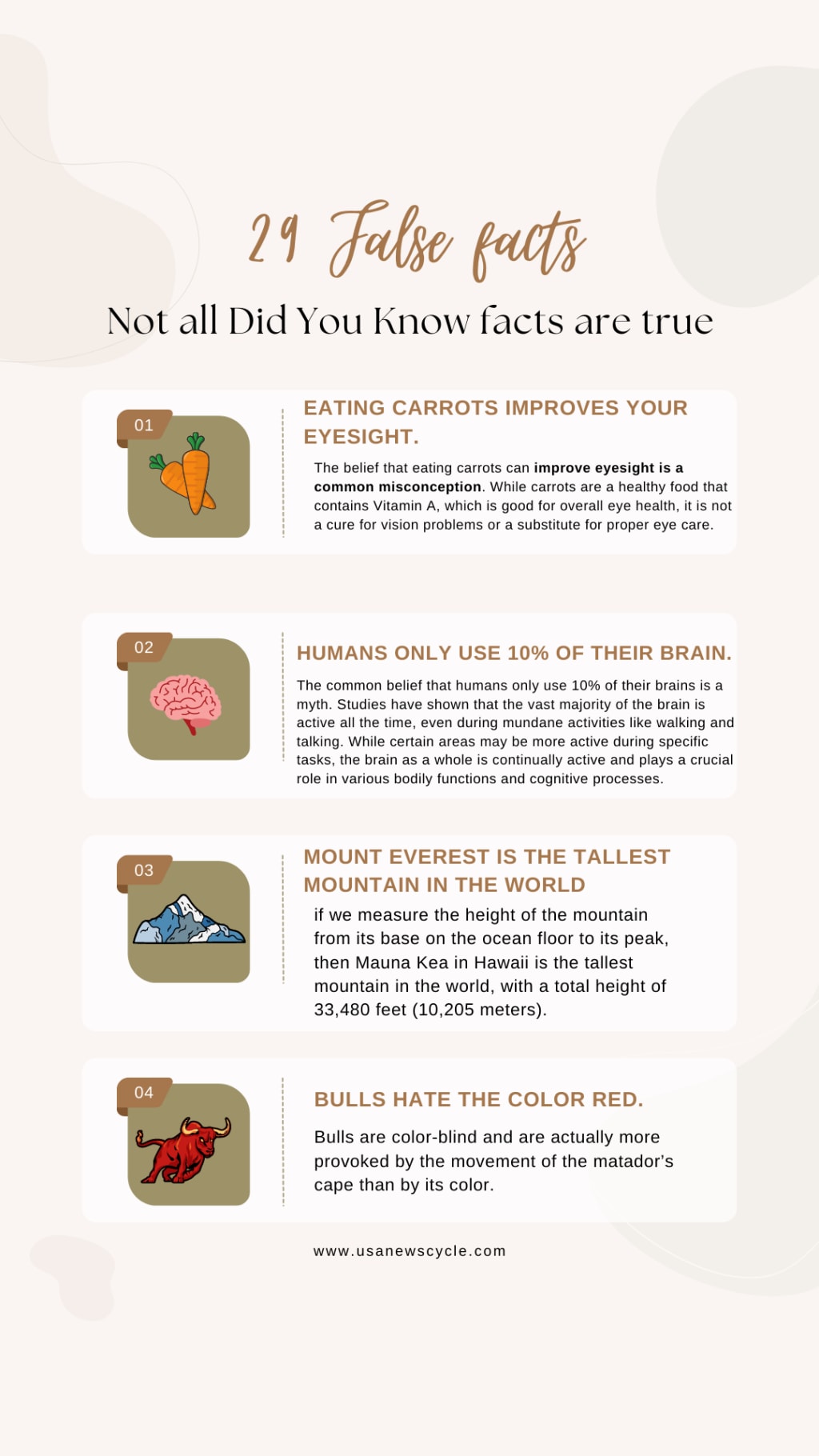
Did You Know facts are statements or claims that present interesting, lesser-known facts or trivia People often share these facts on social media, in classrooms, or in conversations to spark curiosity and initiate discussions. Unfortunately, not all Did You Know facts are true, and some may even be misleading or exaggerated.
The ease of sharing information on the internet, coupled with humans’ tendency to trust the information presented as facts, has made it easy for false facts to spread quickly and become widely believed. However, it is crucial to verify the accuracy of such statements to prevent the spread of misinformation and to ensure that we make informed decisions based on facts, not fiction.
In this blog post, we will examine the top 29 false Did You Know facts and reveal the truth behind them. We will also delve into the reasons why false facts are so prevalent.
It’s crucial to be aware of false Did You Know facts because spreading misinformation can have serious consequences. False facts can cause misunderstandings, reinforce stereotypes, and even harm individuals or entire communities.
For instance, a false Did You Know facts that suggests certain ethnic or racial groups are genetically inferior can fuel discrimination and racism. Similarly, false health-related facts can lead to harmful practices or even the spread of disease.
Furthermore, false facts can erode public trust in critical institutions like the media, government, and scientific research. In a world where information is easily disseminated and accessed, it’s essential to scrutinize the information we encounter and share, and to verify the accuracy of any “facts” we come across.
By staying informed about false Did You Know facts and actively seeking out accurate information, we can help curb the spread of misinformation and make well-informed decisions.
Top 29 False Did You Know Facts
Did You Know Facts: Eating carrots improves your eyesight.
This is a common Did You Know facts that is actually false. While carrots are a healthy food that contain nutrients that are beneficial for overall eye health, such as Vitamin A, eating them does not necessarily improve eyesight.
Vitamin A is essential for maintaining healthy eyes, but it is not a cure for vision problems or a substitute for proper eye care. In fact, eating too many carrots can even be harmful as an excess of Vitamin A can lead to toxicity. Therefore, it’s important to get regular eye exams and follow a balanced diet to maintain good eye health.
Did You Know Facts: Goldfish have a 3-second memory.
No, it’s not true that goldfish have a 3-second memory. Although goldfish don’t have the same cognitive abilities as humans, they are capable of learning and remembering things for much longer periods of time. In fact, studies have shown that goldfish can have a memory span of several months and even recognize individual humans who regularly feed them.
This myth likely originated from a misinterpretation of a study conducted in the 1960s, which found that goldfish could remember certain tasks for up to 3 seconds. However, subsequent research has revealed that goldfish have a much more complex memory than previously thought.
Did You Know Facts: The Great Wall of China is visible from space.
Many people believe that the Great Wall of China is visible from space, but this is not entirely accurate. Although the wall is incredibly long, stretching over 13,000 miles (21,000 km), it cannot be seen with the naked eye from low Earth orbit, where most human-made objects such as space stations, satellites, and shuttles are located.
This myth likely arose from the fact that the wall is impressive when viewed from a high altitude, such as from an airplane or a satellite. However, even from low Earth orbit, the Great Wall of China is difficult to see and blends in with the surrounding landscape, appearing no more visible than any other similarly sized and colored man-made object.
While certain parts of the wall may be visible under specific lighting conditions, it is not visible in its entirety. NASA has confirmed this and dispelled the notion that the Great Wall of China can be seen from space with the naked eye.
Did You Know Facts: The tongue has different taste regions.
It’s a popular misconception that different regions of the tongue are responsible for different tastes such as sweet, sour, salty, and bitter. This belief originated from a misinterpretation of a scientific study conducted in the early 20th century. The study showed that some areas of the tongue are more sensitive to certain tastes, but it didn’t imply that these regions are solely responsible for those tastes.
In reality, taste buds are distributed throughout the tongue and other areas of the mouth, capable of detecting all five primary tastes, including sweet, sour, salty, bitter, and umami/savory, to varying degrees. However, some parts of the tongue may be more sensitive to particular tastes, and individual taste bud cells may also have different sensitivities to various tastes. Besides, factors such as smell, texture, and temperature can also affect our perception of taste.
Therefore, while the concept of a “taste map” on the tongue is not correct, it’s true that various parts of the tongue may have a higher sensitivity to specific tastes. Ultimately, our perception of taste is a complex interplay of several sensory factors, making it a fascinating subject to study.
Did You Know Facts: The Bermuda Triangle is a paranormal zone where ships and planes disappear.
Explanation: While there have been unexplained disappearances in the Bermuda Triangle, they are not statistically higher than in any other similarly trafficked area of the ocean. There is no scientific evidence to support the idea that the Bermuda Triangle is a paranormal zone.
Did You Know Facts: Humans only use 10% of their brain.
The notion that humans only use 10% of their brains is a widespread myth. In reality, we use much more than 10% of our brain on a regular basis. Although certain areas of the brain may be more active than others at any given time, there is no evidence to support the idea that we only use a small portion of our brain.
Brain imaging studies have shown that the vast majority of the brain is active all the time, even during mundane activities like walking and talking. While some regions may be more active during specific tasks, the brain as a whole is continually active and plays a crucial role in various bodily functions and cognitive processes.
Did You Know Facts: Mount Everest is the tallest mountain in the world.
if we measure the height of the mountain from its base on the ocean floor to its peak, then Mauna Kea in Hawaii is the tallest mountain in the world, with a total height of 33,480 feet (10,205 meters).
However, if we measure the height of the mountain from sea level to its peak, then Mount Everest is the tallest mountain in the world, with a height of 29,029 feet (8,848 meters).
Did You Know Facts: Bulls hate the color red.
Explanation: This is a myth that has been perpetuated by popular culture. In reality, bulls are color-blind and are actually more provoked by the movement of the matador’s cape than by its color.
Did You Know Facts: Cracking your knuckles causes arthritis.
The notion that cracking your knuckles leads to arthritis is a popular myth. Research has not found any evidence to support the idea that cracking your knuckles regularly causes arthritis. When you crack your knuckles, it is merely the sound of popping gas bubbles in the synovial fluid surrounding the joints, and it appears to have no long-term impact on joint health.
Excessive knuckle cracking may cause temporary discomfort or reduced grip strength, but it is not related to arthritis. While the sound can be annoying to others, it does not appear to have any significant health consequences.
Did You Know Facts: Vikings wore horned helmets.
The belief that Vikings wore horned helmets is a popular myth that lacks historical evidence. There is no reliable proof that Vikings ever wore such helmets in battle or any other setting. The image of Vikings with horned helmets originated in the 19th century Romanticism movement, which idealized them as savage and heroic warriors. Nevertheless, archaeological discoveries of Viking helmets show that they were typically plain and functional, lacking any elaborate decorations or horns.
Did You Know Facts: Bananas grow on trees.
The statement that bananas grow on trees is a common misconception. In reality, bananas are actually the fruit of a large perennial herb that is native to Southeast Asia. While the banana plant is often referred to as a tree, it is not a tree at all but a plant with a false stem made up of tightly packed leaves. The bananas themselves grow from the plant’s large flower cluster, which develops into a bunch of bananas. The bunch hangs from the top of the plant, and the bananas grow downward, creating the appearance that they are growing on a tree. So, bananas do not grow on trees, but on large herbaceous plants.
Did You Know Facts: Thomas Edison invented the light bulb.
It’s a common misconception to attribute the invention of the light bulb solely to Thomas Edison. While he did develop the first practical and commercially viable incandescent light bulb, the idea of using electricity to create light had been explored by other inventors before him. Edison’s bulb was significant because it used a carbon filament and a special vacuum inside the bulb, which made it long-lasting and efficient. However, several inventors had already created primitive incandescent bulbs using various materials, but they were not practical or efficient enough for widespread use. Therefore, while Edison’s work was a major milestone in the development of the light bulb, he was not the sole inventor of the concept.
Did You Know Facts: Bats are blind.
Many people believe that bats are blind, but this is actually a common myth. Although some bat species have poor eyesight, many have excellent vision and use it in conjunction with echolocation to navigate and find food. Echolocation is a biological sonar system that involves bats emitting high-pitched sounds and listening for echoes that bounce back off objects. By interpreting the echoes, bats can determine the location, size, and shape of objects in their surroundings, even in complete darkness. Bats rely on their eyesight and echolocation together to thrive in their nocturnal environments, and they are not blind at all.
Did You Know Facts: Chameleons change color to blend in with their surroundings.
Many people believe that chameleons change color to blend in with their surroundings, but this is actually a myth. Chameleons primarily use color changes for communication and social signaling, rather than camouflage.
Chameleons are able to change their color by manipulating special skin cells called chromatophores. The colors they can produce depend on the type and number of chromatophores they have, as well as other factors such as temperature, mood, and lighting conditions. By changing color, chameleons can communicate with other members of their species, establish dominance, attract mates, and even warn potential predators. So while chameleons are indeed capable of blending in with their surroundings, this is not the primary reason they change color.
Did You Know Facts: The pyramids were built by slaves.
Contrary to popular belief, the notion that the pyramids were built by slaves is a misconception. Although some laborers were probably forced into service, many of the workers who constructed the pyramids were skilled craftsmen and artisans who received fair compensation for their labor.
According to archaeological findings, the builders of the pyramids were organized into skilled teams and were provided with essentials such as food, housing, and medical care. Some workers were even given honorable burials in or near the pyramids.
The ancient Egyptians had a well-established labor mobilization system that enabled them to utilize the efforts of numerous workers for public works projects such as the pyramids. This system was a combination of conscription, apprenticeship, and skilled labor contracts, and it allowed the ancient Egyptians to construct some of the most impressive architectural feats of the ancient world without relying primarily on slave labor.
Did You Know Facts: All dogs age 7 years for every human year.
Many people believe that dogs age 7 years for every human year, but this is not entirely true. The rate at which dogs age depends on their breed and size. Generally, small dogs live longer than large dogs, and they age more slowly. For instance, a 1-year-old small breed dog might be as mature as a 15-year-old human, whereas a 1-year-old large breed dog might be as mature as a 7-year-old human. Additionally, a dog’s life stage and factors like genetics, exercise, and diet can also affect the rate at which they age. Although various charts and calculators exist to estimate a dog’s age in human years, it’s crucial to remember that these are just estimates, and the rate of aging can vary significantly among individual dogs.
Did You Know Facts: Bats are birds.
It’s fascinating to note that in the past, many people mistakenly believed that bats were a type of bird without feathers. However, scientific classification has since shown that bats and birds belong to entirely different categories. Bats are classified as mammals, while birds are considered aves. One key difference is that bats give birth to live young and produce milk to feed their babies, much like humans and other mammals. On the other hand, birds lay eggs and forage for food to feed their young. So, although bats and birds share certain similarities in their ability to fly, they are actually two distinct and unique creatures with their own characteristics and behaviors.
Did You Know Facts: The Mona Lisa is smiling.
The subject of the Mona Lisa, a painting by Leonardo da Vinci, is often thought to be smiling, but the reality is more complex. Art historians have debated the meaning of the Mona Lisa’s smile for years, with some suggesting that it is enigmatic and difficult to decipher. Some have even suggested that the smile could be interpreted as a slight smile, a smirk, or even a frown. Others have proposed that the Mona Lisa’s expression is not a true smile at all, but rather a subtle, closed-lipped expression known as the “non-smile.” Whatever the case may be, the Mona Lisa’s smile continues to fascinate and intrigue art enthusiasts around the world.
Did You Know Facts: The Earth has only one moon.
Actually, the statement that the Earth only has one natural satellite, commonly referred to as “the moon,” is not entirely accurate. While the moon is the largest and most well-known natural satellite of the Earth, there are also other natural satellites, including temporarily captured asteroids called minimoons. Although these minimoons are smaller and only stay in orbit around the Earth for a short period of time before being ejected back into space, they still count as natural satellites of the Earth. Furthermore, there are many human-made objects in orbit around the Earth, including satellites, space debris, and the International Space Station.
Did You Know Facts: Sharks can smell a drop of blood from a mile away.
Explanation: This is a commonly believed myth that has been perpetuated in popular culture. While sharks do have a keen sense of smell, they cannot detect a single drop of blood from such a distance.
Did You Know Facts: Coffee stunts your growth.
Explanation: This is a commonly believed myth that has been perpetuated for years. In reality, there is no scientific evidence to suggest that coffee stunts growth in children or adolescents.
Did You Know Facts: Albert Einstein failed math in school.
Explanation: This is a commonly believed myth. In reality, Einstein excelled in mathematics and was advanced for his age.
Did You Know Facts: The Great Barrier Reef is visible from space.
Explanation: This is a commonly believed myth. While the Great Barrier Reef is an impressive natural wonder, it is not visible from space with the naked eye.
Did You Know Facts: Lightning never strikes the same place twice.
Explanation: This is a commonly believed myth. In reality, lightning can and does strike the same place multiple times.
Did You Know Facts: The five-second rule for dropped food is safe.
Explanation: This is a commonly believed myth that has been perpetuated for years. In reality, bacteria can transfer to dropped food in less than five seconds.
Did You Know Facts: Brown eggs are healthier than white eggs.
Explanation: This is a commonly believed myth that has been perpetuated for years. In reality, the color of the eggshell has no bearing on its nutritional value.
Did You Know Facts: Napoleon Bonaparte was short.
Explanation: This is a commonly believed myth. In reality, Napoleon was of average height for his time, and the belief that he was short may have been perpetuated by British propaganda.
Did You Know Facts: Eskimos have over 50 words for snow.
Explanation: This is a commonly believed myth that has been perpetuated in popular culture. In reality, Eskimos have a similar number of words for snow as English speakers have for rain.
Did You Know Facts: The Titanic sunk because it hit an iceberg.
Explanation: While it is true that the Titanic hit an iceberg, it was not the only factor in the ship’s sinking. The Titanic was also poorly designed and lacked sufficient lifeboats for all the passengers and crew onboard. Additionally, the crew received warnings about ice in the area but did not take adequate precautions.”
Why These False Facts Are So Common.
There are several factors that contribute to the widespread belief in false facts. These include confirmation bias, which drives people to seek out information that confirms their existing beliefs and ignore contradicting evidence. This can lead to the spread of false information that confirms people’s biases.
Social media algorithms also play a role. These algorithms personalize people’s news feeds and show them content that is likely to engage them. As a result, people may be exposed to false information that has been widely shared within their social network.
Another factor is the lack of critical thinking skills. Many people do not possess the skills necessary to critically evaluate information and determine its accuracy. This can lead to false information being accepted as true without question.
Lastly, people often trust authority figures such as politicians, celebrities, and news anchors, and are more likely to believe information that comes from these sources, even if it is false. These factors all contribute to the spread of false information and the difficulty in correcting it.
Conclusion
In conclusion, false Did You Know facts have become increasingly prevalent in our society due to various factors, including social media algorithms, a lack of critical thinking skills, and blind trust in authority figures. However, it is crucial to verify the accuracy of any information presented as facts to prevent the spread of misinformation and ensure that we make well-informed decisions.
As individuals, we can help combat the dissemination of false information by actively seeking out accurate information and critically evaluating any information presented to us. It’s also essential to be mindful of the potential consequences of spreading false information, which can harm individuals, reinforce stereotypes, erode public trust, and fuel discrimination and racism.
As we continue to navigate the complex landscape of information in the digital age, let us all strive to be responsible and discerning consumers of information. By doing so, we can help promote a culture of accuracy, accountability, and informed decision-making.
About the Creator
hamza saif
I believe that knowledge is power, and I am passionate about sharing our love of learning with others. I work hard to provide accurate and reliable information, and I am always looking for new and exciting ways to present my content.
Keep reading
More stories from writers in Proof and other communities.
The Soft Goodbye Drink: A Gentle Farewell in a Glass
Saying goodbye doesn’t always have to be loud or boozy. Sometimes, the best farewells come in the form of a soft, comforting drink that soothes the soul and leaves a warm memory. Enter the Soft Goodbye Drink: a cocktail that’s light, mellow, and perfect for those moments when you want to toast without the harsh bite of alcohol.
By Anna Walker5 days ago in Proof
The Silent Service Cocktail: A Hidden Gem of the Bar World
When you hear ""Silent Service,"" you might think of submarines or covert missions, but in the cocktail world, it’s a drink that sneaks up on your palate with subtle power and smooth sophistication. The Silent Service cocktail is all about balance, blending flavors that whisper rather than shout. It’s perfect for those moments when you want a drink that’s classy but not overpowering, a little mysterious but utterly satisfying.
By Sofia Mertinezz6 days ago in Proof
Autonomy Is The Real Privilege
Good morning, freedom-seekers! Today we’re gonna be looking at autonomy. A strange word, I know; one many would probably look at blankly and run away from on sight. We’re gonna figure out what it actually means, consider how it’s achieved, and decipher just how deeply most of us are tangled up in dependence without realising it.
By That ‘Freedom’ Guy6 days ago in Humans
Book Review: "The Queen" by Andrew Morton
You're probably wondering why on earth I would read this book. It was free and it was a fair length. That was basically it at first. But another reason is because I enjoyed the show The Crown and so, it only makes sense to read a book that goes through separating facts from fictions - and to be fair, there aren't a lot of fictions about the show it seems. From the birth of the little princess and the way in which her father was reluctantly to become the king, all the way to meeting and marrying the veteran prince, Duke of Edinburgh and even down to the death of her father, queendom and beyond, this book actually gives us a lot about a woman who basically embodied the greatness and modernisation of the British 20th Century.
By Annie Kapur7 days ago in Geeks




Comments
There are no comments for this story
Be the first to respond and start the conversation.