
Classic Movie Review: 'Brokeback Mountain' Opened the World to New Western Stories
It may not technically be a 'Western' in the classic sense, Brokeback Mountain broke boundaries in how to tell a story in the Western tradition.

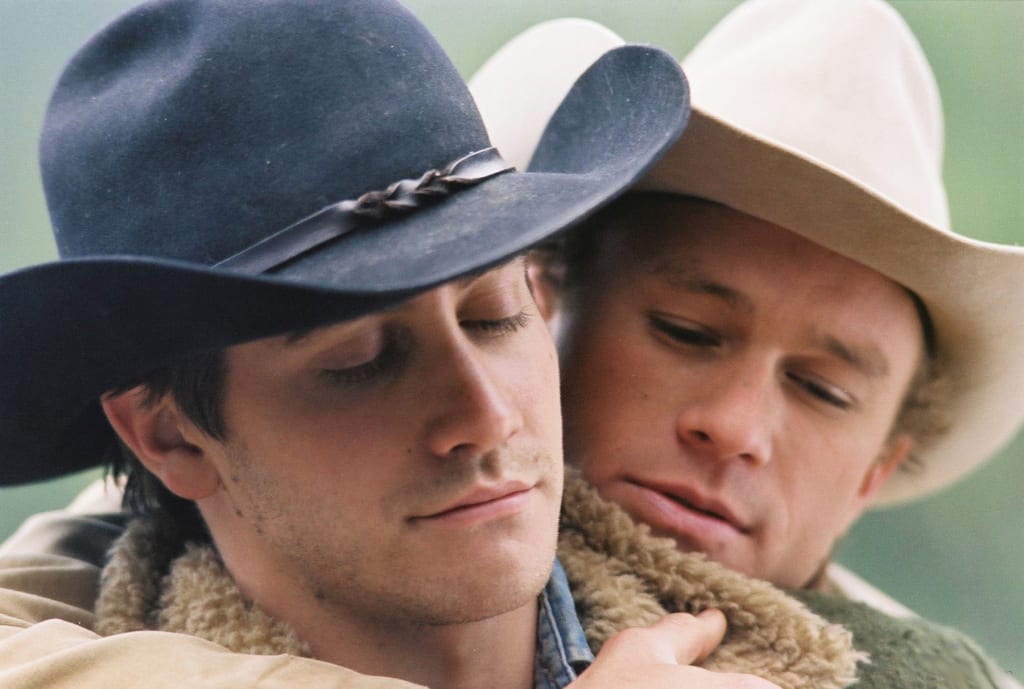
With The Power of the Dog exploring themes of sexuality and masculinity in the context of the mythic American west as it transitioned to modernity and civilization, I was reminded of how Brokeback Mountain explored similar ideas in an even more modern version of the West. With The Power of the Dog nominated for Best Picture at the Academy Awards, and rankling the elderly members of the Academy with its modern themes, it seems that now is as good a time as ever to reflect on Brokeback Mountain.
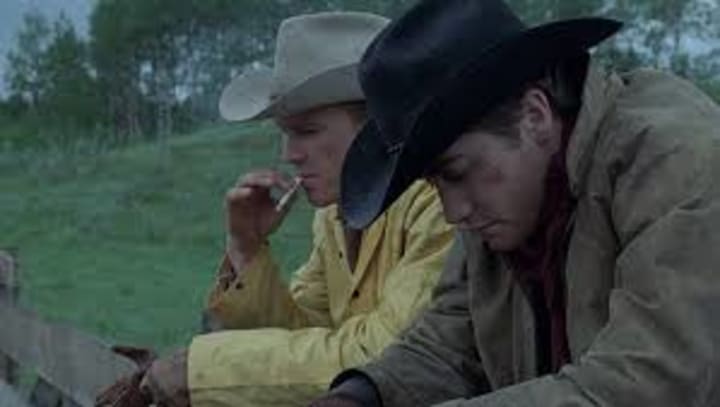
The image of the cowboy in Americana is one of a man who has no emotions, a human callous, not allowed even a tear at the passing of a friend or a good horse. This is the classic American icon that director Ang Lee bravely deconstructs in the compelling, if occasionally meandering, Brokeback Mountain. Starring Heath Ledger and Jake Gyllenhaal, Brokeback Mountain explored explicitly what any number of older films portrayed implicitly or even without intention.

Heath Ledger stars in Brokeback Mountain as Ennis Del Mar and Jake Gyllenhaal is Jack Twist. The two meet in Wyoming in 1963 where both land jobs tending sheep on the Brokeback Mountain range. Ennis is quiet and weary while Jack is outgoing and eager to establish some connection to the guy he will share the next several months worth of meals and work with.
Two men can eat a dinner of steak and beans only so long before they finally begin to become friends, and soon cloistered Ennis is sharing his family history and Jack is lovingly absorbing his friend's newfound loquaciousness. Then, on one very cold night, when Jack is too cold and tired to return to his separate camp aside the sheep herd, the guys share a tent. A seemingly unintentional cuddle soon turns to fondling and finally sex, though each is quick to assure the other of his remaining manhood. "I'm no queer," says Ennis, and Jack replies, "me neither."
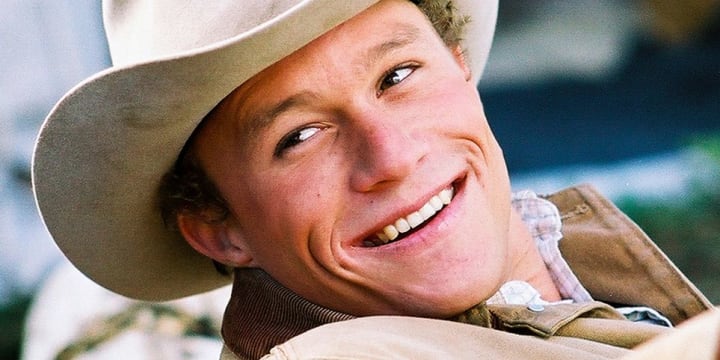
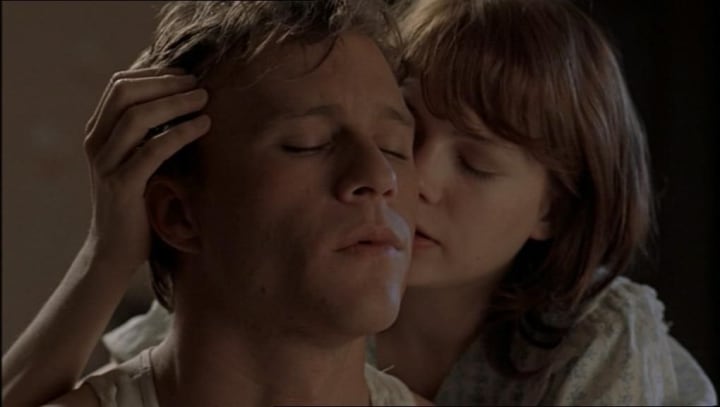
Parting at the end of the summer, with no invitation to return from their suspicious employer, Roy (Randy Quaid), Ennis and Jack separate for some 4 years. In the meantime, Ennis marries his high school sweetheart (Michelle Williams) and has two kids. Jack moves to Texas to take part in the rodeo but holds out hope that someday he and Ennis could be together again. Jack also eventually marries a fellow rodeo rider (Anne Hathaway), though the relationship is friendly at best.
It is Jack who reinitiates a relationship with Ennis, returning to Wyoming for what Ennis tells his wife is a fishing trip. After she catches the two men kissing hello, unbeknownst to Jack and Ennis, she knows that no fish will be caught on this trip. Williams' work in this scene is heartbreaking; even this early in her career, Williams has so much effortless talent and gravity to her work that its impossible not to feel deeply for her.
While Jack harbors fantasies of he and Ennis living happily ever after, owning a ranch together, Ennis is more realistic and aware of the social barriers to such a relationship. As a boy, Ennis' father showed him the rotting corpses of two men suspected to have been living together as a couple. The show was a warning to Ennis that remains with him even as his passions for another man flame almost out of control.
Ang Lee directed Brokeback Mountain from a script by Diana Ossana and Larry McMurtry, based on a short story by Annie Proulx. The involvement of McMurtry was quite intriguing at the time given that he is the writer behind the Lonesome Dove series, a celebration of all the great legends of being a cowboy. For McMurtry to lend his name to a film that deconstructs the very image he has helped cement in modern culture was very interesting and lends a sort of cowboy credibility to Brokeback Mountain. Of course, we know now that McMurtry's contributions were mostly for the non-romantic side of the story, but he nevertheless added to the authentically western sensibility of Brokeback Mountain, an essential element to the deconstructing of the mythic western archetype in the rest of the story.
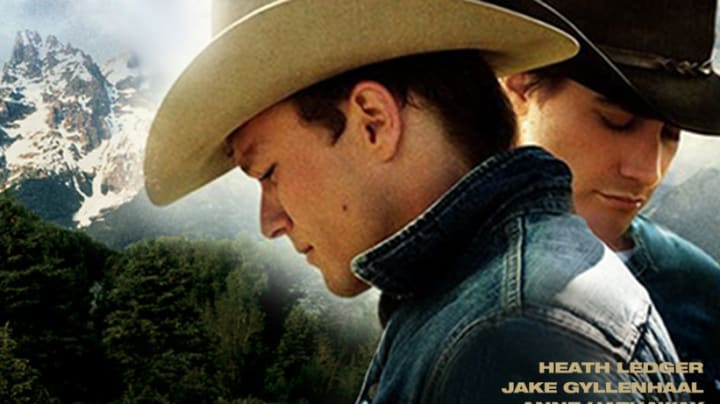
One of the great tragedies of recent Hollywood was the death of Heath Ledger. Though he will forever linked with The Joker in The Dark Knight, his role in Brokeback Mountain is more than the equal of that performance. One could argue fairly that Ennis is the easier of the two lead roles in Brokeback Mountain because there is so much more to play, but that doesn't mean that Ledger takes it is easy at all. His performance is filled with heartbreaking notes of sorrow, agony and passion. Where Jack is certain about his feelings, Ennis is torturously conflicted. Ledger plays the role heartbreakingly well as the film closes.
Jack is a slightly more difficult role, as mentioned, he doesn't have as many big notes to play, and thus Gyllenhaal should be commended. Jack is the one who is certain of his feelings and optimistic about the future if he can convince Ennis to be with him. Gyllenhaal brings layers to the character, more than there are in the script, with his ingratiating country boy demeanor early on and his raw nerve passion late in the picture. Time has only made Gyllenhaal's performance more impressive for me as a more mature perspective, on my part, as a writer, critic, and person, reveals even more complexity in the character of Jack Twist.

However, when it comes to commending the acting in Brokeback Mountain, Michelle Williams steals the film in the all too small role of Ennis' betrayed wife. Williams' brief scenes are devastating and filled with an emotional electricity that radiates from the screen. Williams' performance is tricky in that she could be seen as villainous for seeming to stand in the way of Ennis and Jack's happiness. Williams however, smartly gives the character specificity. This is as much her story as his story and while we may root for him to find happiness with Jack, we understand the pain he caused in her life as much as his own, regardless of why he did it.
The look of horror on Williams' face as she see's Ennis and Jack kiss, unknown to them, is a shot that risks our involvement and support for the forbidden affair of Ennis and Jack. In this scene and a later scene where she confronts Ennis, Williams lays out the emotional stakes of the film, how fraught Jack and Ennis' relationship is and how much tumult can arise from trying to be someone you are not. Williams forces the movie to be fair to her character, even as our heart goes out to Ennis for how the world around him shaped the decisions he made.

There are a few issues with Brokeback Mountain. The film could stand to be a little tighter in the edit. Most troubling however, the part that hasn't aged well, is a tendency for the filmmaker to underline how masculine Ennis and Jack are. The film borders on insecurity at times, even as it is a movie about two men falling in love. A scene where Ledger faces down a pair of drunk bikers offers the compelling visual of Ledger against a night sky filled with fireworks. The scene has symbolic meaning, but it plays as if we were being reassured of his manhood. Gyllenhaal's battle of wills with his overbearing father-in-law plays similarly to Ledger's fireworks scene but with less subtext and even less necessity.
In a perfect world Brokeback Mountain would be judged on only what is actually on the screen, which is a touching yet deeply troubled love story. Jack and Ennis are people first and men second, and because of the effective performances of Ledger and Gyllenhaal we root for them to be together as we would Romeo and Juliet or Julia Roberts and Richard Gere. The film generates great empathy for its two flawed romantic protagonists in the way a good love story should. And yet, there are those who find just the idea of this movie uncomfortable.
17 years since the release of Brokeback Mountain and our collective culture has changed dramatically. The way LGBTQ characters was changed forever by this movie and today, LGBTQ characters are more ubiquitous and celebrated than ever before. That doesn't mean that the discrimination against them has gone away or the problematic reactions to LGBTQ stories have gone away, but thanks to movies like Brokeback Mountain, there is a newfound respect and space for these kinds of stories to be told.
Brokeback Mountain helped to make a movie like The Power of the Dog, itself a deconstruction of the western myths regarding masculinity and sexuality, possible. These two movies share a common lineage as a tribute to the fact that LGBTQ people have always existed, despite the attempts of those who would try to keep them from telling their stories. Both films are a needed reminder that there are more ways than one to remember American or world history. These brilliant films are a necessary challenge to the idea that there was only one kind of American western and despite the hand-wringing of some, they are not a replacement of American history, they are an addition to it.
About the Creator
Sean Patrick
Hello, my name is Sean Patrick He/Him, and I am a film critic and podcast host for the I Hate Critics Movie Review Podcast I am a voting member of the Critics Choice Association, the group behind the annual Critics Choice Awards.
Keep reading
More stories from Sean Patrick and writers in Pride and other communities.
Movie Review: 'Licorice Pizza' is a Glorious Slice of 70's Life
Licorice Pizza stars Cooper Hoffman as Gary Valentine, an enterprising 16 year old with a restless mind. Gary is on angle in every moment of his life having broken into Hollywood as a child actor and parlayed that into other enterprises. As Licorice Pizza plays out we watch Gary find opportunities at every turn due to his immense charisma and curiosity. It’s Gary’s fearless, self promoting confidence, that catches the attention of Alana while she’s working as an assistant to a photographer for Gary’s school pictures.
By Sean PatrickExclusive • 4 years ago
Tomgirls
Introduction: Beyond the Binary In today's evolving landscape of gender identity and expression, the term "tomboy" has long been familiar but have you encountered its counterpart, the "tomgirl"? This emerging concept represents a fascinating shift in how we perceive and perform gender, challenging traditional norms and celebrating fluidity. Tomgirls typically individuals assigned male at birth who embrace traditionally feminine aesthetics, behaviors, or interests while still identifying as male are redefining masculinity in contemporary society. This exploration isn't just about fashion or hobbies; it's about authenticity, self-discovery, and the courageous rejection of restrictive gender boxes.
By David Femboy6 days ago in Pride
Why are there so many ladyboys in thailand
Thailand's vibrant culture is renowned worldwide for its stunning beaches, flavorful cuisine, and welcoming spirit. Among its most visible cultural phenomena especially to international visitors is the prominent presence of transgender women and individuals locally and colloquially known as "ladyboys" (or kathoey in Thai). This visibility often leads to the question: why does Thailand have such a significant transgender population? The answer lies in a unique intersection of culture, religion, history, and modern society.
By David Femboy3 days ago in Pride


Comments
There are no comments for this story
Be the first to respond and start the conversation.