
Visionary Philosopher, Islamic Thinker, and Spiritual Voice of the Muslim World
Allama Iqbal: The Poet of the East


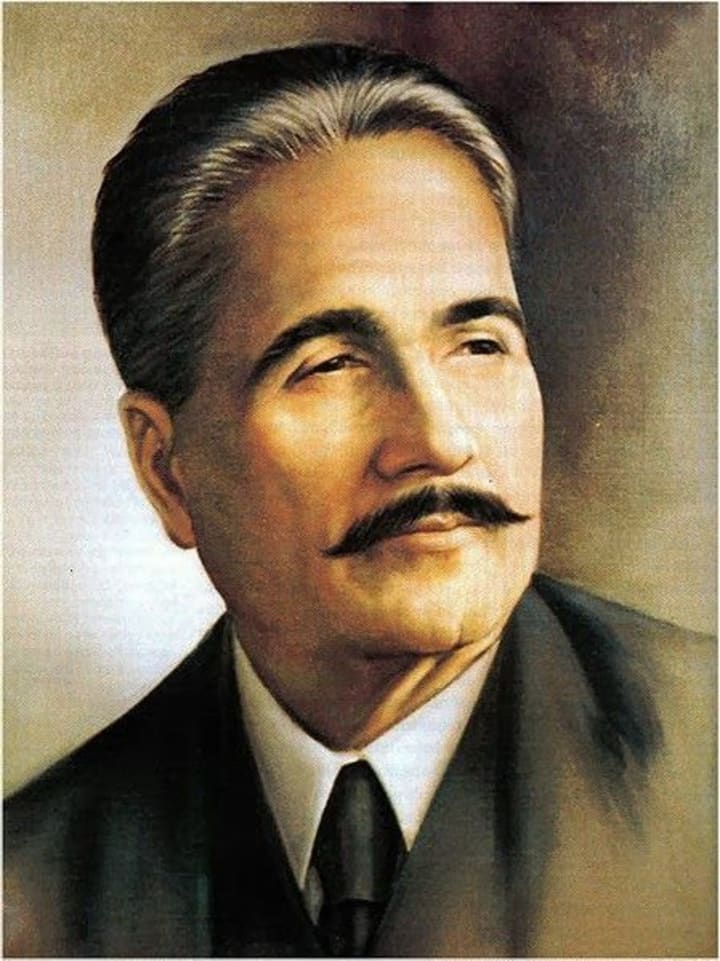
Allama Muhammad Iqbal, widely known as the “Poet of the East,” is celebrated not only for his profound poetry but also for his vision
that inspired millions across the Indian subcontinent. Born on November 9, 1877, in Sialkot, a small town in British India (now
Pakistan), Iqbal grew up in a modest household where education, religion, and literature were highly valued. From an early age, he
showed a deep curiosity for learning, immersing himself in the study of Persian and Urdu literature, as well as Islamic philosophy.
Iqbal’s poetry is unique because it goes beyond the aesthetic appeal of
words; it carries a philosophical depth that reflects his desire to awaken the consciousness of Muslims and humanity at large. His
early works, written in Persian, such as Asrar-i-Khudi (Secrets of the
Self), explore the idea of selfhood and the power of individual potential. Iqbal believed that self-realization and personal
development were essential for societal progress. Through his words, he urged people to recognize their worth and embrace a proactive,
purposeful life.
Education played a crucial role in shaping Iqbal’s worldview. After completing his early education in Sialkot, he went on to study at
Government College Lahore, where he earned his Bachelor’s and Master’s degrees in philosophy. His exposure to Western thought and
literature broadened his horizons. Later, he traveled to Europe, studying at Cambridge and then at the University of Munich, where
he earned a doctorate in philosophy. During his time in Europe, Iqbal engaged deeply with Western philosophy, particularly the works of
Nietzsche, Goethe, and Bergson. Yet, instead of merely adopting
Western ideas, he synthesized them with Islamic teachings, creating a distinctive philosophy that emphasized spiritual renewal, freedom,
and ethical responsibility.
Iqbal’s vision was not limited to personal growth; he was deeply concerned with the socio-political condition of Muslims in India. His
speeches and poetry often reflected a call for unity, self-reliance, and awakening among Muslims who were facing colonial oppression and
social stagnation. In his famous work Bang-i-Dra (The Call of the Marching Bell), he used poetry to inspire action, urging people to
embrace their heritage while striving for modernity and intellectual
advancement. He also wrote Bal-i-Jibril (Gabriel’s Wing), which explored themes of divine love, human freedom, and the pursuit of
knowledge.
Iqbal’s influence extended beyond literature and philosophy; he played a pivotal role in the political awakening of Indian Muslims. He
is credited with articulating the idea that eventually led to the demand for a separate Muslim state, later realized as Pakistan. In his
presidential address to the All-India Muslim League in 1930, Iqbal envisioned a society where Muslims could freely practice their
religion and cultivate their culture, emphasizing self-determination and moral leadership. Though primarily a poet and philosopher, his
ideas had a profound practical impact, shaping the political discourse
of his time.
What makes Iqbal exceptional is his ability to blend thought, emotion, and action. His poetry is infused with metaphors drawn from nature,
history, and spirituality, yet it always carries a purpose—encouraging reflection, courage, and a higher moral vision. Lines from his poems
continue to resonate today, motivating people to rise above despair,
seek knowledge, and strive for justice and freedom. Iqbal’s
philosophy reminds us that true progress requires a balance of intellectual rigor, spiritual awareness, and ethical responsibility.
Allama Iqbal passed away on April 21, 1938, in Lahore, leaving behind a rich legacy of poetry, philosophy, and visionary thought. He
remains an enduring symbol of intellectual courage, spiritual
awakening, and the pursuit of a higher purpose. His life story and works continue to inspire millions in South Asia and around the
world, earning him the title “Poet of the East,” a recognition not merely of his literary genius, but of his profound ability to touch the
human soul and ignite a sense of hope and purpose.
In essence, Iqbal was not just a poet; he was a thinker, philosopher, and a guiding light for a generation seeking identity, freedom, and
dignity. His life reminds us that words, when combined with vision and conviction, have the power to awaken nations and transform
societies.
About the Creator
Niaz Muhammad
Insha Allah, I will write in such a good way that people with weak eyesight or the elderly can easily read it.
Keep reading
More stories from Niaz Muhammad and writers in Poets and other communities.


Comments
There are no comments for this story
Be the first to respond and start the conversation.