
The Last Light in Willow Creek
As the town’s only factory shuts its doors, residents face a future filled with uncertainty — and quiet resilience

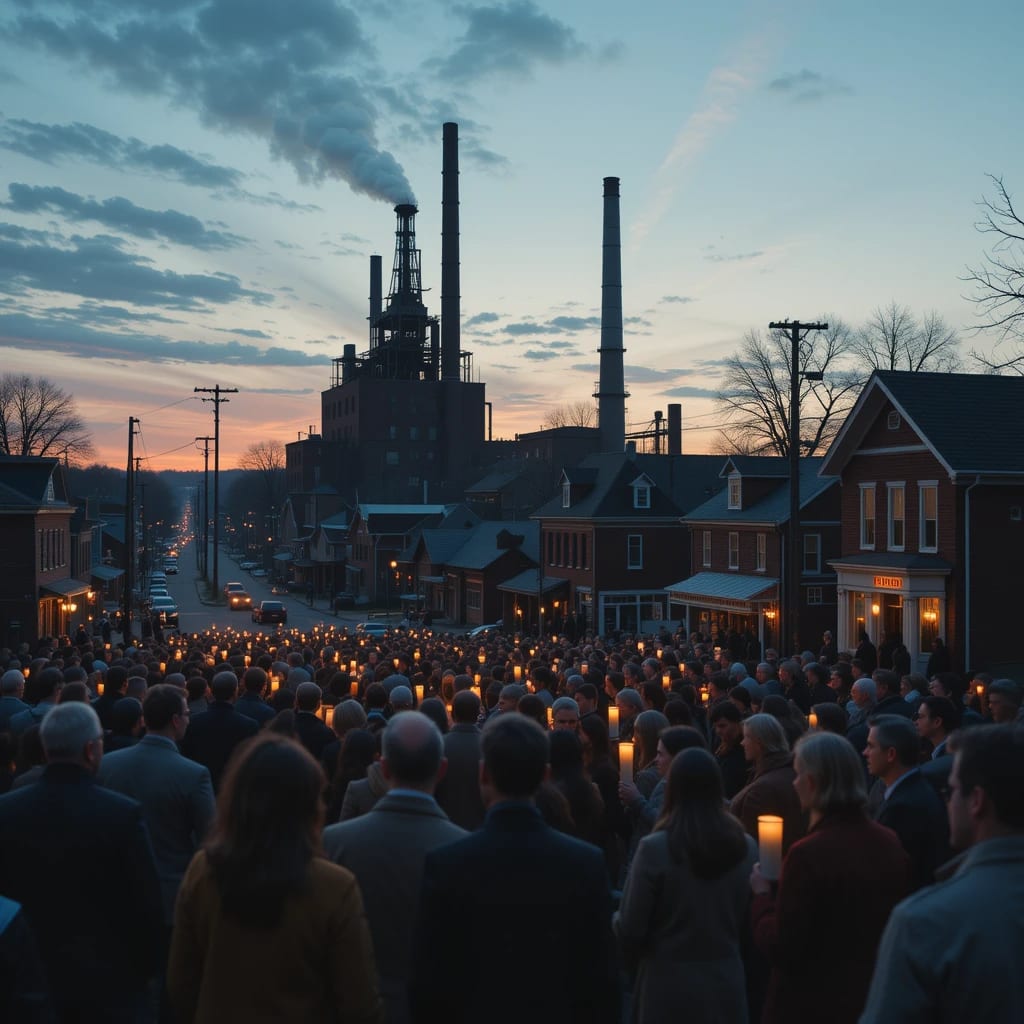
The Last Light in Willow Creek
Willow Creek, Ohio — On a gray Thursday morning, the parking lot of the Maple Ironworks plant sat mostly empty for the first time in nearly eight decades. Only a few rusting pickup trucks remained, their owners lingering inside the building to collect belongings or say a final goodbye. A hush hung over the scene — not the noise of machines grinding to a halt, but the silence that comes when something deeper, something communal, ends.
For the 4,300 residents of Willow Creek, the closure of Maple Ironworks is more than just an economic loss. It’s the severing of a lifeline, a rupture in a rhythm that shaped daily life here for generations. Nearly one in five families had someone employed at the factory, which produced industrial steel components used across the country. Now, they’re left asking the same question, over and over: What happens next?
“This place wasn’t just a job. It was how people lived,” said Dana Cliffton, 51, a third-generation welder who started at Maple Ironworks the day after graduating high school in 1992. “My dad retired from here. My grandfather built part of this plant. And now I’m packing up my locker like it’s the last day of school, except there’s no summer ahead. Just the unknown.”
The shutdown, announced quietly in late March, took many by surprise. Rising production costs, global competition, and new tariffs on raw materials were blamed by management. In a terse press release, the parent company called the decision “strategic and final.” For workers like Cliffton, that offered little consolation.
“I gave them thirty-two years,” he said. “And they gave me a handshake and a cardboard box.”
Main Street Feels the Impact
It’s not just the factory workers who are feeling the sting. On Main Street, signs of economic anxiety are already visible. Marty’s Diner, the kind of place where a cup of coffee comes with a story, has seen a 40% drop in breakfast traffic. The barbershop next door lost three longtime clients last week after they moved out of town in search of work.
“This town used to be noisy,” said Marty DeLuca, wiping down the counter during a slow lunch hour. “Now it’s quiet. Not peaceful quiet — just... empty.”
The mayor, Christine Holloway, has spent the last month in back-to-back meetings with county officials, trying to attract investment or at least secure emergency funding for laid-off workers. But the challenges are steep.
“There’s no easy fix for a loss like this,” she said in her office, its walls decorated with photos from the town’s centennial celebration a few years ago. “We’re looking at federal aid, retraining programs, even alternative energy projects. But let’s be honest — a town like Willow Creek doesn’t rebound overnight.”
Still, Holloway believes there’s a stubborn resilience in her community that no factory closure can erase.
“We’ve been knocked down before,” she said. “And every time, we find a way to stand back up.”
The Young and the Restless
Among the younger generation, the closure has accelerated an already growing trend: leaving town.
“It’s like the writing’s on the wall,” said Jamie Winters, 19, who works part-time at the gas station while studying business online. “If the biggest employer is gone, what’s keeping us here? Memories?”
Winters isn’t alone. A recent informal survey by the local high school guidance counselor showed that 70% of graduating seniors plan to move away within a year. Most cite lack of jobs, slow internet, and “nothing to do” as key reasons.
But not all are giving up.
Zeke Powell, 26, returned to Willow Creek last year after a few rough years in Cleveland. He’s started a small lawn care and handyman service and has already picked up new clients — mostly older residents needing help as their adult children move away.
“This town gave me a second chance,” Powell said. “Now I want to give it one too.”
Signs of Hope
Amid the gloom, there are flickers of optimism.
The local library has extended its hours and begun offering free classes in computer skills, résumé writing, and small business startups. The community center is hosting weekly potlucks — not just for free food, but to keep the bonds of neighborhood intact.
“There’s grief, of course,” said Clara Morton, who runs the library. “But there’s also grit. People are showing up. They’re still trying.”
One unexpected source of hope has come from an artist named Reggie Tangier, who moved to town six years ago from Chicago for cheaper rent and peace of mind. After the shutdown, he began painting abandoned buildings with vibrant murals: sunflowers bursting from smokestacks, children playing among gears and pipes, a woman’s face looking upward beneath the words: “We Still Are.”
“People kept walking by and saying, ‘Thank you,’” Tangier said. “That’s when I realized — maybe color matters more when everything feels gray.”
A Community, Redefined
On Sunday, the town held a candlelight vigil outside the gates of the shuttered plant. Hundreds came, bundled in jackets, holding flickering lights against the chill. Some cried quietly. Others hugged old coworkers or stood alone, staring at the towering silhouette of the factory one last time.
A pastor offered a short prayer. A high school student played “Amazing Grace” on a battered trumpet. And when the wind died down, a moment of silence fell — broken only by the soft creak of the plant’s old sign swinging on its hinges.
As the crowd dispersed, Dana Cliffton lingered.
“It’s funny,” he said, voice thick with emotion. “This place was all smoke and noise and hard work. But standing here tonight, all I can think about is how much love was built into these bricks.”
He paused, looking back once more.
“They can shut the doors,” he said. “But they can’t shut down who we are.”
About the Creator
Shohel Rana
As a professional article writer for Vocal Media, I craft engaging, high-quality content tailored to diverse audiences. My expertise ensures well-researched, compelling articles that inform, inspire, and captivate readers effectively.
Keep reading
More stories from Shohel Rana and writers in Poets and other communities.
The Sound of Rain on Tin
Where the soul listens, and sorrow softens. It began with the roof. A soft tapping, barely there, like the footfalls of ghosts. I sat alone on the back porch of a weathered cabin, high in the hills, a mug of tea between my palms and a thousand miles of silence behind me.
By Shohel Rana8 months ago in Poets



Comments
There are no comments for this story
Be the first to respond and start the conversation.