
The Hurt We Inherit
A reflection on how emotional pain, anger, and harmful behaviors are passed down through generations—and the speaker’s choice to end the cycle.

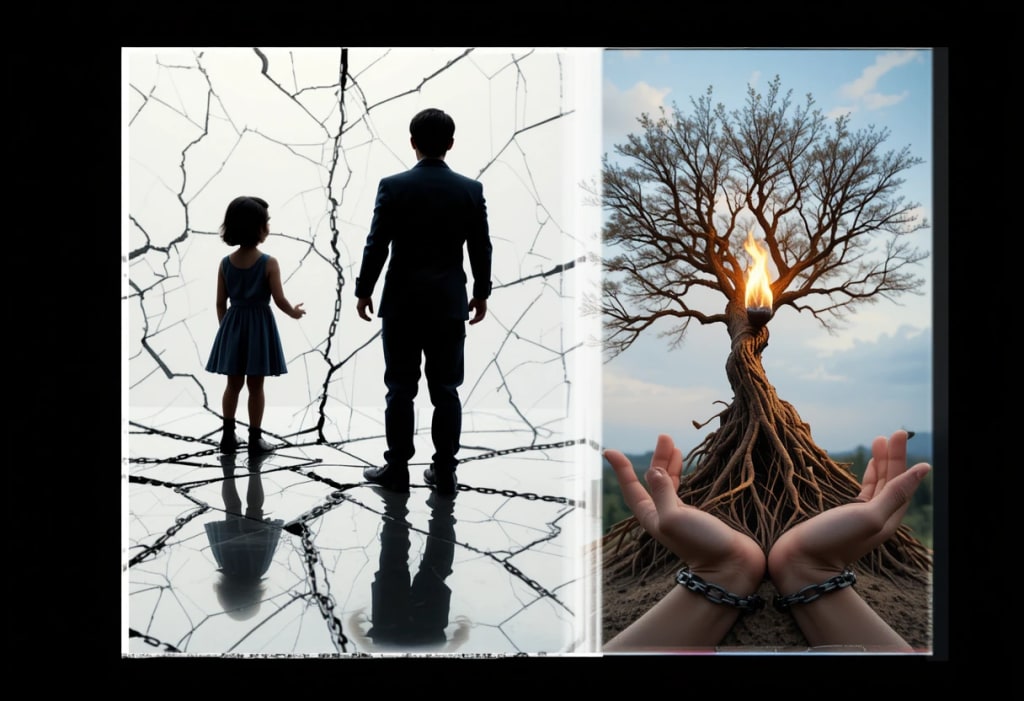
The Hurt We Inherit
A Poem in Essay Form waseem khan
We don’t always inherit silver.
Sometimes we inherit silence.
Fists that were never raised, but always implied.
Sarcasm sharp enough to scar.
Eyes that look away at the exact moment we needed them to stay.
The things we pass down
aren’t always listed in wills.
Some of them live in sighs.
In slammed doors.
In words like,
“You’re just like your father,”
or
“We don’t talk about that here.”
I’ve been carrying things I didn’t pack.
Anger that isn’t mine.
Shame like hand-me-down clothes—
too tight,
too worn,
but expected to wear anyway.
I come from a line of people who never learned to say, “I’m hurt.”
Only, “I’m fine.”
And “Get over it.”
And “Toughen up.”
My grandfather drank his feelings into fists.
My mother folded hers into apology.
And I?
I became a quiet kind of storm.
One that doesn’t flood the streets,
just erodes the edges slowly—
until no one recognizes the shape of me anymore.
There were things we didn’t say.
Like “I love you.”
Or “I’m scared.”
Or “That really hurt.”
Instead, we said,
“What’s wrong with you?”
Or
“You think you’ve got it bad?”
Or the worst:
“I never meant to make you feel that way.”
Pain doesn’t disappear when ignored.
It mutates.
Becomes sarcasm.
Defensiveness.
An inability to sit still with someone else’s grief
because we were never taught how to sit with our own.
They told me,
“You’re so sensitive.”
As if sensitivity was a flaw.
As if kindness wasn’t the bravest form of resistance.
As if feeling too much
meant you were less capable of surviving.
But I’ve learned this:
You can feel deeply and still stand tall.
You can carry empathy without being crushed by it.
You can hold love
and still protect your peace.
I see now that hurt people often raise hurt people.
Not because they are cruel,
but because pain becomes invisible
when it's been your companion for too long.
You stop noticing its weight.
You forget you’re still holding it.
I saw it in my mother—
how she could never quite say what she needed,
how she flinched when complimented,
how she apologized for crying,
like her tears were a burden
instead of proof she was still alive.
And I saw it in myself—
every time I chose silence over truth,
every time I laughed when I wanted to scream,
every time I swallowed my fear because
“it wasn’t that bad.”
But here’s the truth:
It was that bad.
Even if others had it worse.
Even if no bones were broken.
Even if everyone smiled in the holiday photos.
Emotional wounds are real.
They just bruise differently.
They bleed in patterns we call personality.
They scar in behaviors we justify as “just how I am.”
I am learning to uninherit the pain.
To name it.
To sit with it.
To ask it, softly, “Where did you come from?”
Not to shame it.
Not to banish it.
But to understand.
I’ve started talking to the child inside me—
the one who wanted to be seen,
who wanted someone to say,
“Your feelings matter.
You matter.”
I try to be what no one was for her.
Gentle.
Patient.
Present.
I’m also learning this:
Breaking the cycle doesn’t mean blaming.
It means being brave enough to choose differently.
It means saying,
“I will not shout just because I was shouted at.”
“I will not dismiss pain just because mine was ignored.”
“I will not continue this chain of silent suffering.”
It’s not easy.
Healing feels like swimming upstream
with pockets full of stones.
But every time I choose to pause,
to breathe instead of lash out,
to listen instead of judge,
a stone falls away.
And it gets lighter.
I don’t want to pass down my pain.
I want to pass down peace.
Boundaries that feel like love.
Hugs without tension.
Conversations that don’t end in someone leaving the room.
I want to give the next version of me—
whether that’s a child,
a friend,
or a stranger—
something better than I was given.
Not perfection.
Just presence.
And permission to feel.
Author’s Note:
We may inherit hurt.
But we can choose what we leave behind.
Let it be something softer.
Let it be something whole.
About the Creator
Keep reading
More stories from waseem khan and writers in Poets and other communities.
Silver Screen Magic with Mae West
American actress and singer Mae West became a popular film actress during the Great Depression. She started entertaining in vaudeville, then performed on Broadway, and finally went to Hollywood. She signed up with Paramount Pictures and made her debut in the 1932 film “Night After Night.” She also starred in musicals, comedies, and crime dramas. The American Film Institute named her one of the best classic Hollywood actresses.
By Rasma Raisters3 days ago in Geeks


Comments
There are no comments for this story
Be the first to respond and start the conversation.