
🌟 The First King of the World
“A Work from Ferdowsi’s Shahnameh – Part One”
🏰 The Rise of Keyumars
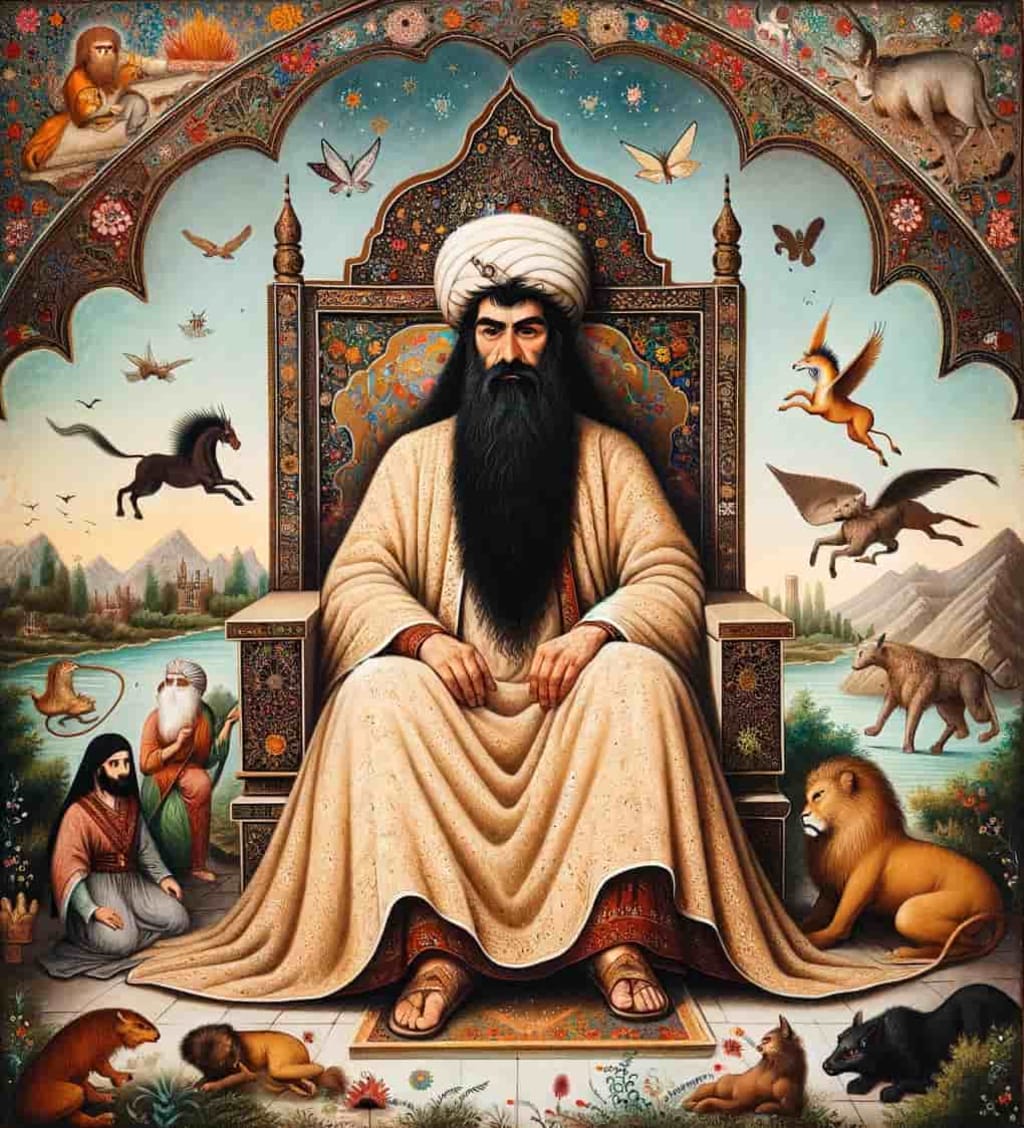
In the world, the first person to establish the ways of kingship and the throne was a man named Keyumars.
He wore a robe made of leopard skin, and the people under his rule were joyful and faithful in worshiping the One God.
👑 Siyamak, the Heir
Keyumars had a son named Siyamak, wise, handsome, and destined to succeed his father.
But nearby, a spiteful demon harbored hatred and envy, longing to claim the throne for himself.
He constantly spoke to the people, and soon a battle seemed inevitable.
The demon had a son, large and fierce, with a wolf-like face, inheriting his father’s evil nature.
⚔️ The Warning from the Angel
During these days, Soroush, the angel messenger, appeared before Keyumars:
“A wicked demon exists, and he will soon try to seize your crown.”
Siyamak asked his father:
“Allow me to raise an army and face the demon.”
He went to battle but was defeated.
The demon’s son attacked Siyamak and tore his heart from his body.
Keyumars was stricken with grief, and the people mourned for a full year.
🕊️ Hushang’s Revenge
Siyamak had left behind a son named Hushang.
He went to his grandfather Keyumars and said:
“I will raise an army and avenge my father’s death.”
Hushang gathered a mighty army of humans, jinn, fairies, and mythical creatures.
He struck a decisive blow to the demon and severed his head.
🌟 The Throne of Hushang
Keyumars ruled for thirty years, during which his people were joyful and content.
Afterward, Hushang ascended the throne:
“I am the ruler of seven kingdoms, and by the grace of God, I am ready to spread justice and generosity.”
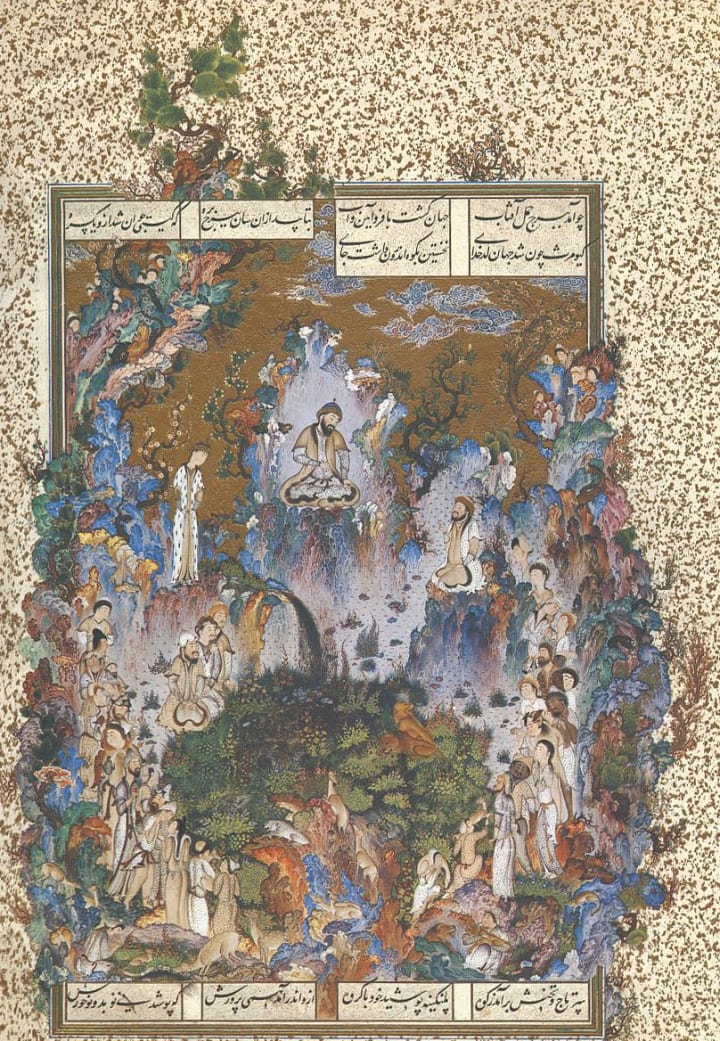
The manuscript contains approximately 760 folios, including 258 illustrated pages depicting Iranian mythology and history. These illustrations were created by the finest royal painters and calligraphers in nastaʿlīq script in Tabriz.
The production of the Shahnameh Tahmaspi was ordered by Shah Ismail I, the founder of the Safavid dynasty, around 928 AH, two years before his death, and took nearly two decades to complete.
After completion, the manuscript was gifted to Sultan Selim II and remained in the Ottoman court until the 19th century. From 1903 to 1959, the Rothschild family owned it. In 1959, Arthur Houghton purchased the manuscript. To settle a tax debt, he donated 78 folios to the Metropolitan Museum of Art, and the remaining folios were sold separately to various collections.
118 folios that remained in Houghton’s collection until his death were later exchanged for Willem de Kooning’s painting Woman III and are now housed in the Tehran Museum of Contemporary Art.
This manuscript is considered one of the most expensive artistic works in the world, with a single illustrated folio selling for $13.8 million in 2019.
About the Creator
ALI ABBASI
“Here, the greatest and most authentic stories of history are written, turning into legends.”
Keep reading
More stories from ALI ABBASI and writers in Poets and other communities.
The Reign of King Jamshid and Zahhak the Serpent-Shouldered
The Legend of King Jamshid — The Second Part of the Shahnameh After the death of King Tahmuras, his son Jamshid ascended the throne. Not only humans, but even the fairies and demons accepted Jamshid as their king. At the dawn of his reign, Jamshid was proud and confident, yet over time, he devoted himself more deeply to the prosperity of his kingdom. With the sacred fire that had been discovered before him and the iron drawn from the mountains, he and his people forged weapons, crafted shining armor, and for the first time in history, they made armor for their horses to protect them in battle. From the threads they spun, they wove beautiful carpets and garments finer than any seen in the world. For fifty years, Jamshid labored to build and perfect these wonders.
By ALI ABBASI3 months ago in Poets
Art is My Meditation
art is a meditation you feel cleaned and anchored well with eyes open wide. Meditation has earned recognition as a mindfulness tool. It does not work for me. But I find spiritual cleansing and deep focusing with my creativity. Art is my meditation.
By Seema Patel4 days ago in Poets



Comments
There are no comments for this story
Be the first to respond and start the conversation.