
The Chair Across From Me
Grief leaves its shadows not in silence, but in the spaces we still set for those who never return.

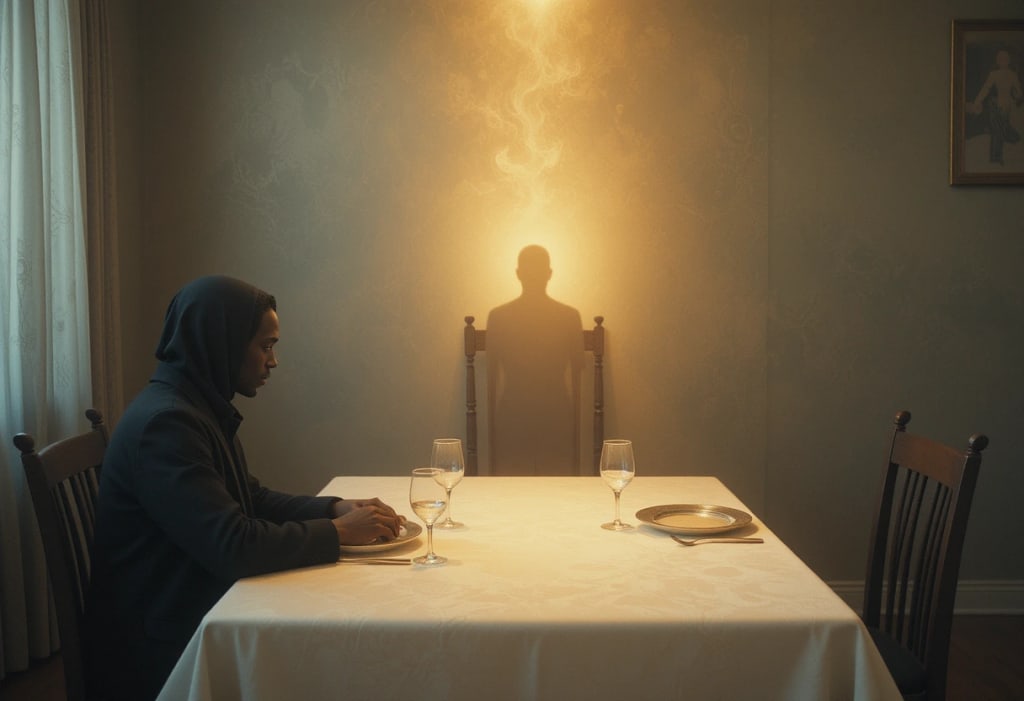
The Chair Across From Me
Grief leaves its shadows not in silence, but in the spaces we still set for those who never return.
Every evening, I set the table for two.
The habit is carved into me as surely as breath. Two plates, two glasses, two folded napkins. And across from me, the chair that is never filled.
It has been almost a year since you passed, though time has twisted itself into something unrecognizable. Days stretch and collapse in strange ways—some so heavy they feel endless, some so fleeting I wake only to discover the night has already fallen again.
But always, at dusk, I light the lamp in the dining room and lay out the table as if you were still here.
I don’t do it for show. No one visits anymore. Friends came at first, with casseroles and soft voices, but grief exhausts those who are not inside it. They moved on. I remained.
And the chair remained.
I think what I miss most is not your voice, or your laughter, but the rhythm of you—the small, ordinary presence of a person who becomes a part of the house itself. The way you tapped your fingers against the table before speaking. The way you leaned your elbow on the chair back and tilted your head, listening to me with half a smile.
Those gestures linger in my memory like candle smoke, invisible until I close my eyes, and then they surround me.
So I set the table. I set it, as though by arranging plates and silverware I might arrange time itself, and you might walk back through the door and sit where you always sat.
The chair across from me waits, night after night.
Some evenings, I talk aloud to it.
I tell you about the errands I ran, the neighbor who trimmed his hedge too close to my side, the letter I’ve been meaning to answer but can’t bring myself to. I tell you how the world feels thin without you in it.
I don’t expect a reply. But speaking into the stillness, I sometimes imagine you are listening, just beyond my reach.
And once—only once—I thought I heard you.
It was a Tuesday. I had just poured myself a glass of wine, the red staining the rim as I set it down. I lifted my own glass in a toast to your absent one, and in the hush that followed, I heard it: the soft scrape of a chair leg against the floor.
I froze.
The chair across from me had not moved, not really, but the sound hung in the air, convincing, undeniable.
I told myself it was the house shifting, the wood contracting in the night air.
But I raised my glass higher. “To us,” I whispered. And for a moment, I almost believed you whispered back.
Seasons passed this way. Spring filled the window with blossoms you never saw. Summer poured its heat into the rooms you never walked through. Autumn scattered its leaves like the pages of a book you never finished.
And still, every evening, I set the table for two.
People say grief lessens. That you learn to carry it. Perhaps they are right. But they never mention how the weight shifts—not into lightness, but into ritual. Into the small, repeated gestures that make the absence bearable.
My ratual is the chair across from me.
Until one night, the ritual broke.
It was late winter, the kind of night when frost paints the corners of windows. I had cooked a simple meal—soup, bread, nothing fancy. I placed your plate across from mine, the napkin folded neatly, the glass waiting.
I sat, as always, and bowed my head in silence before lifting my spoon.
And when I looked up, the chair was no longer empty.
You were sitting there.
Not as a ghostly blur, not as a flicker in the corner of my eye, but solid, clear, familiar. The way you looked on your last healthy day—eyes bright, hair falling across your forehead, the warmth of you glowing against the dim lamplight.
My breath caught. I couldn’t move.
You smiled. “You kept my place.”
Tears blurred my vision. I reached across the table, hand trembling, but before I could touch you, you lifted your glass—the one I had set for you every night—and raised it in a toast.
“To us,” you said.
The sound of your voice—so real, so steady—shattered something in me. I reached again, desperate, but the moment slipped like water through my fingers.
The chair was empty.
Only the glass remained, half-full of wine that I swear I had not poured.
Since that night, I have not set the table for two.
Not because I no longer miss you. Not because grief has lifted. But because I understand now: the chair across from me does not need to be set for you to be here.
You are already here, woven into the rhythm of my days, the cadence of my memories, the silence that listens when I speak aloud.
I still glance at the chair sometimes, expecting to see you. And though it remains empty, I know it is not truly vacant.
For one night, you returned. For one night, the chair was filled.
And that was enough.
About the Creator
Keep reading
More stories from waseem khan and writers in Poets and other communities.
The Last Conversation We Never Had
Story The Last Conversation We Never Had I should have said it when we were sitting on that cracked bench in the park, your scarf fluttering in the spring breeze, and I kept staring at you like I’d never see you again. I didn’t know then that I wouldn’t. I thought there would always be tomorrow, another chance to speak, another quiet moment where the world softened enough to hold us both.
By waseem khan5 months ago in Poets


Comments
There are no comments for this story
Be the first to respond and start the conversation.