slam poetry
Slam poetry: that magical mix of rhythm and rhyme.
Echoes of Now
🌐 Echoes of Now A Poetic Reflection on the Pulse of the Modern Age In cities crowned with neon haze, We walk through screens in mirrored days. Our voices bounce through satellites, Yet hearts grow quiet in the lights. A thousand faces in our hands, We scroll through lives like shifting sand. Connection blooms in silent texts, While eye-to-eye feels too complex. The clock ticks fast, the world rewinds, Yet somehow we are far behind. In chasing speed, we've lost our place— A name, a thought, a touch, a face. Still, in the hum of data streams, We stitch together scattered dreams. A spark survives beneath the code, The human thread within the load. So let us pause and breathe again, Remember joy, remember pain. The future’s built from what we sow— Even now, in this bright echo.
By Muhammad Saad 3 months ago in Poets
The Door That Waits
The Door That Waits No one knew where the door came from. It stood in the middle of an empty field at the edge of town, untouched by time or weather. There were no walls, no hinges, no frame holding it in place—just a tall, wooden door standing alone, perfectly upright, as though someone had placed it there carefully and walked away. At first, people thought it was a prank. Then a strange art piece. Then a portal, perhaps, to somewhere—or something—else. But no matter how many times they walked around it, knocked on it, or pushed it open, it just creaked gently, revealing only more grass behind it. Nothing magical happened. Nothing at all. So they left it alone. Except for Mira. Mira wasn’t like most people in town. She had the quiet, restless soul of someone who always felt like life was happening somewhere else. She worked at the local bakery, smiled politely at customers, and saved every spare coin in an old glass jar beneath her bed. But every day, when her shift ended and the smell of cinnamon and yeast clung to her clothes, she walked out to the field and stared at the door. She didn’t know why. Something about it called to her. Not with words or voices—just a feeling. Like the hum in the air before a storm or the silence before a leap. Each time she touched the wood, warm from the sun, she expected something to happen. But it never did. Until the morning everything changed. It had rained the night before, and the field was still damp with dew. Mira was late leaving the bakery, but something urged her toward the field anyway. When she got there, the door was open. Wide open. This time, the world behind it wasn’t the same field. Through the doorway was something else: a sunlit path lined with trees she'd never seen before. Birds she couldn’t name sang in the distance. The air shimmered, not with heat—but with promise. Mira froze. She looked around. No one else was there. The town hadn’t noticed. The door waited. Her heart pounded. Was it a trick? A dream? Maybe it led nowhere—maybe she’d walk through and vanish forever. But maybe... maybe it led to the life she’d always wanted. The one she dreamed of in quiet moments. A life of meaning, of adventure. A place where she belonged. She took a step forward, then another. Her foot passed the threshold. A soft breeze brushed her cheek, sweet and warm. She smiled. For the first time in her life, she didn’t hesitate. She walked through. And the door closed behind her. The next morning, it was gone. People noticed eventually. They murmured, pointed, and shrugged. Some said the wind must’ve blown it over. Others swore it had never been there at all. But they moved on. All except one small boy named Eli, who sometimes wandered near the field and stood for a long time staring at the empty patch of grass. One day, he told his mother, “I think there used to be a door there.” She smiled, patting his head. “Maybe, sweetie.” Eli said nothing more. But he kept looking. Because sometimes—when the sun rose just right and the air was still—he could swear he heard something in the distance. A creak. A whisper. A door waiting.
By Muhammad Saad 3 months ago in Poets
The Gift of Words
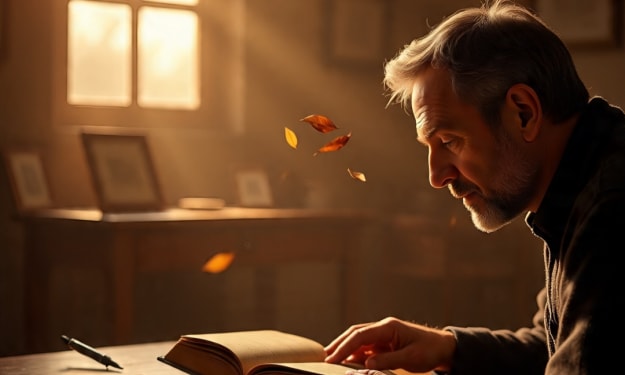
The wind rustled gently through the open window, carrying with it the scent of autumn leaves and a quiet hum of the world outside. Inside the modest study, surrounded by shelves lined with worn books and half-filled journals, sat Arman — a poet whose words had once stirred crowds, but whose voice now belonged only to the pages in his notebooks. On this particular day, the room felt different. The golden light of the late afternoon sun painted long shadows across the floor, and a kind of stillness hung in the air, as if the world paused to listen. Across from him stood his twelve-year-old son, Rayan, whose eyes had always been full of questions. Lately, though, those questions had grown quieter — replaced by the silent confusion of growing up. Arman had seen it before. He remembered the weight of that age — too old to be a child, too young to be a man. And so, he had prepared a gift — not one of toys or gadgets, but something far older. Far deeper. Arman reached into the drawer and pulled out a thick, leather-bound book. Its cover was worn, the edges frayed from years of turning pages in the middle of the night. It wasn’t just a book. It was his life. “This,” Arman said, holding it out with both hands, “is for you.” Rayan hesitated. “Is it one of your poetry books?” “Yes,” Arman smiled. “But it’s more than that. This one… I never published. I wrote it for you. Since the day you were born.” Rayan’s hands trembled slightly as he took the book. He opened it carefully, seeing page after page of neat handwriting, faded ink, and delicate drawings in the margins — birds, trees, stars, and hearts. “I don’t understand,” he whispered. “Why give this to me now?” Arman leaned back in his chair, eyes misting with emotion. “Because there are things in life that can’t be taught with rules or explained with logic. Some lessons live in the spaces between words — in poetry, in silence, in feelings. I want you to have this, Rayan, so that even when I’m not beside you, my heart still is.” Rayan flipped to the first page. The title read: For My Son, Who Taught Me to Listen Again. He glanced up. “You wrote all this… just for me?” Arman nodded. “Every poem in there was written on a day you changed me — a question you asked, a moment you cried, the way you laughed at the stars. You may not understand all of it now. But someday, when you’re ready, those words will find you.” Silence settled between them, not awkward or uncertain — but full, like the pause after a beautiful line of poetry. Rayan hugged the book to his chest. “I didn’t know words could feel like this,” he said softly. “They can,” Arman replied. “Words can heal, guide, and remind us who we are. They outlive us. And if they come from love, they never die.” As the sun dipped below the horizon, casting the room in amber hues, Rayan sat beside his father. They didn’t speak for a long time. There was no need. The boy had received not just a book, but a piece of his father’s soul — a map of feelings, a legacy of love, a timeless gift etched in ink and carried by the heart. And in that quiet room, the poet passed down the greatest verse he had ever written — the story of a father and son, bound not just by blood, but by words that would live forever.
By Muhammad Saad 3 months ago in Poets
The Timeless Voice: A Journey Through the Origins of Poetry
Long before the invention of writing, before books, screens, or pens, there were stories. And among those stories, some were different—they sang. These were the first poems, born from the rhythm of human life: the beat of the heart, the sway of walking feet, the cycles of seasons, and the rise and fall of the sun. Poetry likely began as an oral tradition, a way for early humans to preserve memories, explain the mysteries of the world, and connect deeply with one another. With no written records, they used rhythm, repetition, and rhyme to remember. A well-crafted line was easier to recall, and in this way, poems became the keepers of knowledge, history, and feeling. In ancient Mesopotamia, one of the world’s earliest civilizations, poetry appeared in written form over 4,000 years ago. The Epic of Gilgamesh, inscribed on clay tablets in cuneiform script, is one of the oldest surviving pieces of literature. This story-poem told of gods, kings, friendship, death, and the search for immortality—universal themes that echo through poetry even today. Farther west, in Egypt, poetry was carved into tomb walls and written on papyrus. These poems often praised the gods or expressed love and longing. Meanwhile, in India, the Rigveda, a sacred collection of hymns in Sanskrit, was being composed around 1500 BCE. These poetic verses blended religion, philosophy, and the rhythms of recitation in ways still admired and practiced. By the time of ancient Greece, poetry had become central to education, culture, and identity. Homer’s epics, The Iliad and The Odyssey, told of war, adventure, loyalty, and fate. Greek poets like Sappho and Pindar introduced lyrical poetry—short, emotional pieces meant to be sung, often accompanied by the lyre. Poetry wasn't just entertainment; it was a way to explore what it meant to be human. Rome continued this tradition, with poets like Virgil and Ovid shaping Latin literature. Their works blended myth and personal reflection, laying a foundation that would inspire European poets for centuries. After the fall of the Roman Empire, poetry didn’t vanish—it simply changed shape. In medieval times, poetry lived in monasteries, castles, and village squares. Troubadours in France and minstrels in England sang ballads of love and loss. In Persia, poets like Rumi and Hafez used verse to express spiritual longing and divine love. In China and Japan, poets captured nature’s beauty and fleeting moments in elegant, minimalistic forms such as tanka and haiku. The Renaissance brought a rebirth of poetic exploration. Shakespeare, the towering figure of English literature, wove poetry into his plays and sonnets, shaping the English language with unforgettable lines. Across Europe, poets began to explore individual emotion, political ideals, and artistic beauty through new styles and forms. By the 19th and 20th centuries, poetry was transforming again. The Romantics celebrated nature, emotion, and the imagination. Later, modernists like T.S. Eliot and Langston Hughes broke traditional forms to reflect the complexity of the modern world. Free verse, spoken word, and performance poetry began to thrive, opening doors for poets from all backgrounds to share their voices. Today, poetry is as diverse and alive as ever. It lives in books, songs, slams, Instagram posts, and classroom lessons. It whispers in love letters and shouts in protests. From ancient chants around a fire to digital poems shared around the globe, poetry has never stopped evolving. Why has it lasted so long? Because poetry is a mirror—and a voice. It reflects who we are and gives us words when words are hardest to find. Whether it’s the cry of a warrior, the longing of a lover, or the hope of a child, poetry captures the soul of humanity. And as long as we have stories to tell and feelings to feel, poetry will remain—our timeless voice.
By Muhammad Saad 3 months ago in Poets