book reviews
Reviews of the best poetry books, collections and anthologies; discover poems and up-and-coming poets across all cultures, genres and themes.
Colors in Verse: The Rainbow of Poetry
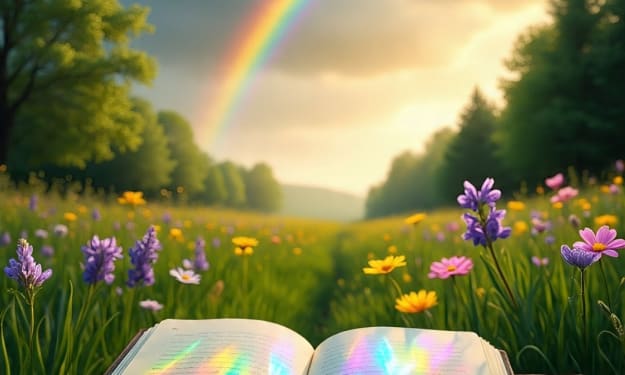
After a quiet rain, the sky opened like a freshly painted canvas. A delicate arch of colors stretched from one horizon to the other—seven glowing bands that seemed to hum softly with life. As droplets still clung to leaves, a young poet named Arham stood beneath the rainbow, notebook in hand, feeling as though the heavens themselves had spilled ink into the air. For Arham, poetry had always been a mystery. He loved words, yet they sometimes felt dull and gray—like clouds waiting for the right spark to release rain. He often wondered what gave poems their color, what made them breathe with emotion. That afternoon, as he gazed at the shining arc in the sky, the answer began to unfold. Each color of the rainbow, he realized, was a verse of its own—a poem written by nature. The deep red spoke of strength and love, bold and brave. The orange shimmered with creativity and warmth. Yellow danced like laughter and friendship. Green whispered of renewal and life. Blue carried peace and reflection. Indigo dreamed of mystery, and violet glowed with imagination and spirit. Arham took a deep breath and began to write. His words flowed like the rain that had just fallen. “Red, you are the heart of fire and dawn, Orange, the song of hope newly born, Yellow, the smile of a waking sun, Green, the promise when storms are done. Blue, the calm that follows pain, Indigo, the dreamer’s lane, Violet, the soul that feels the unseen— Together, you paint what words have been.” As his pencil moved, something inside him shifted. He realized that poetry wasn’t about difficult words or perfect rhymes—it was about feeling. Just as the rainbow didn’t ask to be admired, poems didn’t beg to be understood; they simply appeared, born from emotion, reflecting light through the prism of the heart. That day, Arham began to write differently. He no longer forced words onto paper. Instead, he listened—to the wind, to the birds, to the soft rhythm of his own thoughts. He wrote about moments: the hush after rain, the laughter of children splashing in puddles, the scent of wet earth, and the promise of sunlight breaking through clouds. Weeks passed, and his notebook filled with verses. When he read them aloud to his friends, their eyes glowed with the same wonder he had felt under the rainbow. “Your poems make us see feelings,” one friend said. “It’s like each line has a color.” Arham smiled. He had discovered that true poetry paints the soul. Every poem carries shades of joy and sorrow, light and shadow—just like a rainbow. And even when storms pass, what remains is the beauty they leave behind. Inspired, he began teaching younger children in his town how to write poetry. Instead of giving them rules, he gave them colors. “Write a red poem when you feel brave,” he said. “Write a blue poem when you need peace. Write a yellow one when you want to smile.” Soon, the little classroom walls were covered with colorful verses—words that glittered with feeling and imagination. One afternoon, as the sun dipped low, another rainbow appeared in the distance. The children ran to the windows, pointing and cheering. Arham watched them, smiling, and thought about how poetry—like the rainbow—connects heaven and earth, heart and mind. It appears when light meets rain, when joy meets struggle, when imagination meets truth. He picked up his pen once more and wrote: “In every color lies a song, In every heart, a place to belong. The rainbow fades, but leaves behind, A poem painted in the mind.” As the last rays of sunlight melted into the horizon, Arham closed his notebook. He knew then that poetry wasn’t just something to write—it was something to live. Every color of the world was a verse, and every day was a chance to read a new one. And so, the poet walked home beneath the glowing sky, carrying the colors of his heart—his own rainbow of poetry.
By Muhammad Saad 4 months ago in Poets
The Birth of Poetry
Long before words were written and stories were inked on paper, there was sound — the gentle hum of rivers, the rustle of trees, the heartbeat of the earth beneath bare feet. In that ancient world, before kingdoms and books, before pens and scrolls, human hearts still longed to express what they felt. And so, poetry was born — not from knowledge, but from emotion; not from invention, but from the natural rhythm of life itself. It is said that poetry came into being the first time a human felt something so deeply that mere gestures or cries could not contain it. Perhaps it was a mother humming softly to her child under the stars, her voice swaying like the wind, carrying love and comfort. Perhaps it was a hunter standing beneath the moon, whispering thanks to nature for its gifts. Or maybe it was a traveler, gazing at the endless sky, wondering where life came from and where it would go. In those days, speech was still new. People used sound to name things, to warn, to call. But one day, someone’s voice rose differently — not to command or describe, but to feel. The sounds became rhythm; rhythm became melody; and melody became meaning. Those who heard it were moved in ways they could not explain. They didn’t yet call it “poetry,” but they felt its power — the power to connect heart to heart, soul to soul. From then on, people began to listen not only with their ears, but with their hearts. Around campfires, under the open sky, words began to dance. Men and women spoke of love, courage, fear, loss, and hope — the same emotions that fill poems even today. When rain fell, they sang of its sadness; when the sun rose, they praised its warmth. They found music in the world around them and echoed it in their words. In ancient civilizations — Egypt, Mesopotamia, Greece, and India — poetry became a sacred art. It was used to praise gods, record victories, and teach wisdom. The earliest poems were prayers, songs, and hymns. In temples, priests chanted verses to honor life and creation. In royal courts, poets shaped words into tales of heroes and dreams. Their verses carried the spirit of humanity across generations. But beyond temples and palaces, poetry lived in every heart. Farmers sang as they worked. Lovers whispered verses to one another under the moonlight. Mothers lulled their babies with rhythm and rhyme. Poetry became the bridge between life’s silence and its music — between what could be said and what could only be felt. As time passed, writing gave poetry a new home. The words that were once spoken by firelight were carved on stone, then written on scrolls and pages. Yet even as the world changed, poetry remained timeless — a reflection of the human soul. It grew in every language, every land, carrying new meanings but the same heartbeat. The reason poetry endures is simple: it speaks to something eternal within us. It captures moments we cannot hold, emotions we cannot measure, and truths we cannot explain. It reminds us that even in our most silent times, we are never alone — because someone, somewhere, has felt the same. Today, poetry still flows through our lives. It lives in songs, in prayers, in stories, and even in the quiet words we whisper to ourselves when no one is listening. It connects the past with the present, the ancient voice by the riverside with the modern heart that still longs to speak in rhythm. And so, the birth of poetry was not the invention of an art form — it was the awakening of the human spirit. It was the moment when feeling found a voice, when the heart learned to speak in beauty. From the first hum beneath the stars to the verses written today, poetry remains what it has always been — the purest language of emotion, the gentle song of the soul, and the eternal proof that humanity has always needed more than words to truly be heard.
By Muhammad Saad 4 months ago in Poets
Love mean in 90's
Love means the madness of two people, pulling each other close to their hearts; Love means taking risks in life, walking barefoot in the sand of separation; Love means leaning very much towards each other; Love means heavy rain, walking in and out of the rain continuously; Love means talking incessantly in front of a cup of cold coffee; Love means sitting face to face even after the conversation is over.
By Afia Naima Haque4 months ago in Poets