
Recycled Memories
A poetic reflection on how we inherit emotions and traumas from our ancestors—memory as something passed down in the DNA

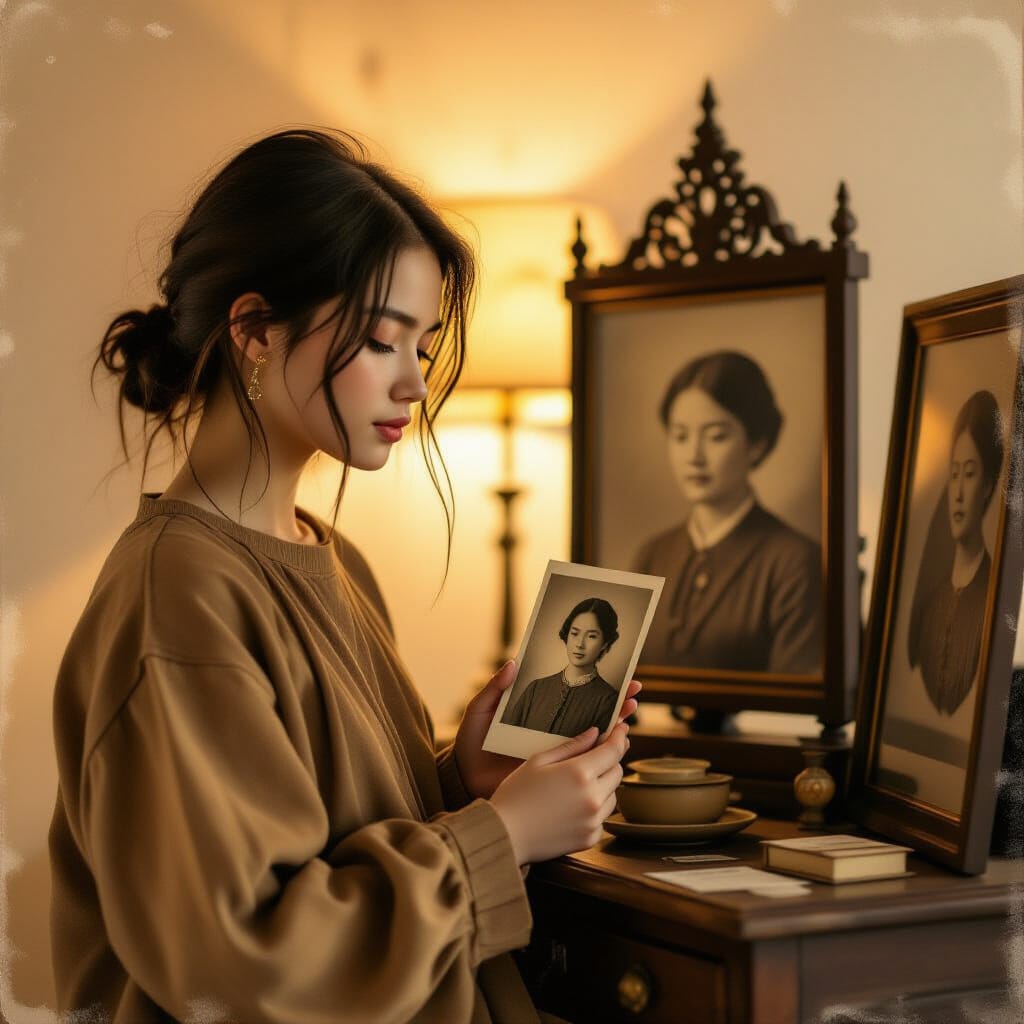
Recycled Memories
By [Huzaifa dzine]
I still remember the taste of her tears.
Not my tears—hers, though somehow they passed through me like water through porous stone. I was seven, standing in Grandma Marguerite’s kitchen, listening to her whispers as she stirred the pot of bean soup. The wooden spoon clacked against the sides, but I heard something deeper: a trembling in her voice, a memory she carried like an heirloom passed down through generations.
“When I was your age,” she said, “we hid under floorboards while bombs fell on our town.”
Her words didn’t mean much to me then—war was a story, a black-and-white photograph in a tattered album. But that night, at home, I dreamed of dark tunnels and distant explosions, and in the morning I woke with a knot in my chest that didn’t belong to me, yet wouldn’t leave.
Trauma is curious.
It travels through the blood. It skirts the edges of your consciousness in the form of sudden shivers or unexplained grief. It embeds itself in your bones and whispers that the world is fragile, insistently reminding you of the violence you never witnessed.
When I was twelve, I slammed my bedroom door during a thunderstorm and nearly passed out from panic. My mother found me huddled beneath the blankets, holding a photograph of a smiling stranger—a sepia-toned boy in a uniform.
“That’s your great-uncle René,” she said softly. “He never came home from the front.”
Her gentle words unlocked something inside me: a phantom pain in my chest, as if I, too, had lost a brother.
Memory isn’t confined to journals or photo albums.
It travels on the wind, lies dormant in your DNA, waits for the right combination of sight, smell, or sound to awaken. My father’s hands still shake when he cuts onions—Grandpa Marcel’s hands trembled after returning from the fields of Verdun. My younger sister can’t stand the scent of lilacs, though she’s never known the farm where our great-grandmother hid her children in the lilac bushes to shield them from patrols.
—
Inheritance
—
I tried to map this inheritance. I traced my family tree, pinning names and dates on colored ribbons. But the branches were tangled. Pain and courage grew from the same roots. My grandmother’s songs of lullabies were interwoven with dirges of loss. My mother’s laughter carried a hesitation, a half-beat pause before joy.
In college, I studied genetics. I read research on epigenetics—how trauma can leave chemical markers on our genes, altering the ways they express themselves. My professors spoke of the “soldier’s heart” and the “widow’s grief” handed down through cell division. Suddenly, my nightmares and my sister’s panic attacks had a diagnosis, a thread that connected us to faces frozen in time.
One winter morning, I visited the old family cemetery, where our ancestors lay beneath marble stones. The wind rattled the bare branches above me, scattering dead leaves. I knelt before Grandma Marguerite’s grave and gently pressed my palm against the cold stone.
“I feel you,” I whispered. “All of you.”
The air seemed to respond, a hush falling over the snow-blanketed ground. I closed my eyes and imagined the weight of their stories passing into me: the fear they endured, the fleeting moments of happiness, the ache of separation. I could almost hear their footsteps moving forward, generation by generation, until they stood inside me.
Healing is not erasure.
I learned that you cannot purge yourself of these recycled memories—they are part of the mosaic that makes you whole. Instead, you hold them gently, like heirlooms. You honor them by living fully, by writing your own stories in the margins.
So I wrote.
I filled journal after journal with reflections on how my grandmother’s trembling hands had become my own. I painted canvases streaked with gray and gold, where shadows morphed into hopeful light. I wrote poems that spoke of inherited sorrow and surprising resilience:
“Our DNA hums with lullabies and laments—
a double helix of tears and triumph.
We are the sum of every silence held
and every song raised in the dark.”
Today, I stand in my own kitchen, stirring a pot of lentil stew. The wooden spoon is mine now, but the echo of Grandma’s kitchen lingers in the gentle rhythm of my movements. When I taste my own tears—if tears should ever fall—it will be with the awareness that they are not just mine. They are the legacy of love and loss, fear and forgiveness that has traveled through me, through my mother, to my grandmother, and back again.
I smile, feeling the warmth of inheritance in my bones. The recycled memories are no longer burdens; they are gifts. They remind me that courage is not born in isolation, but in the collective heartbeat of countless souls who have walked this earth before us—who carried their shadows so that we might one day step into the light.
And as I lift a steaming bowl to my lips, I carry their stories forward, a living testament to the power of remembrance and the beauty of being both vessel and storyteller.
About the Creator
Huzaifa Dzine
Hello!
my name is Huzaifa
I am student
I am working on laptop designing, video editing and writing a story.
I am very hard working on create a story every one support me pleas request you.
Thank you for supporting.
Reader insights
Outstanding
Excellent work. Looking forward to reading more!
Top insight
Expert insights and opinions
Arguments were carefully researched and presented
Keep reading
More stories from Huzaifa Dzine and writers in Poets and other communities.
The Ghost in My Mirror
The Ghost in My Mirror By [Huzaifa dzine] Every morning, I see her. She stands just behind the foggy sheen of the mirror, where my reflection should be. Her eyes mimic mine, but they are older somehow—haunted. Her skin carries the same freckles I have, but they’ve turned pale like faded ink. Her shoulders slump with a weight I never agreed to carry. Still, she waits there every day, wordless but watching, as I splash water onto my face and pretend not to notice.
By Huzaifa Dzine6 months ago in Poets
Standing While Falling
Quotation from Friedrich Nietzsche "He who wrestles long with monsters should beware lest he himself become a monster. And if you gaze long into an abyss, the abyss also gazes into you. Man is not destroyed by suffering, but by the meaning he makes of it."
By LUCCIAN LAYTH6 days ago in Critique



Comments (2)
great
Very nice ♦️♦️♦️