

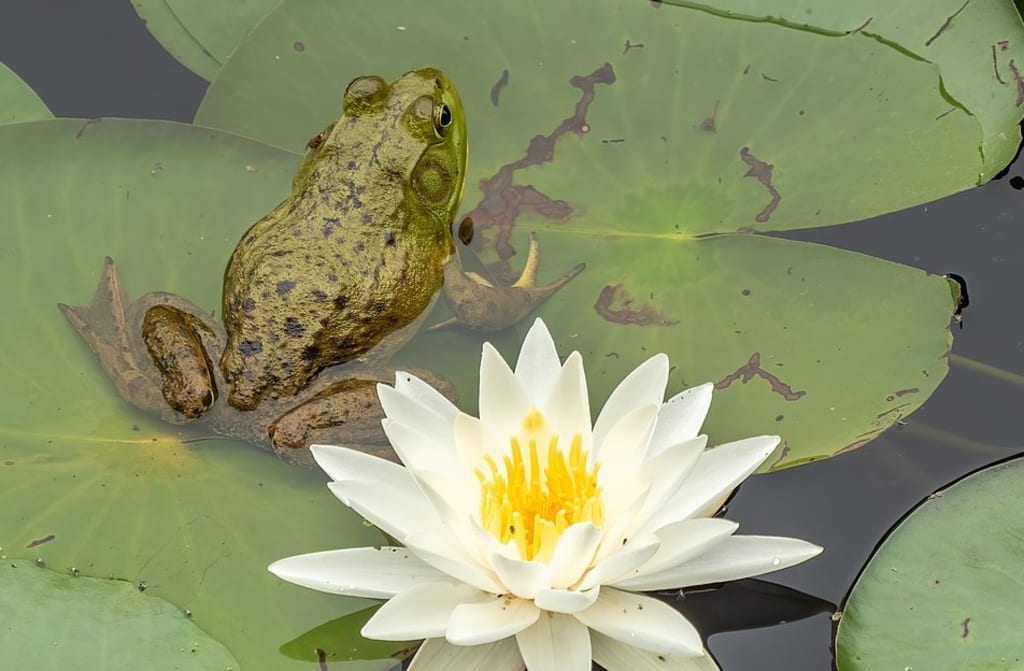
Consider
Old pond
Frog jumps in
Sound of water
This is a figurative translation of a poem by Matsuo Bashō, considered one of the Japanese masters of haiku. I have not attempted to rewrite it into the typical haiku 5-7-5 syllable format because it would sound clumsy and crude. In Japanese (written using English characters) it would sound something like:
Furu ike ya
kawazu tobikomu
mizu no oto
When I first came across haiku it must have been some 25 years ago. I bought an illustrated book of this form of verse as a gift for my father. He stayed in Japan in the 1950s and had an interest in all things Japanese for the rest of his life. Not sure what I made of the poems then, but now I find it quite an interesting form to represent and encourage contemplation.
I have just published a poem in this form: Cage within I don't say it is anything special. To be fair I only wrote my first haiku (for a Vocal challenge) a couple of years ago. You be the judge but I thought to write it to express a specific idea or concept. The same idea and concept was written in a previous article about sudoku, a Japanese form of puzzle. In my somewhat irregular mind the two things are inextricably linked and not just by cultural origin.
To understand what I mean by this you might like to read each of these two stories. Perhaps read the sudoku piece first.
Do you see what I mean about “Cage within a cage… Smaller cage…”? If not, look again at the featured image in the sudoku story. Look at the squares within a square within a square. This is the literal meaning I intended to convey when I wrote this verse. Yet it is not the only meaning and the meaning I was searching for was not limited to this interpretation.
When I wrote the sudoku piece I was struggling to explain how I often notice that finding ways to solve a sudoku puzzle can help me to resolve life’s problems. I found that, when writing the haiku, however, I was able to explain exactly what I meant in just 17 syllables. I wrote the haiku as a kind of riddle. The answer to the riddle is ”sudoku” but this is not the answer to the haiku.
What I am trying to get at is that haiku are open to interpretation. The whole point in writing them is to allow the writer to contemplate the meaning of something witnessed in life. Questions of life have no easy answers and so when we contemplate the meaning of a frog jumping into a pond we are free to conclude that it is just a frog jumping into a pond, the literal meaning, or we can delve further. We may or may not want to delve further into the meaning. Either way it is first the writer’s, and then the reader’s, prerogative to decide.
My method of solving sudoku, as explained in the article, goes beyond putting numbers into boxes (cages). It looks at the patterns created by the Arabic symbols used: 3x3, 3x3, each box enclosed in another box of nine boxes, itself enclosed in a bigger box. I referred to these boxes as cages for the purpose of the riddle. But using this term I also create other possible interpretations for myself as well as the reader.
So if, having read the haiku, you think that it is about the human spirit being caged, you are also right. This is also how I saw an alternative interpretation to the literal one. That is why I included the Bob Marley line “none but ourselves can free our minds” in my explanation.
Are there any other interpretations to add to these two? Certainly, I could think of others, and if any reader finds other meaning in the haiku (or in a game of sudoku) please let me know in comments.
The whole point of Old Pond is that it is open to interpretation. It was written as the result of a period of time spent in contemplation. Some might call this meditation or even prayer. The result is in any case the haiku. Once written, and once it has been read by any other person, the meaning of the haiku ceases to be the author’s property. It is released to the world, like a frog jumping into a pond, and is now there for the reader to contemplate.
Finding hidden meaning in haiku is like finding hidden meaning in our own lives and the universe around us. If you have never written a haiku before, give it a try.
Forget about the syllable count to start with. You can edit it later and play around with the words. Just take a good long look at something in nature and think about its meaning. Try to convey that meaning in as few words as possible. Think of other, more elegant ways to express your feelings for this thing you are writing about. Look for beauty in the unlovely. Only then do you need to consider rewriting into the 5-7-5 pattern, if at all.
When the wind blows over a meadow and then ceases, what has become of it? If a frog is eaten by a heron, does it cease to exist? Is our memory of it leaping into the pond altered by subsequent events? Has some of the meaning we attach to the frog, such as the sound of it entering the water, survived the death of the frog?
You might think all of this contemplation is pointless, which is fine, perhaps it is. Sometimes, however, the only way to solve a knotty problem is to look at it from a different angle. As writers, we need to understand that there is infinite variety in the ways that something may be described in words. Sometimes we may want to describe a thing clearly, concisely and unambiguously. Sometimes, however, the ambiguous meaning can be more meaningful.
I still hear the sound of that long-dead frog plopping into its pool. I can still appreciate the contemplation given to this event by the long dead poet.
Can you?
About the Creator
Raymond G. Taylor
Author living in Kent, England. Writer of short stories and poems in a wide range of genres, forms and styles. A non-fiction writer for 40+ years. Subjects include art, history, science, business, law, and the human condition.
Keep reading
More stories from Raymond G. Taylor and writers in Poets and other communities.
Cage within
Cage within a cage Smaller cage imprison thus Ending bring release O ~ 0 ~ o Some readers may quickly guess the meaning of this haikuesque conundrum. If you do, please feel free to let me know that you have, in comments, but without giving the game away. If you can't guess, please put it down to my obscure frame of reference.
By Raymond G. Taylorabout a year ago in Poets
A body
a body washes On sparkling sand; a cold hand Reaches for nothing.
By Melissa Ingoldsbyabout 8 hours ago in Poets



Comments (5)
beautiful haiku and beautiful explanation, I read your article about sudoku, but I didn't know about this very interesting connection!
Ohhhh, the answer to the riddle is sudoku!! Hahahahahaha that's brilliant! Also, I didn't think much about the Haiku. To me, the frog jumped into the pond. That's about it 😅😅
Great image and sound your poem create in my mind
Good article. I love pretty much anything Japanese. I also find haiku to be little puzzles. There is kind of a fun international competition coming up in Washington DC called Golden Triangle Haiku. You can enter two for free based on their theme. They publish the winners during their cherry blossom festival in late March. It's good to look through their literature as they encourage non traditional entries. They also publish a fun map showing the countries/states where entries came from. https://goldentriangledc.com/event/golden-haiku/
You gave us a lot to think about here. Great work.