
Japanese Girl in Red Shoes
A Story of Love, Loss, and Legacy

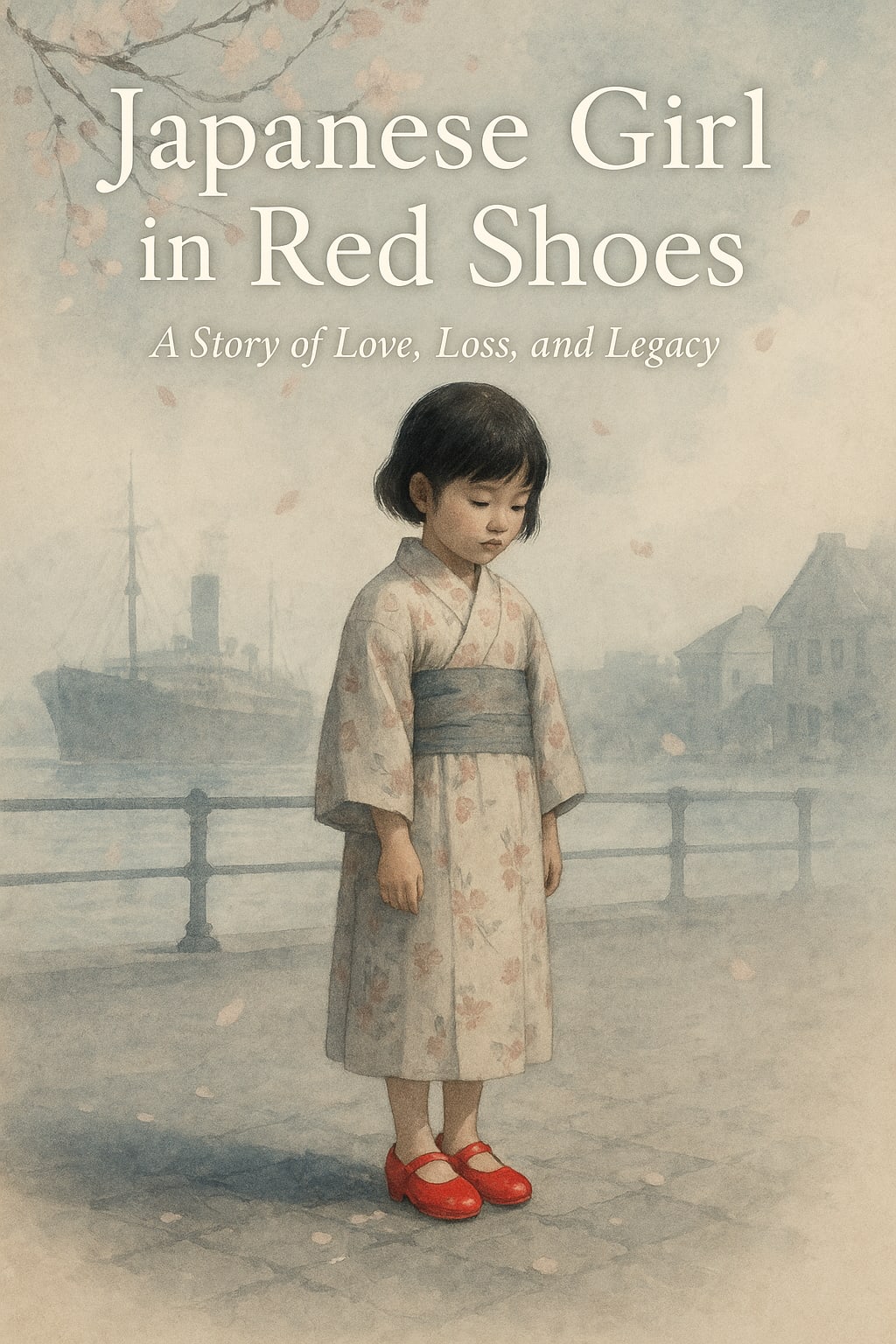
In a quiet corner of Yamate Hill in Yokohama, Japan, stands a bronze statue of a little girl. Her head tilts slightly, her eyes fixed on the horizon, as if still waiting for someone to return. On her feet are a pair of red shoes — bright, polished, and almost glowing under the sun. She is known simply as the Japanese Girl in Red Shoes.
The statue commemorates a girl named Kimi Iwasaki, whose short life touched hearts across generations. Her story, real and raw, inspired one of Japan’s most hauntingly beautiful children’s songs, “Akai Kutsu” (Red Shoes), written in 1922 by poet Ujō Noguchi and composed by Nagayo Motoori. But behind the poetic lyrics lies a human story — of a child caught between cultures, of a mother’s painful sacrifice, and of a nation grappling with its past.
Kimi was born in 1902 in Shizuoka Prefecture to a single mother, Kayo Iwasaki. Struggling to survive in an era of social stigma and poverty, Kayo made the difficult decision to entrust Kimi to an American missionary couple, the Hewitts, who promised to raise her with love and care. The couple planned to take Kimi with them to America, where they believed she would have a better life.
But fate had different plans
Shortly before their departure, Kimi fell seriously ill with tuberculosis, a disease that was often fatal in those days. Not wanting to take a sick child across the ocean, the couple left Kimi in the care of a Christian orphanage in Tokyo, run by missionaries. There, she remained until her untimely death at the age of nine. Her mother never saw her again.
Kayo Iwasaki believed for the rest of her life that her daughter had gone to America, and she passed away never knowing the truth — that her little girl had died on Japanese soil, alone and unrecognized.
Years later, Ujō Noguchi, who had been close to Kayo, penned the lyrics to “Akai Kutsu,” capturing the sorrow of separation and the innocent longing of a child torn from home. The song tells of a girl in red shoes who was taken away by a foreigner, sailing across the ocean, never to return. It’s a lullaby of lost hopes, whispered through generations.
The red shoes became a symbol — not just of Kimi’s story, but of all the children and families separated by war, migration, poverty, or politics. They represented innocence, vulnerability, and the silent pain of goodbyes.
Over the decades, the song grew into a cultural treasure in Japan, taught to children in schools, sung softly by mothers to lull their babies to sleep. Few knew the true story behind the lyrics. But for those who did, the song carried more than melody — it carried memory.
In 1989, the city of Yokohama erected the statue of the girl in red shoes, facing the harbor where ships once departed for foreign shores. Another statue was placed in Azabu, Tokyo, near the orphanage where Kimi died. These quiet memorials invite passersby to pause, reflect, and remember.
Tourists often stop to take pictures of the girl in red shoes. Children place flowers or small toys at her feet. Some tie little red ribbons to her wrists. Many don’t know her name, but they feel the weight of her story.
Today, over a century later, Kimi Iwasaki lives on — not in photos or family albums, but in a song, in a statue, and in the hearts of those who hear the melody of “Akai Kutsu.” She reminds us that behind every face is a story. Behind every story, a truth. And behind every truth, a life that matters.
In her silence, the Japanese girl in red shoes speaks louder than words.
About the Creator
Syed Umar
"Author | Creative Writer
I craft heartfelt stories and thought-provoking articles from emotional romance and real-life reflections to fiction that lingers in the soul. Writing isn’t just my passion it’s how I connect, heal, and inspire.
Miss Persephone's Manual to a Seemingly Ordinary Life
Miss Persephone was found at the dining table, her blue eyes swollen, her tears arriving and retreating like the tides of the ocean. Earlier that day, her family had visited her in the retirement home where she had lived for eight years. It was her eightieth birthday.
By Imola Tóth3 days ago in Fiction




Comments
There are no comments for this story
Be the first to respond and start the conversation.