
Why Pet Collars Matter More Than We Think
For Both Cats and Dogs

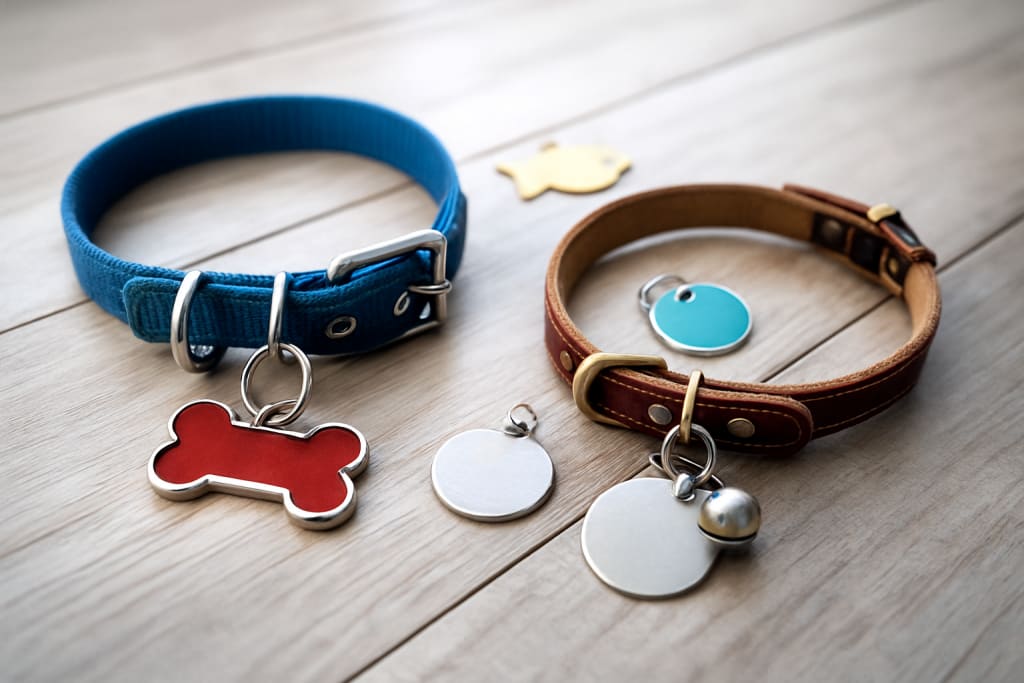
Domestic animals read the world through continuity. A collar or ID tag may look trivial to a human, but to a dog or a cat it can operate as an identity object. I have seen this pattern across enough households, shelters, and animal-welfare cases to know it is not coincidence. When an animal becomes distressed after its collar is removed, the reaction is almost always tied to safety, belonging, and recognition.
Dogs track identity through relational anchors. The collar carries scent from the human household, from the yard, from the daily routine. It carries the dog’s own scent as well. That blend becomes a stable reference point. When the collar disappears, their nervous system notices the gap. Many dogs will stand still, look toward their handler, or check for the presence of the tags. Some will search the floor or stay close until the collar returns to its place. A pattern like this signals more than habit. It signals fear of displacement.
There is a practical reason for that reaction. In the real world, a missing collar can mean risk. No identification. No visible claim. A dog’s instincts are not wrong. Safety and belonging have always hinged on markers that tell others who is connected to whom. Modern collars are a continuation of that principle, and dogs adjust to these signals with the same seriousness their ancestors used for pack alignment.
Cats respond differently because their emotional language rests on territory instead of relationship. They build maps from scent. A collar becomes a mobile piece of that map. It holds the cat’s scent, the home’s scent, and the physical pressure they have learned to expect around the neck. When the collar is removed, their map loses a reference point. The cat may hide, pace, vocalize, or groom the collar area as if searching for orientation. This is not dramatics. It is a nervous system recalibrating after the sudden disappearance of a known marker.
Some cats and dogs check their tags after grooming or play. They may touch them briefly with the nose, glance at the metal, or pause until they feel or hear them. Those behaviors are micro-assessments. Animals investigate cues the same way humans check a key ring or wallet before leaving the house.
Verification is a survival behavior.
Animals with trauma histories tend to show stronger responses.
- A dog that has been rehomed once may react immediately when the collar comes off.
- A cat that lived outdoors before entering a household may treat collar removal as a signal that stability is uncertain.
Attachment objects matter more to creatures that lost stability before they ever had a chance to trust it. I have seen this pattern clearly in rescue environments. Animals track continuity with remarkable accuracy.
Collars, tags, and similar objects also carry sensory data that provide reassurance.
- The metal sound of a tag can be a predictable part of an animal’s sensory field. Remove it and the quiet feels wrong.
- Scent is another factor. The ID tag collects smell from hands, fur, rooms, and outdoor spaces.
When a cat or dog smells its tags after removal, it is checking the status of its world. Those checks are grounded in biology, not emotion alone.
From a behavioral-science standpoint, the collar operates as a portable identity marker.
- It signals belonging to a home.
- It signals safety.
- It signals predictability.
When it disappears, the animal is not responding to the object itself. It is responding to the sudden void where recognition used to live.
People sometimes describe this as “clingy” behavior or treat it as personality. It is not personality. It is the nervous system interpreting a change in identity markers. Humans do the same thing with badges, uniforms, wallets, key cards, or any object tied to recognition and safety. Animals simply express their concern with fewer filters.
This is why some dogs refuse to settle until the collar is returned. It is why some cats stare at their tags with the same seriousness they use when scanning the yard for intruders.
- Both are reading for continuity.
- Both are confirming that nothing essential has changed.
Belonging is not abstract for animals. It is sensory. When the thing that carries their scent, their tags, and their symbolic tie to their human disappears, the reaction is a form of protective logic. That logic has kept their species alive for thousands of years. It should not be dismissed today.
In closing, the collar should matter to us as responsible pet owners because our pet believes it does.
Sources That Don't Suck
American College of Veterinary Behaviorists. (2020). Decoding your dog. Houghton Mifflin Harcourt.
Bateson, P., & Bradshaw, J. (2021). Animal welfare: An evidence-based approach. Oxford University Press.
Horowitz, A. (2017). Being a dog: Following the dog into a world of smell. Scribner.
Overall, K. L. (2013). Manual of clinical behavioral medicine for dogs and cats. Elsevier.
Turner, D. C., & Bateson, P. (2014). The domestic cat: The biology of its behaviour. Cambridge University Press.
About the Creator
Dr. Mozelle Martin
✍️ 38-Year Forensic Analyst | ⚖️ Constitutional Law Studies | 🧠 Writer | 🔍 Cold Case Consultant | 🕶️ PET VR Creator | 🔭 Licensed Investigator | ✈️ USAF
Keep reading
More stories from Dr. Mozelle Martin and writers in Petlife and other communities.
For No Reason
I wrote this as a teenager and forgot it existed until I found it again in old files. I’m putting it here because the core point is still true, and still denied. It’s told in the voice of a dog, but it’s not a breed or pet-specific statement. It’s a sequence statement. Same logic applies to any animal living under chronic neglect or abuse.
By Dr. Mozelle Martinabout a month ago in Petlife
The Summer I Was Chosen by a Northern Mockingbird
During the long, suspended days of the pandemic, a wild mockingbird began visiting my driveway and chose me, again and again. What started as a strange encounter became a brief, meaningful connection that I still carry with me.
By Erica Roberts 6 days ago in Petlife



Comments