
When the night falls silent, my dog starts barking.
Is he scared, lonely, or just a dog?

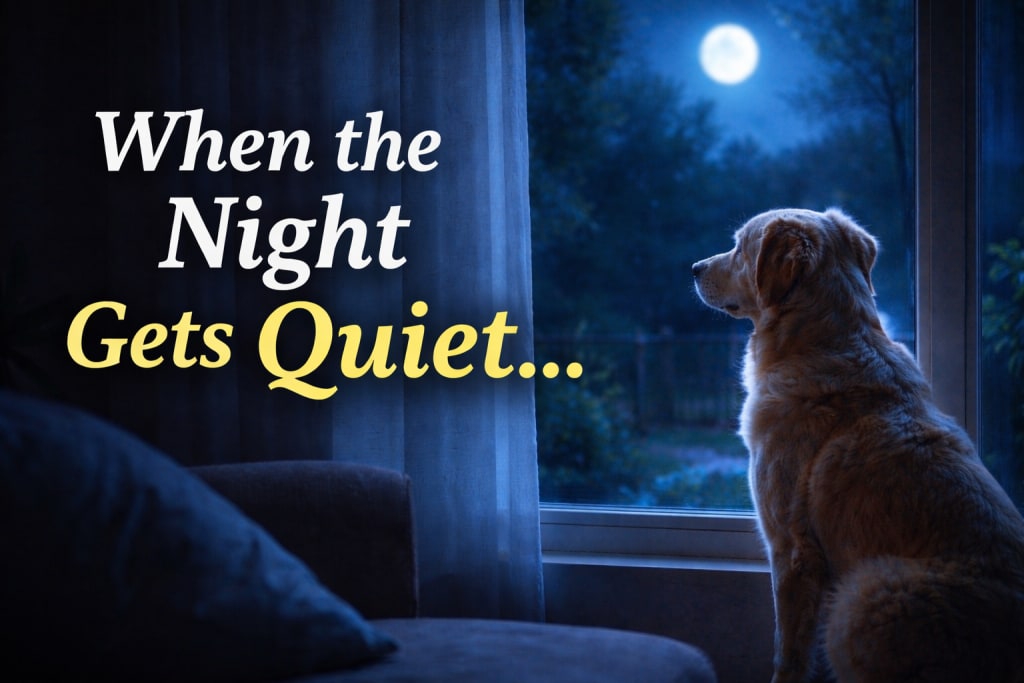
When night finally settles in, I expect silence.
The lights are off, the phone is charging, and the world feels like it’s holding its breath. This is the moment when everything is supposed to slow down. But just when the silence feels complete, it does.
A bark.
Sharply sudden. A question that echoes through the house as if no one had asked it out loud.
At first it startled me. Then it bothered me. And finally, it made me wonder: Why now? Why does my dog wait until the world is quiet to find his voice?
If you live with a dog, you probably know this moment. The day passes peacefully, but the nighttime tells a different story. And the more I paid attention, the more I realized that barking after dark isn’t random. It’s communication.
Night changes everything.
During the day, dogs are surrounded by movement, noise, and routine. There’s activity, interaction, and constant reassurance that they’re not alone.
At night, all of that disappears.
For humans, night means rest. For dogs, it can mean uncertainty. Their senses don’t shut off when the lights go out—they sharpen up. Sounds travel farther. Smells linger longer. Shadows are stretched into unfamiliar shapes.
What feels calm to us can make them feel suspicious.
When my dog barks at night, it’s rarely aggressive. It’s alert. Curious, sometimes anxious. Almost like he’s saying, “Something’s different. Are you paying attention to this too?”
Is it fear?
Sometimes, yes.
Darkness can increase anxiety, especially in dogs that are young, rescued, or have experienced instability. Night removes visual cues, and without them, imagination fills in the void.
A distant sound becomes a threat. A moving shadow becomes an intruder.
Fear-based barking often sounds different. It’s paired with pacing, whining, or an inability to resolve. The dog isn’t trying to dominate the night—he’s trying to avoid it.
And fear doesn’t make the dog weak. It makes him honest.
Is it loneliness?
Even when we’re in the same house, nighttime can make dogs feel isolated.
Humans retreat to the bedroom. Sounds fade. Touch disappears. For creatures wired for pack life, that sudden separation can feel unnatural.
Some dogs bark not because they see danger, but because they sense distance.
They want reassurance. A sign that they are not left behind. A reminder that the bond still exists even when the house is quiet.
Loneliness doesn't always feel sad. Sometimes, it feels loud.
Is it just a habit?
Sometimes, barking at night becomes a learned behavior.
A bark leads to attention. Attention leads to interaction. And suddenly, the dog knows that barking at night works.
Dogs are incredible pattern readers. If barking results in a door opening, a response to a voice, or a light turning on, the behavior reinforces itself.
This doesn’t mean the dog is manipulative. It means the dog is smart.
Is it protection?
There’s something deeply instinctive going on here, too.
Dogs have protected humans for thousands of years. At night — when visibility is low and vulnerability is high — that instinct kicks in.
Your dog may genuinely believe that it’s his job to stay alert while you sleep.
That bark may not be fear at all. It could be responsibility.
“I see. I get it.”
When barking is a message, there’s no problem.
We tend to label barking at night as bad behavior. Something needs to be fixed. Something needs to stop.
But barking isn’t the problem. It’s a symptom.
The real question isn’t “How do I get my dog to stop?”
It’s “What is my dog trying to say?”
Sometimes the answer is simple: more exercise, more mental stimulation, more routine.
Other times, it’s deeper: anxiety, discomfort, aging, or even pain. Older dogs may bark at night because they’re confused, anxious, or struggling with changes they don’t understand.
In those moments, barking becomes a plea for help.
Listening instead of reacting
The night my perspective changed was the night I stopped rushing to quiet him and started watching instead.
I noticed his posture. His ears. The direction of his gaze. The tone of his bark.
He wasn’t bad.
He was alert. He was getting emotional. He was just what he is — a dog trying to navigate a world that feels very different after dark.
Once I adjusted his routine, gave him more reassurance, and created a calmer environment at night, the barking softened. Not immediately. But slowly.
Understanding replaced frustration.
The sound of survival
There’s something debilitating about barking at night. It strips away distractions and leaves only instinct, emotion, and connection.
Dogs speak loudest during the quietest hours.
Not because they want to disturb us — but because that’s when they feel the most.
So when the night falls silent and my dog starts barking, I don't see it as noise.
I hear awareness. I hear concern. I hear companionship.
And sometimes, I hear.
About the Creator
Paw Planet
Start writing...🐾 Paw Planet is where puppy love meets storytelling—sharing heartwarming tales, training tips, and adventures of wagging tails. A home for dog lovers who believe every paw print tells a story. 🐶✨
Keep reading
More stories from Paw Planet and writers in Petlife and other communities.
Explaining Nighttime Barking in Dogs
Barking at Night Can Be Confusing. Your dog may be calm, friendly with everyone, and seemingly well-adjusted all day. Then night falls, the house falls silent, and suddenly the barking starts. Every night. Sometimes briefly. Sometimes endlessly.
By Paw Planet about 5 hours ago in Petlife
The Summer I Was Chosen by a Northern Mockingbird
During the long, suspended days of the pandemic, a wild mockingbird began visiting my driveway and chose me, again and again. What started as a strange encounter became a brief, meaningful connection that I still carry with me.
By Erica Roberts 13 days ago in Petlife
The Rift Behind the Palace Smile
Behind the polished smiles, glittering gowns, and carefully choreographed royal appearances, a quieter and more complicated story was unfolding. To the world, Kate Middleton and Meghan Markle represented modern royalty: intelligent, elegant, and destined to reshape the future of the British monarchy together. But behind palace walls, the reality was far less harmonious. It began not with shouting matches or public scandals, but with small moments—glances, silences, and subtle discomforts that slowly grew into something impossible to ignore. One of the earliest cracks appeared during the Royal Foundation Forum in 2018. The event was meant to showcase unity between Prince William, Kate, Prince Harry, and Meghan. Cameras captured smiles and friendly conversation. But backstage, tension filled the air. As Meghan prepared for the stage, she casually asked Kate if she could borrow her lip gloss. It was an ordinary request, the kind women make without thinking. Yet Kate hesitated. According to Prince Harry’s later account, Kate looked uncomfortable—almost startled—before reluctantly handing it over. It was a tiny moment, but it spoke volumes. To Meghan, the hesitation felt cold. To Kate, the request felt intrusive. Two women, standing only feet apart, were already operating by completely different emotional rules. Kate had spent nearly a decade learning how to survive inside the royal system. She understood restraint. She believed in caution. Every gesture, every word, every expression was carefully controlled. Meghan came from a world where openness was power. Hollywood had taught her to speak freely, to connect emotionally, and to command attention. She was confident, expressive, and unafraid of being seen. Neither approach was wrong. But together, they collided. At the forum, the contrast became obvious. Meghan spoke passionately, effortlessly engaging the audience. She appeared polished, confident, and natural on stage. Kate, pregnant and exhausted, spoke more quietly and cautiously, following the traditional royal style. Headlines soon praised Meghan’s performance. Some even suggested she had “stolen the show.” For Kate, who had spent years patiently earning her place, it felt unsettling. Behind the scenes, another comment worsened the situation. Meghan reportedly joked about Kate having “baby brain” during her pregnancy. Meghan may have intended it lightly, but Kate was suffering from severe pregnancy sickness and was physically struggling every day. The remark cut deep. Soon, the four royals sat down for a tense private meeting. Emotions were high. No one yelled. No one exploded. But nothing was truly resolved either. They left knowing one truth: coexistence was necessary, but closeness might never be possible. Then came the wedding. In the days before Meghan and Harry’s ceremony, a disagreement broke out over Princess Charlotte’s bridesmaid dress. Rumors spread quickly that Meghan had made Kate cry. Meghan was labeled difficult, demanding, and cruel. Years later, Harry revealed the opposite: Meghan had been the one in tears. According to Harry, Kate insisted the dress needed to be remade entirely. Meghan, overwhelmed by wedding stress and family chaos, felt pushed too far. The argument ended with Meghan crying alone. Kate later arrived with flowers and apologized. The truth, as always, likely exists somewhere in the middle. But the damage was done. When Meghan publicly addressed the issue during her interview with Oprah Winfrey, she stated clearly: “The reverse happened.” With those three words, a silent war became public. Kate remained quiet, bound by royal tradition. Meghan spoke openly, determined to reclaim her narrative. William stood firmly by his wife. Harry stood firmly by his. Two brothers who once shared everything now stood on opposite sides of a widening divide. What makes this story tragic is not who was right or wrong. It is what was lost. Two women who could have been allies became symbols of rivalry. Two brothers who once walked side by side became strangers. A family built on tradition proved unable to adapt to change without breaking. The lip gloss, the dress, the comments—none of them truly mattered. What mattered was the clash of two worlds: Silence versus expression. Tradition versus transformation. Endurance versus reinvention. And once those forces collided, there was no turning back. The palace remained standing. But the fairy tale did not.
By Behind the Curtainabout 8 hours ago in Petlife


Comments
There are no comments for this story
Be the first to respond and start the conversation.