
What You Need to Know About Your Dog's Vaccines
A Quick Guide to What's In Your Dog's Vaccines

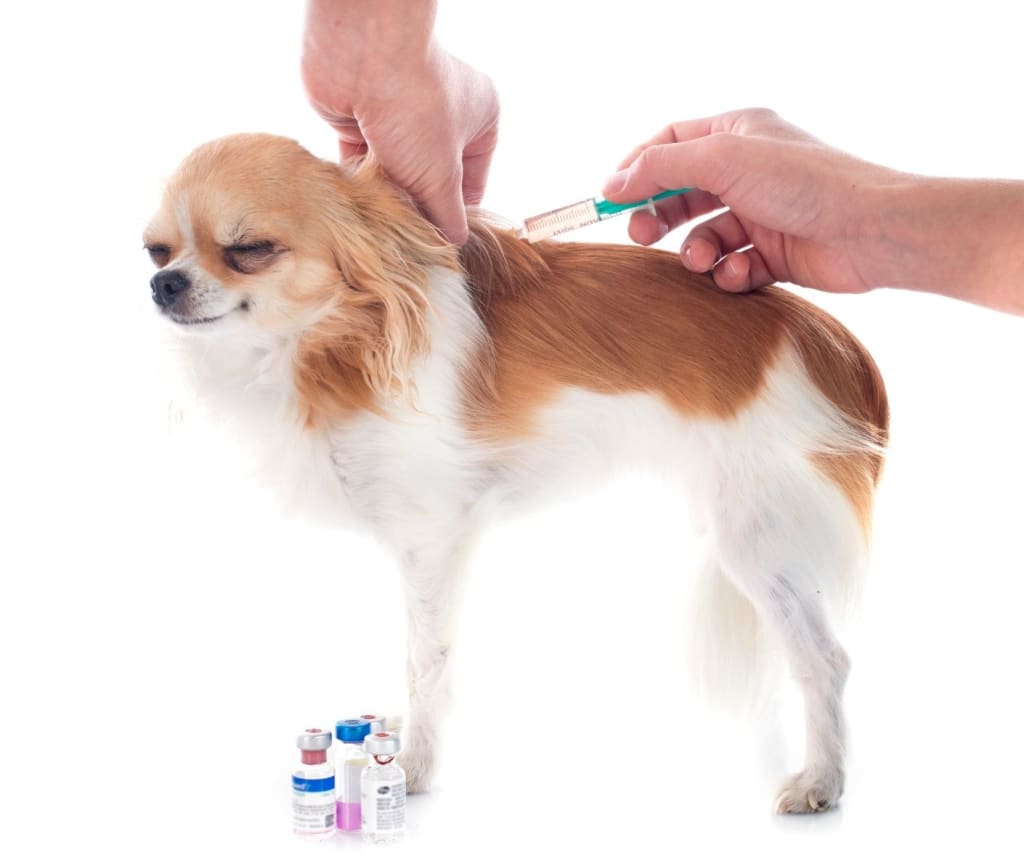
When you go to the veterinarian for vaccines, you may be asked about several vaccines. This can become confusing, and you may not be sure exactly what your dog needs. You don't want to over-vaccinate your dog, but you also need to make sure that he or she gets the vaccines that are necessary.
Here are some vaccines that your veterinarian may recommend for your dog.
Your dog needs to have a Rabies vaccine. This disease, which is caused by the rabies virus, affects the brain and central nervous system. It is transmitted by direct contact with saliva from an infected animal. This is usually through a bite.
The rabies vaccine is so important because it can affect humans also. It is also deadly! Many states require all dogs (and cats) to have a rabies vaccine to keep everyone healthy!
The distemper vaccine is a single vaccine that covers a variety of diseases, including distemper, hepatitis, parvovirus, and parainfluenza.
- Distemper is a highly contagious respiratory disease. It is spread through saliva, urine, and feces. It is often fatal.
- Hepatitis is an infectious disease that can lead to severe liver damage. If left untreated, it can cause death. It is quite serious in puppies and older dogs and is spread through contact with infected urine.
- Parvovirus is a highly contagious viral infection of the intestinal tract. It is spread through contact with the feces of another infected dog. It strikes quickly and can be deadly for puppies. This disease was rare, until recently when people stopped vaccinating their dogs as much as they used to.
- Parainfluenza is a viral respiratory infection that may cause Kennel Cough. It is usually transmitted by contact with the nasal secretions of an infected dog. Puppies and older dogs are at a greater risk for parainfluenza.
- Your dog's distemper vaccine may also have Leptospirosis in it. This is a bacterial disease that can cause kidney and liver problems. If left untreated, it can cause kidney failure. It is spread through infected urine. If a wild animal has leptospirosis, it can urinate near streams and standing water. If your dog drinks dirty water, he or she may be at risk for the disease. Leptospirosis can also be spread to humans, which makes it even more important.
Your veterinarian may also recommend other vaccines, depending on your dog's lifestyle (as well as what you want to do).
The Bordetella vaccine is also known as the Kennel Cough vaccine. It is used to prevent the bacterial infection that causes kennel cough. If your dog has kennel cough, it may be alone, or it could be a combination of respiratory diseases.
If your dog is around other dogs, he or she should probably get the bordetella vaccine. This may include going to the kennel or the groomer. You may also want to protect your dog if you take him or her to the dog park or allow your dog to spend time with a lot of other dogs.
The Lyme vaccine is helpful to protect your dog against this complex bacterial disease. It can cause pain in the joints and lameness. Lyme disease is spread through the bites of infected deer ticks.
When you are trying to decide what vaccinations your dog needs, you should be able to talk to your veterinarian and technicians. He or she will be able to figure out the risks your dog has, in order to come up with a good plan for his or her vaccines.
Whether you want to vaccinate your dog or not, he or she needs to have a rabies vaccine. The distemper shot is also important to keep your dog as healthy as possible. If he or she is around other dogs, you may want to get the bordetella vaccine. If you live in an area with a lot of ticks, you should protect your dog against Lyme disease.
About the Creator
Shelley Wenger
Small town country girl in southern Pennsylvania. Raising two boys on a small farm filled with horses, goats, chickens, rabbits, ducks, dogs, and a cat. Certified veterinary technician and writer at Virtually Shelley.
Keep reading
More stories from Shelley Wenger and writers in Petlife and other communities.
Some More Things Vet Techs (And Vets) Are Tired of Hearing
The response from my articles, Things Vet Techs (And Vets) Are Tired of Hearing and all of the rest, have been overwhelming. The job is continuing to be overwhelming and the amount of things that clients complain about are becoming unbearable.
By Shelley Wenger4 years ago in Petlife
A Dart at Dusk
Seconds ago, the sullen sun set on the two of us… my exuberant furry companion and me. A fresh breeze embraces us, delivering welcome relief from the day’s oppressive heat. His typical stumbling and staggering along — apace with a sloth — has turned into trip-trapping, high-stepping, almost skipping along.
By Angie the Archivist 📚🪶4 days ago in Petlife
The Chair That Never Came
The ballroom shimmered beneath a thousand lights, every breath in the room carrying a quiet note of expectation. It was the annual Global Philanthropy Summit — the kind of gathering where names were whispered, not introduced, and where power did not need to announce itself. Guests filled the hall in practiced elegance: CEOs, founders, donors whose signatures could build hospitals or topple companies. Their names were printed on cards in the front rows — curated, counted, and arranged weeks ahead of time. And then, she arrived. Megan, the Duchess of Sussex, stepped into the room with her aide at her side — unlisted, unexpected, yet walking with the confidence of someone long accustomed to the world bending for her. A ripple went through the staff. She wasn’t on the schedule. Her name wasn’t on the seating chart. Yet here she was — bright, smiling, certain that a seat had been prepared simply because she had entered. Her assistant gestured toward the front row — an empty chair, momentarily vacated by a tech billionaire who had stepped away. They approached. A tap on her shoulder stopped her. “I’m sorry, ma’am,” an event coordinator said, voice low but firm. “This row is reserved. We have a place for you on the side.” It was polite. It was professional. But it was also final. Witnesses described a frozen moment — the duchess pausing, her fixed smile barely shifting. She waited. Surely someone would come. Someone always did. Someone to pull forward a chair, clear a space, make room for The Duchess. But the room moved without her. Guests settled. Conversations resumed. Cameras flashed for other faces. No eyes searched for her. No staff scrambled. For a long, awkward stretch of minutes, she stood — a royal silhouette in a space where titles were currency no one traded in. Only after the keynote began did someone quietly guide her to a chair far off to the side — not ignored, but unmistakably ordinary. It was a message sharper than any royal protocol. Here, pedigree meant nothing. Here, you had to earn your place. As she sat, her posture perfect, she seemed smaller somehow — not in height, but in certainty. She had left behind a palace she felt confined her. Now she was discovering that the world outside was not a red carpet rolled out on demand, but a maze of circles that chose who belonged. No one glared. No one mocked. Worse — no one cared. And as the lights dimmed and the speaker continued, the duchess realized that a story she controlled for years — of escape, of reinvention, of ranking above the room — had slipped unexpectedly from her hands. Because in this world, there were no thrones to claim. Only seats to earn. And on this night, hers had not yet been built. Yet the echoes of that evening stretched far beyond the ballroom. In the days that followed, the incident circulated quietly through private WhatsApp groups, PR offices, and agency boardrooms long before it drifted onto newsfeeds. It became not merely a moment, but a cautionary parable whispered among people who move unseen behind red carpets and televised galas. The philanthropic summit, for all its glamour, was in essence a workplace — one built on long hours, unglamorous logistics, and delicate balances of influence. Those who earned their seats — hedge fund architects, founders who spent decades scaling companies from kitchen tables, activists who slept more nights in tents than in five-star hotels — had arrived with portfolios of proof. Their chairs symbolized legacy, labor, and investment. That was the silent contradiction that defined the tension of the evening: a clash between earned capital and perceived entitlement. Long after the lights dimmed, several attendees recalled the most striking image of the night was not Meghan’s presence, but the posture she held. Standing still while those around her settled into ease created a tableau impossible to ignore. The body language told its own story — a woman accustomed to doors opening, suddenly meeting a door that did not move. But the narrative is not static. Those closest to Hollywood know perception shifts as quickly as ticket sales or social algorithms. For every room closing, another may open. A new initiative, a breakout documentary, a bold charity partnership — any could rewrite the arc. Indeed, some observers saw the moment less as punishment and more as a turning point. A “reset” disguised as discomfort. Within crisis, opportunity hides — and public figures have reinvented themselves from weaker positions. The industry rewards resilience almost as much as originality. Whether Meghan interprets the evening as humiliation or instruction remains unseen. What will matter most is the response — not in speeches or statements, but in action. Consistency. Delivery. Showing up in rooms after the spotlight fades, not only before it rises. The silent lesson of the missing chair was not only you cannot assume your place — it was you can build one. Chairs — literal or symbolic — are manufactured, funded, and earned. They are pulled up by those willing not just to sit, but to contribute. The question now hanging over future rooms is simple and powerful: Will Meghan build her chair — or wait for another one to be offered?
By Behind the Curtain5 days ago in Petlife




Comments
There are no comments for this story
Be the first to respond and start the conversation.