
What do the extinct Ogasawara variegated wood pigeon and the endangered red-headed black wood pigeon eat?
In the spring of 1828, the Russian exploration ship "Senavinin" arrived at the Ogasawara Islands in southern Japan,,,,,


In the spring of 1828, the Russian exploration ship "Senavinin" arrived at the Ogasawara Islands in southern Japan. The archipelago was far from mainland Asia and the four major Japanese islands and was uninhabited at the time. For thousands of years, the creatures here have lived and reproduced according to a unique evolutionary path. The entire archipelago is like a museum of biological evolution.
Kittlitz, a German naturalist who came aboard the "Senavignon", launched a scientific investigation into "Chijima" and its surrounding areas in the Ogasawara Islands. He not only collected various biological specimens but also left many natural notes and hand-drawn drawings. Based on these data, in 1832 Kittlitz gave a scientific name to a local endemic pigeon. He named this pigeon, which is much larger than the domestic pigeon and has ga reen-purple metallic luster, " Columba Versicolor ", which is usually called "Ogasawara variegated wood pigeon" in Chinese.
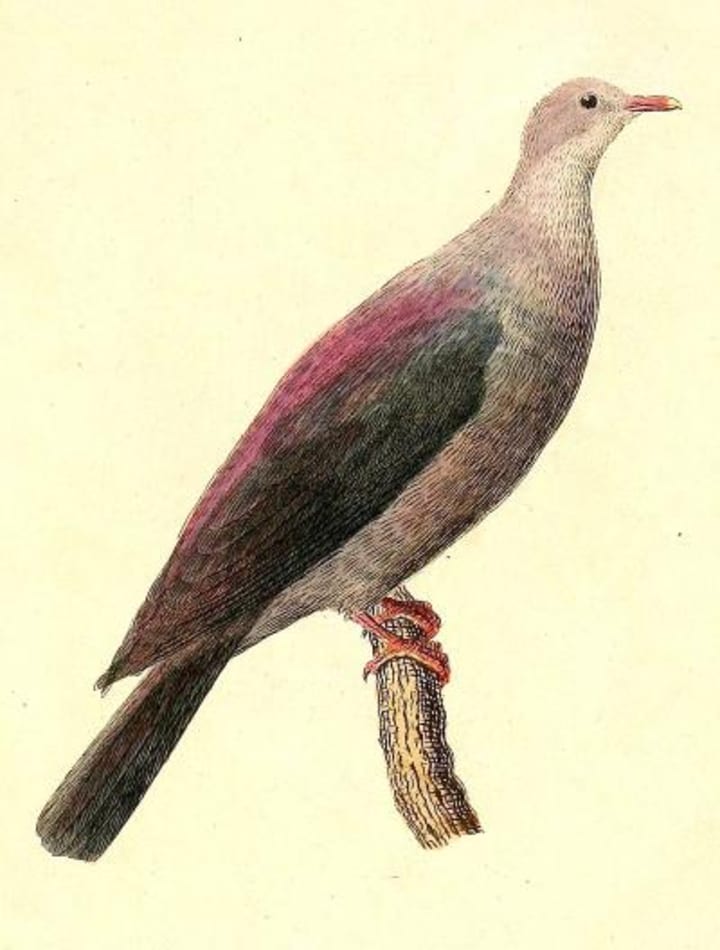
When Kittlitz came to the Ogasawara Islands, there were two unique species of pigeons living there. One is the Ogasawara variegated wood pigeon (referred to as the variegated wood pigeon) mentioned above, and the other is called the "red-headed black wood pigeon", which is a unique subspecies formed in Ogasawara by the "black wood pigeon" in East Asia. . These two species of pigeons have coexisted for thousands of years in the small archipelago. In modern times, their fate is very rough.
Just over half a century after being named, the variegated wood pigeon went extinct. In the autumn of 1889, the Swedish taxidermist Holst collected a specimen of the variegated wood pigeon on the "Medium Island" in the north of Chijima Island. This is the last record of the bird's survival. Let's look at the red-headed black forest pigeon. According to the statistics of the Japanese Ministry of the Environment in 2006, the population of the red-headed black forest pigeon is only about 40, and it has reached the brink of disappearance.
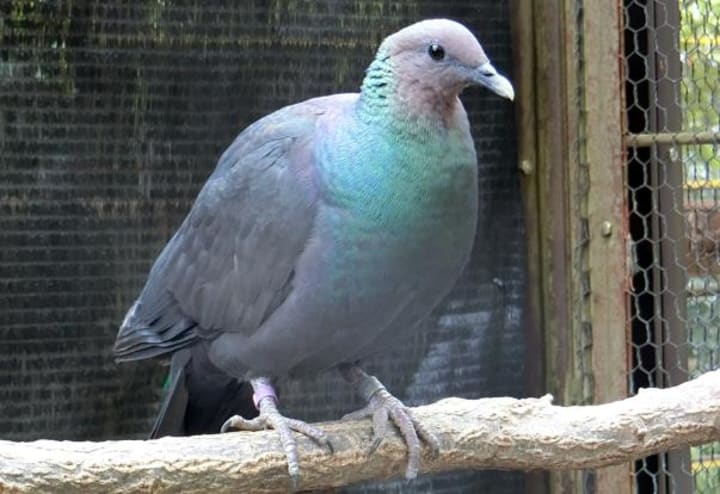
To summarize the lessons of species extinction and saving endangered birds, Japanese researchers have studied these two types of pigeons from various directions. There is a hypothesis that these two pigeons may have a symbiotic relationship in terms of "feeding habits". After the variegated wood pigeon became extinct, the symbiotic relationship was destroyed, which led to the gradual disappearance of the red-headed black wood pigeon.
Starting from "feeding habits" to studying birds seems to be a good starting point, but the actual operation is difficult. Figuring out exactly what a bird eats requires a lot of observation and dissection. For example, in the mid-20th century, Chinese ornithologists collected and dissected nearly 1,000 sparrow specimens to investigate the feeding habits of sparrows. Only then did they reach a scientific conclusion and removed the "harmful birds" from this little bird. hat. Such research work is not easy for the common birds around us, let alone extinct birds like the variegated wood pigeon.
Today, there are only three known specimens of the variegated wood pigeon, and none of them are in Japan. This makes the related research of Japanese scholars difficult. However, the scientific researchers are more or less stubborn with the stubborn temper of "knowing that there are tigers in the mountains, but preferring tigers to the mountains". On the one hand, they conducted field investigations in the Ogasawara Islands to study the plants that the variegated wood pigeon might feed on, and on the other hand, they consulted a large number of ancient and modern documents, especially the scientific research notes of naturalists in the 19th century. The mysterious "recipe" of the variegated wood pigeon gradually surfaced.
In 1859, the naturalist Kittlitz wrote in his memoirs of sailing: "I have recorded a particularly large pigeon locally (Ogasawara). That pigeon especially likes to eat the small cones of the Fächerpalme."
The scientific name of this large pigeon is directly written in the memoir, which refers to the Ogasawara variegated wood pigeon. From the surviving specimens, the variegated wood pigeon (body length 45 cm) is indeed larger than the red-headed black wood pigeon (body length 43 cm). This record of eating habits is highly credible. But what exactly is the Fächerpalme on record?
Fächerpalme is a native plant, but Kitlitz doesn't recognize it. Based on the shape of the plant, he preliminarily speculated that it was a kind of plant of the genus Bayeux. In the 1884 hand-drawn artwork, he marked it with the scientific name " Corypha japonica " and put a question mark next to it. The "Corypha" in the scientific name means " Beryllium ".
However, Kittlitz's classification of this plant is incorrect. Japanese scholars continued to explore the clue of Fächerpalme. They combined the local plant distribution of the Ogasawara Islands and then compared the characteristics of the plants in the 1884 plate. Finally, they concluded that Fächerpalme is a plant of the genus Pulau, which is native to East Asia. A unique subspecies formed in Ogasawara. This plant is widely distributed in the Ogasawara Islands to this day, and the locals use its leaves to make fans.
As a result, the text in Kittlitz's memoirs of voyages has been newly interpreted: "Ogasawara variegated wood pigeons like to eat the cones of the local palmetto." Regarding the "cones," Kittlitz's notes in 1844 There is also a further description in the book: "The big pigeons use the hard fruits of the local palmetto as food." - This seemingly ordinary record surprised the researchers.
Compared to other trees in the Ogasawara area, the fruit of the palm is "large". The oval fruit can be more than 1.7 cm in diameter, larger than ordinary glass marbles, and the outer soft part is very thin, and the seeds inside are very hard. According to Kittlitz's records, the variegated wood pigeon is indeed "hard and soft".
No other bird on the Ogasawara Islands now eats such large fruits. Although the endangered red-headed blackwood pigeon is also more than 40 cm long, they only eat smaller fruits and seeds. Palm fruit and seeds. The black and white picture on the left shows the hard seeds peeled off, and the fresh fruit on the right.
Based on this, researchers infer that the difference in diet between variegated wood pigeons and red-headed black wood pigeons is one of the reasons why they can coexist year-round on the Ogasawara Islands. Both types of pigeons may eat the "trumpet" fruit, but the variegated wood pigeon can "exclusively" the plus-size palmetto fruit, which makes the competition between the two greatly reduced.
If the above theory is true, the Ogasawara Islands have lush palm-flower forests, and the fruits and seeds scattered at the bottom of the forest should be the "easy-to-get" delicacies of variegated wood pigeons. So why did they go extinct? At present, it is generally believed that the extinction of the variegated wood pigeon is caused by deforestation, the introduction of exotic species such as cats and mice, and human capture. The exact answer to this extinction mystery remains to be further studied and explored in future generations.
About the Creator
Richard Shurwood
If you wish to succeed, you should use persistence as your good friend, experience as your reference, prudence as your brother and hope as your sentry.
Keep reading
More stories from Richard Shurwood and writers in Petlife and other communities.
A Dart at Dusk
Seconds ago, the sullen sun set on the two of us… my exuberant furry companion and me. A fresh breeze embraces us, delivering welcome relief from the day’s oppressive heat. His typical stumbling and staggering along — apace with a sloth — has turned into trip-trapping, high-stepping, almost skipping along.
By Angie the Archivist 📚🪶6 days ago in Petlife
Japan Pet Food Market Size and Forecast, 2026–2034
Market Snapshot The Japan Pet Food Market is projected to expand significantly, growing from US$ 6.72 billion in 2025 to US$ 14.68 billion by 2034, registering a robust CAGR of 9.07% during the period 2026–2034. This growth is being driven by rising pet ownership, increasing pet humanization, strong demand for premium and functional nutrition, and growing awareness around pet health, aging, and preventive care.
By Aaina Oberoi5 days ago in Petlife


Comments
There are no comments for this story
Be the first to respond and start the conversation.