
Three snow leopards, searching all over the mountain for the scent of pan sheep, can chase their prey until they jump off a cliff.
What do you know about snow leopards.


The snow leopard is one of the feline species and a high-value representative. It is a high-altitude species that lives mainly in the highlands.
Because of its thick and warm fur and high value, the snow leopard was hunted and killed in large numbers for a long time in the past, leading to a decline in the population and even to the point of being endangered.
The snow leopard population only started to grow again after the world cracked down on poaching and poaching, coupled with a growing awareness of animal protection, and the phenomenon of retaliatory hunting and killing of snow leopards by herders gradually decreased or even disappeared.
As the flagship species of the highland ecosystem, and also known as the "barometer of the health of the high altitude ecosystem", the snow leopard's existence is of great significance. The global population of snow leopards is about 7,500, distributed among 12 countries in Central Asia.
The staff of the nature reserve, while observing the infrared camera data recently, were surprised to find snow leopards. One of the cameras captured a total of three snow leopards walking leisurely past the camera before and after.
Some of them patrolled the territory while making scent marks; some searched all over the mountain for signs of pan sheep, and some just broke into the camera's field of view during their leisurely wanderings.
Snow leopards belong to the big cats, but will be smaller compared to the size of tigers and leopards. As adults, most individuals are between 22-55 kg, with a few larger male snow leopards that can grow to over 75 kg.
Because of the relatively alpine environment, they live in, snow leopards have the typical characteristics of highland species. For example, they have large nasal cavities, which ensure more air intake, and thick and fluffy fur, especially longer abdominal fur, which helps them to keep warm.
Compared to other felines, snow leopards have a large, thick, and long tail, which allows them to run and keep their balance on bare rocky terrain, but is also used as a "mask" at the mouth and nose to keep warm.
It is the king of the bare rock areas in the rocky mountains
Generally speaking, not only humans, but also many wild animals prefer to live in areas with temperate climates, birds and flowers, fertile land, and abundant products, but the snow leopard is an exception.
They prefer bare rocky areas in the mountains to forested areas with more vegetation. Snow leopards spend most of the year in these areas, and it is only during the harsh winter months that they move their range to lower elevations in the mountains and forests.
In spring, when the snow starts to melt, they move to higher altitudes again. Snow leopards are most often found at altitudes between 3,000 and 5,000 meters, and they have a strong ability to move at this altitude.
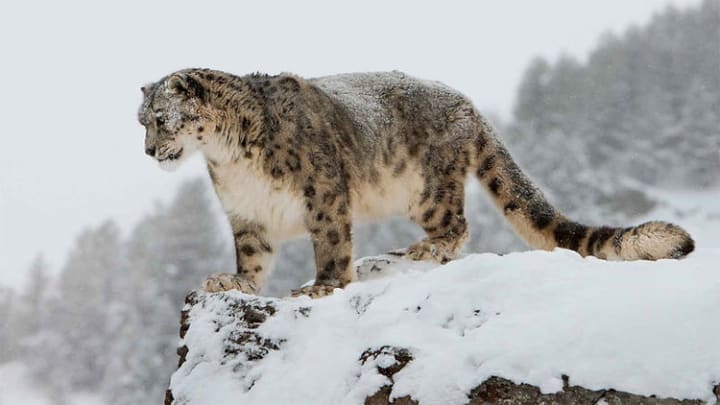
Because of the harsher environment of the plateau, there is a lack of large predators such as tigers and leopards compared to the grassland and forest ecosystems at lower altitudes, so the snow leopard, as a large feline, naturally becomes the king of the beasts in the bare rock zone, inhibiting the population development of a host of hoofed animals and helping to maintain the balance of the plateau ecosystem.
During the long evolution of the species, the snow leopard has adapted to the alpine living environment and has produced some adaptive changes. Scientists have detected a gene called "EPAS1" in most plateau species, including Tibetan wolves, Tibetan mastiffs, and snow leopards.
This gene has proven to be very important in making these highland species more sensitive to changes in oxygen, with stronger skills in distributing blood and regulating breathing.
Excellent climbing ability, able to chase prey to jump off cliffs
Snow leopards have relatively short limbs and dense, fluffy fur, so they look "chubby" and cute as a whole.
Like most felines, the snow leopard is a solitary creature, with habits similar to those of tigers and money leopards. The snow leopard lives alone during the day, and only during the rutting season do the paired males and females live together for a short time.
Snow leopards are nocturnal, usually resting or patrolling their territory during the day, looking for signs of prey. They come out to hunt at night, and their frequency of activity reaches a climax in the evening and early morning.
The prey of snow leopards are hoofed animals such as pan sheep, rock sheep, and northern goats, but they have also been seen eating dry otters and poultry, and livestock.
Snow leopards prefer to move on bare rocky areas because these areas, too, are frequented by hoofed animals such as pan sheep. Although pan sheep feed on a variety of plants, they have a penchant for licking salt.
The surface of the rocks on the bare rocky areas in the high mountains often contain various kinds of salt, so although there is nothing to eat in these areas, there are "snacks" that the sheep love to eat. Many times we see flocks of sheep on top of cliffs, licking the rock face.
Because the snow leopard's gray and white fur is covered with black spots, it is a good camouflage color on bare rock areas, and its climbing ability is so strong that it can move freely even on bare rock areas.
In the entire feline family, there is almost no one who can match the snow leopard in terms of mobility on bare rocky terrain. Therefore, even though hoofed animals such as pan sheep and rock goats have strong climbing skills, snow leopards can capture them with their excellent hunting ability.
For a bite to eat, snow leopards often chase their prey to jump off cliffs, and in some cases, even jump off together.
There was a video of a snow leopard chasing a rocking sheep on bare rocks, biting the prey just as it fell off a cliff, but even so, the snow leopard still did not let go of its mouth, which shows how brave it is.
The snow leopard is a big cat that doesn't growl
Many people have the subjective impression that big cats should be able to make deafening roars like lions and tigers, but the reality is that although the snow leopard is also a big cat, it does not roar. This is due to the vocal structure of the big cat, which is more flexible because its hyoid bone is not fully ossified.
Felines that cannot growl, such as pumas, lynxes, rabbits, etc., have fully ossified hyoid bones. The exception is the snow leopard, whose hyoid bone is somewhere in between, so the snow leopard's call is most unusual.
Species that can growl cannot purr, and species that can purr cannot growl, so the snow leopard can neither growl nor purr like a kitten.
Perhaps it is because it lives on a snowy mountain and if it growls, it may trigger an avalanche.
The future challenge for the snow leopard is climate change, as the Tibetan plateau has risen by 3 degrees Celsius in the past 20 years.
Some experts and scholars have studied that further global warming in the future will result in a significant reduction of snow leopard habitat, which could exceed 65%.
Of course, climate change also brings new challenges for snow leopards. Money leopards, which originally live in low-elevation forests, will intersect with snow leopards as the forest line moves upwards, and this is already happening.
About the Creator
Olive
Early to bed and early to rise, makes a man healthy, wealthy, and wise.
A Dart at Dusk
Seconds ago, the sullen sun set on the two of us… my exuberant furry companion and me. A fresh breeze embraces us, delivering welcome relief from the day’s oppressive heat. His typical stumbling and staggering along — apace with a sloth — has turned into trip-trapping, high-stepping, almost skipping along.
By Angie the Archivist 📚🪶6 days ago in Petlife
Real camouflage for people and machines is getting closer thanks to materials inspired by octopuses.
Engineers now have a closer resemblance to octopus skin thanks to a new colour-changing material that can change both its colour and surface roughness in less than 10 seconds. The soft photonic skin was created by Stanford University researchers using patterns on its surface that are tiny than a human hair.
By Francis Dami6 days ago in Petlife



Comments
There are no comments for this story
Be the first to respond and start the conversation.