
The world's largest whale's first dissection reveals that it has nine stomach chambers.
as well as the upper jaw's little vestigial teeth.

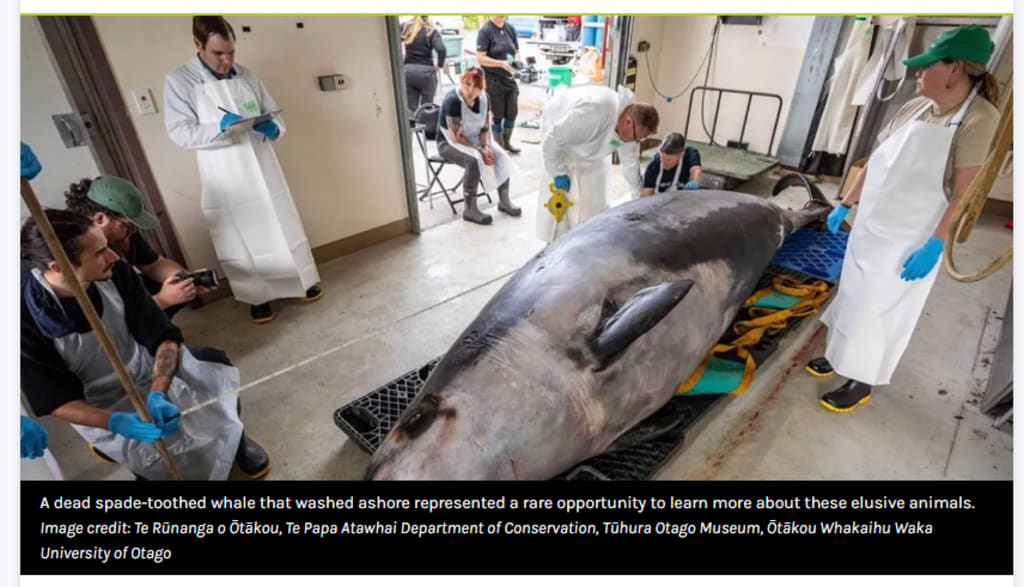
Indigenous people and conservation experts in New Zealand have gained a better understanding of one of their taoka, which means treasure in the language of South Island Māori culture, thanks to the first-ever dissection of the rarest whale in the world. Only six spade-toothed whales have been confirmed to date, and no one has ever seen one alive. Mesoplodon traversii is the rarest species of beaked whale.
On July 4, employees of the Department of Conservation (DOC) arrived to look into allegations of a dead, beached whale close to the tiny fishing community of Taieri Mouth. The five-meter (16-foot) male spade-toothed whale was discovered to be "one of the most poorly known large mammalian species of modern times" upon their arrival, shocking them, according to DOC Coastal Otago Operations Manager.
Dissection of a spade-toothed whale
It was the first time a whole spade-toothed whale specimen had been retrieved for study, and seeing such a creature washed ashore was a unique and crucial chance to gain more knowledge about the species. Now, some new information about the anatomy of spade-toothed whales has been revealed via the first-ever dissection of one.
In a recent statement about the dissection, Rūnanga member Rachel Wesley said, "This tohorā (whale) was not only the first of its kind to be dissected by science, but it was also the first time our hapū (subtribe) worked with scientists to pull together Indigenous and western knowledge systems so we can all gain a better understanding of the whale and its behaviors."
Our rakatahi (young people) spearheaded this procedure, with guidance from our distinguished guests from Ngāti Wai, Hori Parata, and his son Te Kaurinui, who are tōhuka (experts) in handling this taoka (treasures). Our rakatahi can resurrect traditional matauraka (knowledge) and create a comprehensive knowledge system to be passed down to future generations by collaborating with and learning from leaders in te ao Māori and Western science.
Whales with spade teeth have vestigial teeth.
For the first time, their research showed that the upper jaw of spade-toothed whales has little vestigial teeth. These kinds of vestiges are thought of as evolution's relics, showing that they originally had a more important function and that, despite their current reduction, there hasn't been any evolutionary push to completely eradicate the trait.
Whales' smaller hind limbs are sometimes cited as another illustration of vestigial characteristics that date back to their time as landlubbers, some 50 million years ago. Even when the legs are now only little hip remains, they can nevertheless have a very seductive use.
There are nine stomach chambers in spade-toothed whales.
The spade-toothed whale's numerous stomach chambers—nine, to be exact—as well as some hints about their eating and communication habits were another intriguing characteristic.
DOC Marine Science Advisor and beaked whale specialist Anton van stated, "We found squid beaks and some lenses from the eyes of squid, a few parasitic worms, and maybe some other parts of organisms that we are not quite sure of in some of those stomachs."
"A parasitologist will investigate them to determine their identity."Additionally, we discovered intriguing structures linked to both sound generation and feeding. In order to characterize this species and draw similarities with comparable species, we weighed, measured, and described a variety of muscles and organs. All of them contribute to the corpus of knowledge we are accumulating.
It is a terrible day for the species when a rare animal dies, but perhaps by understanding more about spade-toothed whales, we will be better able to protect them in the future. Te Rūnanga o Ōtākou gave the person the name Ōnumia in reference to the region of the same name where the whale was discovered at the Taiari River's mouth.
bringing back a custom that connects people to the natural world.
About the Creator
Keep reading
More stories from Francis Dami and writers in Petlife and other communities.
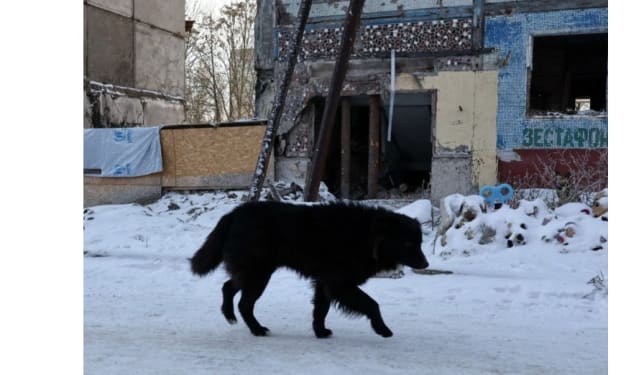
Dogs are reverse domesticated due to the conflict in Ukraine.
After months of continuous fighting, the surviving canines near Ukraine's front lines have clearly changed to resemble wolves in both appearance and behaviour. Their changed bodies demonstrate how characteristics formed by centuries of human friendship can be quickly erased by battle.
By Francis Dami20 days ago in Petlife
Authenticity and Presence: What Animals Can Teach Actors About Emotional Truth
Actors spend years searching for authenticity. Acting schools teach technique, rehearsal methods focus on emotional preparation, and directors guide performers toward believable moments on screen. Yet sometimes the most meaningful lessons about authenticity come from unexpected places.
By Andreas Szakacs2 days ago in Petlife


Comments
There are no comments for this story
Be the first to respond and start the conversation.