
The ‘monster’ dog who taught me true love
Gruesomely sick, abused, and scared
There’s a reason why Greece’s ancient storytellers imagined mermaids, centaurs, flying horses, women with snakes for hair, and man-eating, one-eyed giants. The magic of the place is so potent that when you visit there even today, those and other fabled creatures won’t seem far from real.
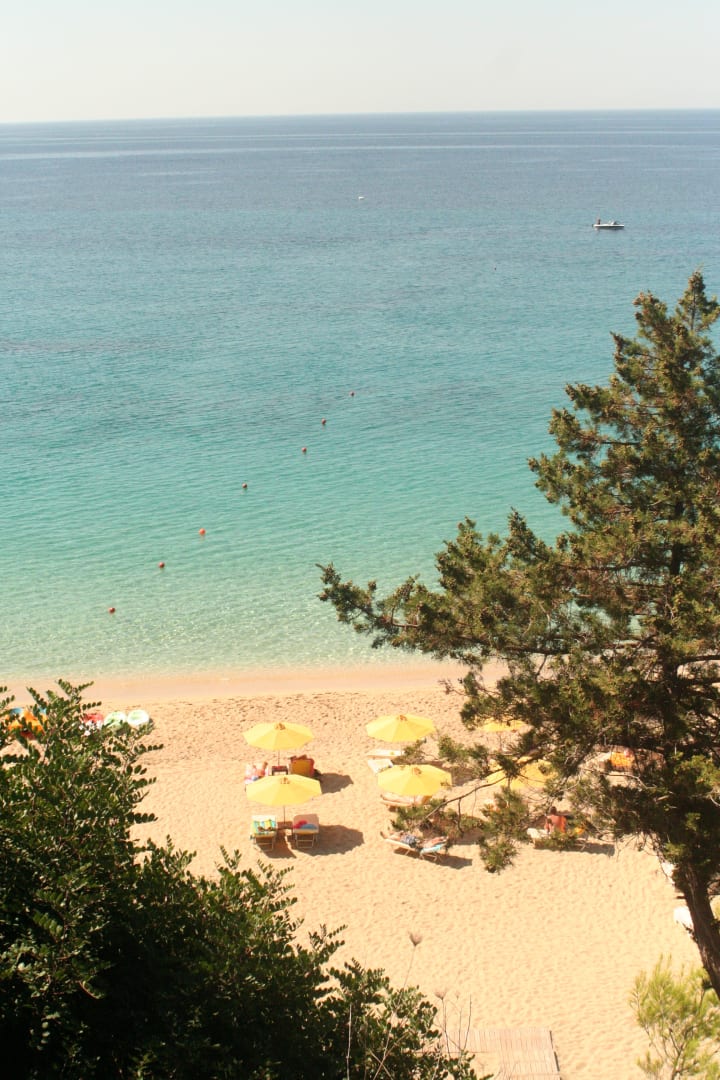
On almost any night, especially when the creamy glow of a full yellow moon bathes a Greek island, you’re bewitched by the sea’s whispers on the nearby shore, its tangy scent mixed with the perfume of wild herbs. You’re spellbound by the thousands of years of history that created columned temples, timeless plays and poetry, and democracy. You’re enchanted by home-grown olive oil and fresh basil on the best tomatoes you’ve ever tasted, seasoned with the sea salt lingering on your lips after your sunset swim.
Greece entices you into her embrace, infusing you with strange powers to see more clearly, to listen more closely, and to let your heart feel more strongly than ever before.
But what you wouldn’t expect, even on one of those magical nights, is to find one of the country’s mythical monsters in the middle of a mountain village road, desperately needing rescue.
Under a full September moon almost a decade ago, that’s what we thought we saw… at first.
Bleeding and fearful
If it hadn’t been for that moon, I might have hit and killed him. The moonlight protected him with an eerie halo.
I slammed on the brakes.
For a confused moment all I saw was a large beast standing with head down, legs akimbo.
My friend Melissa and I both gasped.
A pair of eyes, baleful and wary, blinked into my headlights. Then they found my eyes and held them.
That’s when I saw the worst of it.
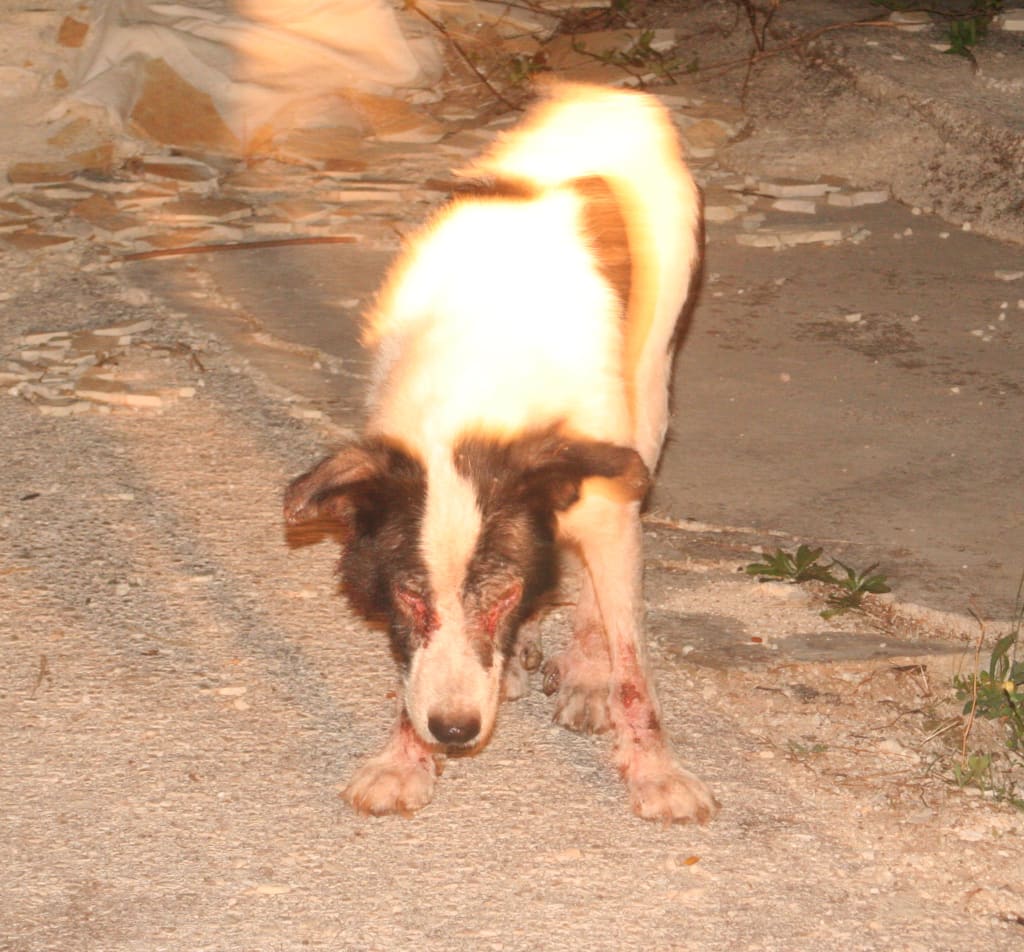
The monster was bleeding.
“Oh no,” Melissa was the first to understand the truth. “It’s… it’s… a dog!”
“It is?” By the time the question left my mouth Melissa had opened her door and jumped out.
“Careful!” I warned. “Keep your distance!”
Melissa and I are both longtime animal rescuers who will do almost anything to help one in need, but I didn’t want my friend to get mauled by a panicky ill or injured canine.
Though not easily dissuaded, Melissa isn’t foolish, either. She walked a few feet toward the dog, then stopped when he bared his teeth.
I pulled over, parked, and flipped on the car’s emergency flashing lights to signal our presence to any other motorists who might come through.
“He’s got blood everywhere,” she said.
My breath caught when I left the car and saw she was right. Blood oozed over his face, his ears, and lower front legs.
“What has happened to you?” Melissa asked the dog.
His answer was a low, threatening growl.
Heartbreak ahead
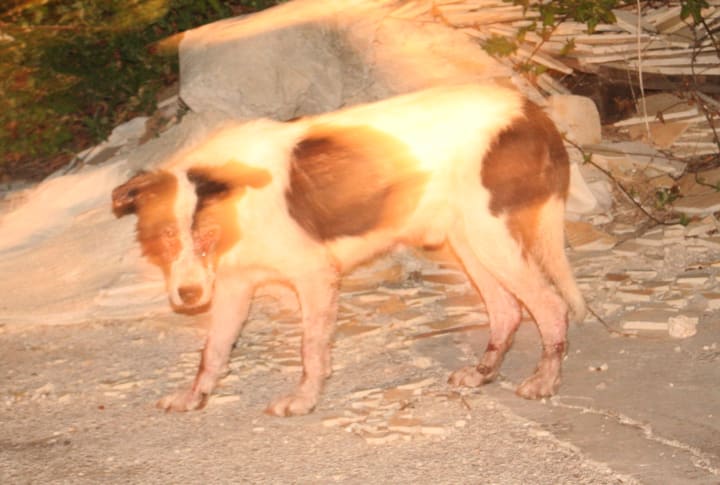
Despite the horror of the scene, I noticed the dog’s beauty. About the size and shape of a German shepherd, but with striking coloring—a black mask and black patches on a white background. Even in his gory condition he exuded a majesty that made me think of tragic but tough Greek heroes… Agamemnon, Leonidas, Phillip II.
Aesthetically, I fell in love with him on the spot. In practical terms, as an experienced rescuer, I knew that falling in love with a dog like that paved the road to heartbreak. He was ill and/or injured. Frightened. Perhaps aggressive. Loose on the street. At night. Out in the middle of almost nowhere.
I wasn’t even supposed to be in Greece anymore. My husband’s patience had already stretched through numerous exhausting and expensive pooch and kitty rescues during the year I’d spent there without him—a year that had started out as just a couple of months for me to rehabilitate our crumbling old house there on my family’s ancestral island of Kefalonia.
The rescues had… well… sort of delayed things a little.
Hubsy, home alone in California caring for our large pack of eight previously rescued dogs while working hard to support us all, was not amused.
Heartbreak. Yep. Big, bad heartbreak.
The selfish and tired part of me wished we’d never seen this dog. Because now that we had, we had to do something. But what? And how?
There didn’t seem to be a home nearby, until the dog showed us that indeed there was one. He slunk up a short concrete ramp to the unfinished second story of a house.
On one side of the ramp, a locked gate barred a stairway that led downhill to the lower floor of the residence, where lights shone and a TV chattered.
“Should we ask if he’s theirs?” Melissa was already at the gate.
Trailing behind, I kept my eyes on the dog.
Failure for the animals
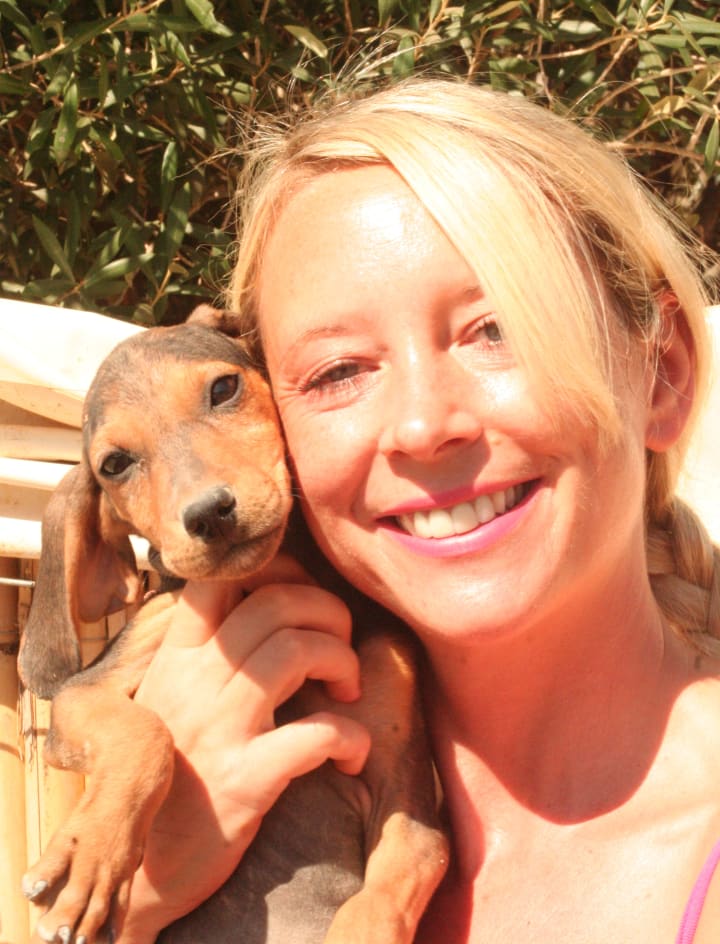
I felt ashamed that Melissa had to see such an animal. Of course she was spending every day with many more dogs like him, some even worse off, while volunteering at the island’s main shelter Animal Rescue Kefalonia (ARK) as part of her extraordinary mission to provide hands-on help at shelters worldwide.
She knew as well as I did about Greece’s failure to provide enough public education, shelters, and veterinary services including spay/neuter to curb its ever-growing population of homeless dogs and cats.
Nevertheless, she was a guest in Kefalonia, having come from the United Kingdom, and as a proud half-Kefalonian I wanted her to be enthralled by our isle’s stunning beauty—not appalled by its horrors—for at least one day.
We were supposed to be relaxing after our little do-it-yourself car tour of the beautiful island—not hanging around in a mountain village trying to figure out what to do about a wretchedly messed-up dog.
“Hello!” I called out in Greek. “Excuse me! Hello?”
A woman answered, “Yes! Hello! I’m coming!” She climbed the stairs. Soon a young man joined her.
“We’re sorry to bother you,” I began, “but my friend and I were driving by, and we saw a dog. He’s in bad shape. Right now he’s on your roof, barking.”
“That’s a stray,” said the woman.
Her son “Petros” [pseudonym] explained he had first seen the dog two years before, on the road about four kilometers away. He had started feeding him, and eventually the dog turned up at their home. So Petros had continued the feedings. But no matter how much food he provided to the ravenous dog, he never gained weight.
About ten months before, the dog had started losing fur. Later he began to break out in sores.
As the illness worsened, Petros said he tried to contact one of the local animal rescue groups—one that had since gone defunct. He had described the situation to a woman who said the group would help. But Petros said he never heard from her again.
He wanted very badly to help the dog more, he said, but didn’t have the time or the money. So he decided to at least make sure he was always fed. Sometimes, on stormy nights when the dog didn’t show up, Petros would walk for half an hour in the rain to find and feed him.
Rescuer’s dilemma
Throughout the conversation I translated for Melissa into English. To my great admiration, she offered important questions to Petros and his mother that my own brain’s freaked-out state wasn’t producing.
They said the dog had endured the awful lesions for at least a couple of months. He’d received no veterinary attention, but Petros had gotten a powder for the lesions from the pharmacist.
He would let Petros handle him unless he was in an agitated state, like tonight, then Petros wasn’t completely confident in him.
He came around on most days, usually at night after Petros got home from work.
Melissa looked at me. There was an unspoken question on both our minds. What should we do?
Our options:
Option #1 – Find a way to get the barking dog into the car. Phone and probably awaken Maria Marina Machado, head of Animal Rescue Kefalonia (ARK), and deliver the dog straight there.
Upside: Dog spends the night in safety, and we sleep guilt-free.
Downside: Getting bitten on the way to ARK was a possibility. I really hate being munched by dogs and cats, and would hate it even more if Melissa left the island with a memento “tattoo” in the form of fang scars.
Option #2 – Leave the dog where he was for tonight, make a sensible plan, and come back for him tomorrow.
Upside: Keep ourselves safe.
Downside: Feel guilty.
Petros, his mother, and the dog all watched us, waiting for an answer.
Impulse control
Having sustained my share of “love bites” in the past—to the tune of 50 stitches—I am no longer a very brave dog rescuer. Nowadays I believe that discretion is the better part of valor, as the saying goes. You can’t help anybody if you get yourself hurt.
In the case of the sick and bloody dog, he was now barking nonstop. Every time we dared move in his direction he’d dash off a few meters with his tail between his legs, then resume a defensive warning posture with head and tail high and stiff. He really was not interested in having us near.
Also I wasn’t thrilled about the thought of catching sarcoptic mange, if that was what the dog had. A couple of my rescuer friends had caught it from dogs they’d taken in, and it wasn’t pretty.
The “monster” dog did not seem to be in an emergency situation. He had been on the streets for at least two years and had endured the bloody lesions for months, according to Petros.
So I wimped out. I settled for leaving the dog in place for the time being, until we could devise a better plan to rescue him.
“May we exchange phone numbers?” I asked Petros. “I don’t know exactly how we’re going to help, but I promise we will.”
Melissa added, “Don’t worry, Petros. You’re no longer in this alone. We will help.”
Armed with Petros’s mobile number, Melissa and I drove away. We had dinner. We talked about other things.
At one point I said, “Whew, am I glad we didn’t pick up that dog! What a ginormous hassle it would’ve been to deal with a fresh rescue so late at night.”
Melissa made no comment. I got the feeling that if it had been up to her, she would have found a way to get that dog into the car and take him straight to ARK, where she had been volunteering some 12 hours a day for almost a month solid.
What she did say was that whatever I decided to do, she would stand by and help in every way she could. Coming from a person like Melissa, that’s no empty promise.
Carefully planned chaos
Even while dropping off Melissa at the downtown apartment where she stayed courtesy of ARK, I was congratulating myself on my wise decision.
And even while taking a shower and getting ready for bed, I smiled about how great it was to be able to do that, instead of having the bother of an ailing, possibly aggressive dog on my hands.
What a savvy and sensible rescuer I had become, instead of the anything-goes, no plan in sight, kamikaze-style rescuer I used to be.
Nope, no more of that impulsive nonsense. Tomorrow, in the clear light of day, I’d construct a clever plan for just what needed to be done.
With a few more smug pats to my own back, I climbed into bed, rested my head on the pillow, and pulled up the covers.
Then, there I lay. For hours. Eyes wide open.
Because all I could see in my head were his eyes—bloody, wary, and weary.
I am sick, those eyes had pleaded, even while he growled and barked. I am tired. I need help.
Perhaps it is because we hear such voices in our heads that some people believe we animal rescuers are nutty. And, alas, maybe we are.
“When you see an animal in trouble,” my hubsy asked me one day back in the 1980s, “you know what you tend to do?”
This was right after we had tried (and miserably failed) to help a group of sick and starving dogs at the ruins of ancient Pompei in southern Italy.
Bracing myself, I considered the vast array of possible answers.
He shook his head like an exasperated father with a precocious child. “You go crazy. You go all Buckaroula Banzai.”
It was hard to argue with that. And I had to grin. In Greek, adding the suffix “oula” turns female names into endearments. “Buckaroula” didn’t sound so bad, considering the alternatives.
Remembering his words, I whispered a prayer that he wouldn’t get too furious at his Buckaroula once he heard about the new and difficult rescue she was plotting.
In the morning, soon after the hardworking moon had ended her shift and left the skies to her partner the sun, I was in the car headed for the village of Troianata. Friend and veteran rescuer Paley Frances had once told me that if you’re looking for a stray dog, the best time to search is at dawn and at dusk, when they tend to be most active, foraging for food and water.
I am so not a morning person that halfway over there I realized I was wearing the left shoe from one pair of shoes and the right shoe from another, and that I had forgotten my drivers’ license, notebook, and camera.
Those were things that would have been carefully packed by Ms. Savvy and Sensible rescuer. But the bloody dog in Troianata didn’t really need those things. What he needed right now was Buckaroula Banzai. And she was on her way.
The ten-day quest
Catching a dog who does not wish to be caught is never easy, but in this case it turned out to be a lot harder than I’d figured. Ten days harder, to be exact.
Though I had captured plenty of reluctant Fidos before, most of them felt at least some need to be rescued. This one clearly did not.
He seemed to believe he was just fine. Petros and his mom provided food and water. There was some shelter in the shrubbery near their home. Moreover he felt a duty to protect them and their property. So my daily appearances were not at all welcome.
Every day I saw bared teeth, curled lips, and menacing glares. Food I left on the ground would not be touched until I got back into my car.
Petros offered to try to catch him on a leash then call me, but usually he didn’t get home from work till nearly midnight, and couldn’t always locate the dog at that hour.
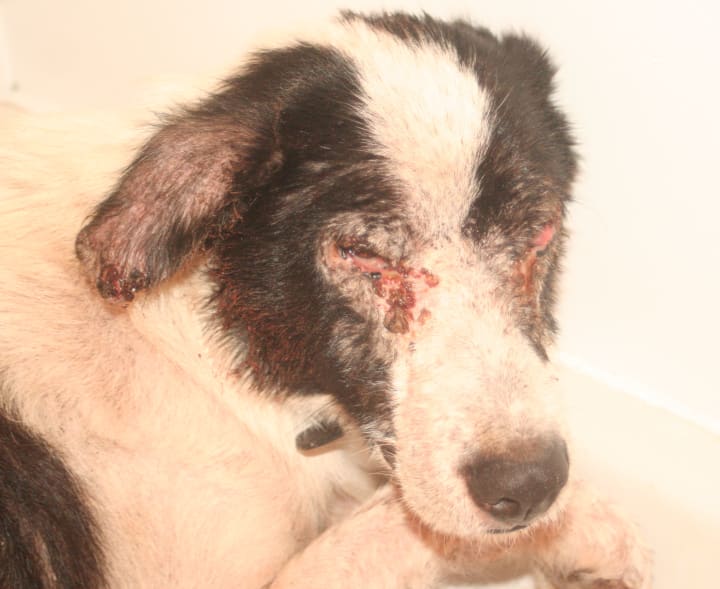
Sometimes, before skittering away, the dog allowed me close enough to see the bleeding, oozing sores around his eyes, on his ears, his leg joints, and lower forelegs. His coat looked dull and dry. His walk was strangely stiff, stilted.
Sarcoptic mange might be the culprit, but to me it seemed that something else was afflicting him. Significant veterinary care loomed on the horizon.
Meanwhile I hadn’t yet told Hubsy. As far as he knew, I’d be home within the month. I was pretty sure that if I caught the dog, that timeline was not going to happen.
A call to Dr. Amanda Micheletti, one of the excellent veterinarians on our island, confirmed my suspicions.
“Leishmaniasis,” was almost the first word out of her mouth after she saw the photos I’d emailed. “That’s probably what he has. And maybe Ehrlichiosis too.”
My heart sank. Those are two words you never want to hear in association with any animal. Serious parasitic diseases, they can and do kill many dogs, especially strays, but not before causing them months or even years of suffering.
“Bring him to me,” said Dr. Amanda. “He needs to start the medications immediately.”
After explaining why that was easier said than done, I asked about euthanasia. “He seems so sick. Wouldn’t that be the kindest thing?”
“Why do you want to do that?” she asked, a little archly. “He can get better.”
“Really?”
“Well I haven’t examined him yet, but unless they’re very old, we can usually bring these cases back to health and stabilize them, often for many good years of life ahead.”
“But completing the treatments can take week or months, right?”
“Yes.”
“And what about his behavior? I don’t do aggressive dogs.”
“That will pass once he’s feeling better,” she promised. “Anyway we’ll train him. I’ll help.”
“Seriously? You’re already up to the gills with your own rescues, Dr. Amanda. When will you find time to help?”
“Don’t worry. I will.”
“I’m supposed to go home. This dog is a serious project.”
“True. But he’s worth it. He has a loving, courageous heart. You’ll see.”
“Can you tell that to my husband?”
Dr. Amanda chuckled. “He’ll understand once he meets him in California.”
Testing the bonds of love
Hubsy’s reaction turned out to be worse than expected. A lot worse.
Was I ever going to come home? Did I not love him anymore? Didn’t I love our dogs? Was this my way of walking out on him and on them?
All valid questions that I probably would have asked him too, if he had left me alone with eight canines and flown to off to Greece to rescue more, taking nine-plus months longer than promised. Adding to the trouble, my mission of repairing our house on the island was nowhere near accomplished.
“I’m sorry,” I kept saying. “I’m so very sorry. I just can’t leave that dog out there.”
“Take him to the shelter!” Hubsy struggled valiantly to control his fury. “Or convince someone else to rescue him. You can’t save them all. You don’t even live there. You live here. Theoretically, at least. Come home.”
It wasn’t the first time he’d gotten angry about my incessant rescuing, but it was the worst. In the days after that call he became brusque, barely wanting to speak at all.
Our three-plus decades of marriage had included him putting up with a lot from me, and I from him. One thing we had in common through it all was an intense sympathy for animals, and a desire to help them.
His compassion extended to humans, too. Together we had rescued my elderly Aunt Kallie and her husband Captain Mimi (short for Demetrios), who had both developed dementia at about the same time. In return for taking them to the U.S. and caring for them for six years until they passed away, we had received their house there on the island, which had become my Greek rescue headquarters. But the house was worth nowhere near what we had spent on my aunt and uncle’s care.
Hubsy had graciously accepted that heavy financial burden, along with the copious amounts of time required from both of us to look after Aunt Kallie and Cpt. Mimi. With varying degrees of enthusiasm he also had participated in and funded almost a hundred percent of our rescue, fostering, and re-homing of more than 200 animals over the years.
Now I was asking him for even more of a sacrifice. Was that fair? Not a bit. He had every right to be hurt and angry. But that dog in the mountain village was in such dire need. According to Dr. Amanda, he probably wouldn’t even survive a few months without treatment.
The Leishmania protozoan parasite would continue to ravage his skin, then could also move on to his internal organs. It tended to target the kidneys. It could damage the eyes, brain, heart, liver, and bone marrow. It caused joint inflammation. Lameness. Anemia. Seizures. Behavioral problems. An all-around dastardly organism.
The Ehrlichia parasite wasn’t much nicer, bringing its own whole set of scary symptoms. When combined with the Leishmania, as it indeed turned out to be the case for in Agapi, its effects could be even worse, because the animal’s beleaguered immune system had to try to fight them both.
And I hadn’t even managed to catch this dog yet. He sure wasn’t making things easy. I couldn’t just keep driving out there, hoping for the best, delaying my return home even longer.
Nowadays Greece wasn’t seeming quite so magical to me anymore. The country’s horrendous homeless animal problem was turning into my problem—a big one. A problem so big, in fact, that it threatened to break up my marriage.
I had to make a better plan.
Kind friends save the day
While I tried to figure out how to rescue that darn dog, my own rescue arrived in the form of kind friends.
Although my husband remained pretty livid, I got the opposite reaction from buddies. My Facebook tribe and other friends around the world were super supportive, showering me with encouragement, as were my rescuer pals on the ground there in Kefalonia, without whom I never could have caught the elusive dog.
The first to lend a hand was octogenarian Mr.Yiannis Gnesoulis, a longtime friend of my family, and a devoted animal lover. One evening he rode with me up to the village and accompanied me from house to house, business to business, knocking on doors, asking locals for their help.
“If you see him,” he told everyone, “please call Katerina immediately so she can come right over. And please be nice to the dog. He’s having a rough time.”
“You mean that monster?” one of them replied. “He’s sick and contagious. He should be shot.”
Mr. Gnesoulis turned various shades of raging red. “Hurting animals is against the law. This dog here in your community needs help, and this lady who doesn’t even live here is working very hard to give it. I don’t want to hear ignorant things like what you just said.”
Fortunately the remaining locals had great respect for Mr. Gnesoulis. Most were already concerned about the dog, and promised to stay on the lookout. They whispered to us that some of their unkind neighbors treated the ill dog like a pariah, bombarding him with rocks to keep him away from their properties.
Next my British expatriate friends Mary and Neal rose to the occasion. Assuming I was able to catch the dog, I’d need to put him in a crate for the ride home—a crate too large to fit in my little rented car. Mary and Neal offered not just their truck, but ended up providing their courage, too.
On Day Ten of my dog quest, I asked Petros not to feed him. I wanted the big black-and-white boy to be extra hungry for a special little dinner—some tasty canned food laced with the sedative pills I’d requested from the vet.
In preparation for his homecoming, I swept and scrubbed a room in the vintage stone cottage on our property, adding bowls and a cozy bed. The main house where I lived was too much of a remodel mess to safely host a dog, so the cottage would have to suffice for now.
When one of the villagers phoned to let me know the wandering pooch was taking a siesta behind the church, Mary and Neal followed me there in their truck, loaded with the crate I’d bought.
From a distance we watched as the dog wolfed down the medicated concoction I’d placed near him. Then we waited. And waited. And waited some more. The pooch hung around, but didn’t look the least bit affected by the sedatives.
The perfect name
While I bit my nails, fretting that when Fido finally did get woozy he’d wander off somewhere I couldn’t find him, Neal took matters in hand.
He strolled nonchalantly toward the dog carrying more food, dropped it, kept walking, and waited till the dog bent his head to eat. Then from behind, he lassoed him with the leash.
I held my breath, sure the dog would either bite or bolt. But he did neither. In minutes, with Mary’s help, Neal had gently coaxed the drowsy dog into the crate. In another half-hour we had pulled up in front of my house.
As the two of them unloaded the crate and carried it into the cottage for me, I started sobbing. “You can’t imagine what this means to me. Such a relief!”
Mary patted my back. “It’s the least we could do. Now you have the hard part.”
Neal nodded. “I don’t think healing him is going to be easy.”
After they drove off I realized that Mary had left a care package for me on the table—fragrant carrot ginger soup, fresh homemade bread, and a note: “In case you don’t have time to cook tonight.” Tears filled my eyes again.
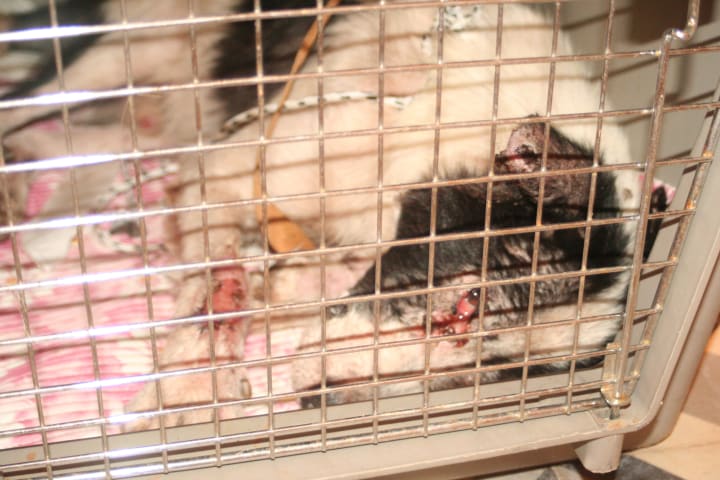
I looked at the dog, snoring softly in his crate. Blood all over him, and all over the blankets I’d used to pad the bottom.
Now that I could see him more clearly under the lights in the cottage, the sight of the lesions nearly made me sick.
Neal was right. Healing him would not be easy.
But this dog had lots of people on his side—not just me. He had Melissa, Petros and his mom, Dr. Amanda, Mr. Gnesoulis, Mary, Neal, my many other friends, and eventually, with a little luck, perhaps my husband.
I prayed that Dr. Amanda would turn out to be right. Hubsy would forgive my long absence once he fully understood this dog’s dire circumstances. Wouldn’t he? Wouldn’t love win the day, in the end?
Suddenly I knew what to name the big fellow. Agapi. Greek for “love.” In the Bible, the word represents the highest, purest form of love—unconditional, unselfish, and charitable. Some theologians say it’s about God’s love for us. Others emphasize the altruistic love that we give our fellow beings.
Typically in Greece the word is used as a female name, but this Agapi was macho enough that a girly moniker wasn’t going to faze him.
What I couldn’t yet know
I opened the crate door.
He opened his eyes.
“Agapi?” I murmured.
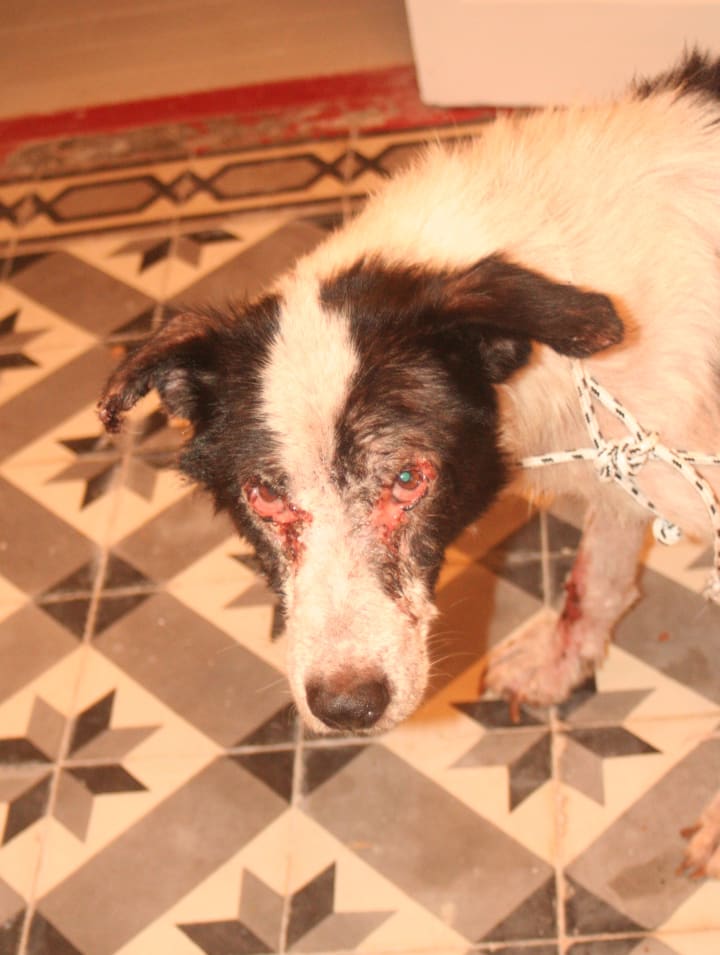
The dog who had been snarling, growling, and barking at me for ten days stood up. He stepped out of the crate.
I gulped, determined to give him the benefit of the doubt. But just in case, I had packed my pockets with dog biscuits. If he decided to lunge, I would jump on the table and distract him by tossing the treats into the next room so I could make a break for the cottage door.
Instead Agapi stretched. And yawned. Looked up at me. And wagged his ragged, flea-infested tail.
It was a low, slow, soothing sway, his unique, signature wag—one that I would come to cherish during the coming decade.
But I didn’t yet know that.
Nor did I know that that this pitifully ill and abused, but brave and forgiving dog would soon beguile both my husband and me.
Like others of his ancient, noble breed, which we later discovered was Greek mountain shepherd dog, or Ellinikos Poimenikos, Agapi had a thing about family unity. It meant everything to him.
Not only would he not break up my marriage—he would help patch it back together.
And I couldn’t yet have had the slightest clue on the important role that this thin, sickly animal would soon play in our lives. That I would get sick too, of a disease about as bad as his—endometrial cancer. That I would get it twice, face alarming odds of death, require heavy-duty treatment, and that Agapi’s imperturbable calm, his low-key but steady loyalty, and his unflagging good cheer would be essential to my recovery.
In that moment, I only knew that I was already learning from him.
Saving him would require sacrifice. Other folks had already given of themselves. Petros walking through the rain to find and feed him on stormy nights. Mr. Gnesoulis, Mary, and Neal helping me catch him. Melissa and other friends offering donations. Dr. Amanda promising to help heal and train him.
They had all demonstrated their agapi.
Now it was my turn. Did I have it in me?
I took a biscuit out of my pocket and held it out. Hesitating only briefly, Agapi took it gently from my hand.
What I wanted to do next was coax him into the tub and wash the blood, gore, and fleas off the poor guy. But that would be too much. Tonight he needed to eat, then rest. So did I, for that matter.
“OK, sweetie. I’d really like to pet you, but I guess we should take that slow too. Hang loose for a bit while I go get your dinner.”
When he looked up at me again with his gruesome, blood-rimmed eyes, raising his raw, bloody ears, I sensed he was asking me questions that I would need to learn how to answer. The two of us had a lot to find out about each other.
That’s when I got the first glimmer that perhaps Dr. Amanda was right. This enigmatic dog, this “monster,” did indeed seem to have an expansive, courageous spirit. Already he looked prepared to start leaving the traumas of his past behind, to set aside his fear of the unfamiliar world, to begin his battle with the vicious parasites attacking his beautiful body, and to move on toward a new life.
I held out my hand. He took a small step forward, sniffed, and brushed his cheek on it. Just a tentative, feather touch, but our first touch ever.
Against all doubt, the magic of Greece had done its work, as it always did, sharpening my senses and opening my heart farther than I’d dreamed they could go.
Now that magic was busy once again, turning a monster into a friend.
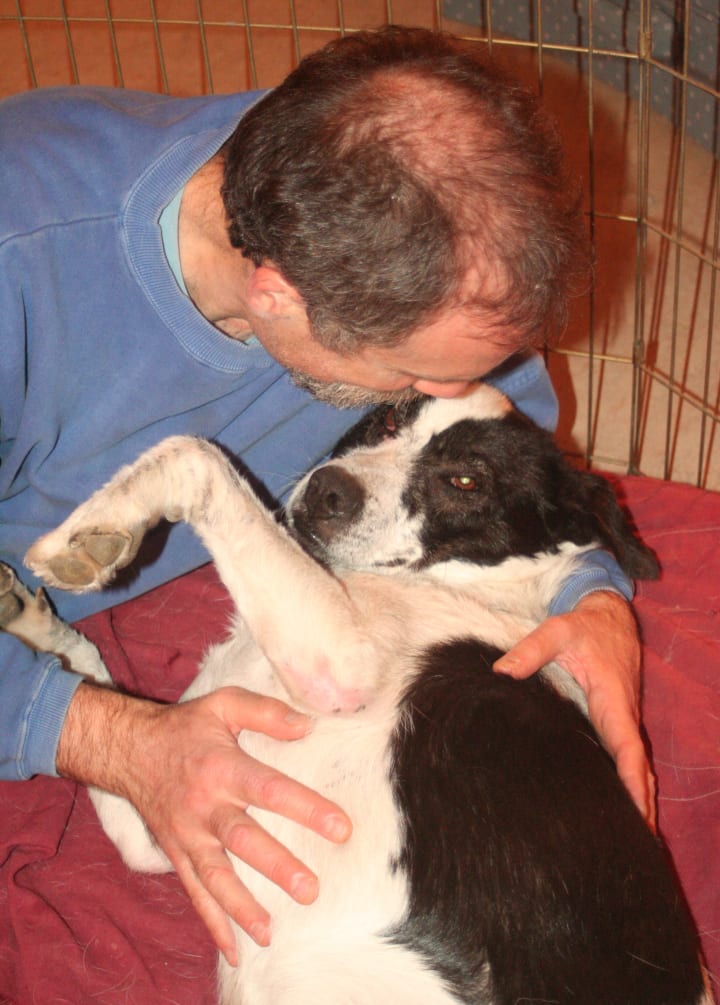
About the Creator
Katerina Lorenzatos Makris
Katerina has written 17 published novels (as Kathryn Makris), a handbook on dog rescue, a teleplay for CBS, fiction for The Bark, and hundreds of articles for mainstream media. Find her at RescueDiva.com and AnimalIssuesReporter.com..
Keep reading
More stories from Katerina Lorenzatos Makris and writers in Petlife and other communities.
A Dart at Dusk
Seconds ago, the sullen sun set on the two of us… my exuberant furry companion and me. A fresh breeze embraces us, delivering welcome relief from the day’s oppressive heat. His typical stumbling and staggering along — apace with a sloth — has turned into trip-trapping, high-stepping, almost skipping along.
By Angie the Archivist 📚🪶4 days ago in Petlife
Real camouflage for people and machines is getting closer thanks to materials inspired by octopuses.
Engineers now have a closer resemblance to octopus skin thanks to a new colour-changing material that can change both its colour and surface roughness in less than 10 seconds. The soft photonic skin was created by Stanford University researchers using patterns on its surface that are tiny than a human hair.
By Francis Dami5 days ago in Petlife


Comments
There are no comments for this story
Be the first to respond and start the conversation.