
The Enigmatic Okapi: A Journey into the Heart of the Forest
The Enigmatic Okapi

The Enigmatic Okapi: A Journey into the Heart of the Forest
Introduction
The okapi, known scientifically as Okapia johnstoni, is one of nature’s most fascinating and elusive creatures. Often referred to as the "forest giraffe," the okapi has captivated scientists, conservationists, and animal enthusiasts alike since its discovery. This article delves into the history, biology, behavior, and conservation of the okapi, providing a comprehensive look at this remarkable animal.
Chapter 1: Discovery and History
Early Encounters
The okapi was unknown to the Western world until the early 20th century. Native to the dense rainforests of the Democratic Republic of the Congo (DRC), its discovery is credited to Sir Harry Johnston, a British explorer, and naturalist. In 1901, Johnston obtained a pair of striped skin specimens and skulls from local hunters, which he sent to the Zoological Society of London. These specimens sparked significant interest and led to the formal scientific description of the species.
Indigenous Knowledge
Before its Western discovery, the okapi was well-known to the indigenous peoples of the Congo Basin. The Mbuti pygmies, for instance, referred to the animal as the "o'api" and revered it in their folklore. The okapi’s elusive nature and the dense rainforest habitat it occupies contributed to its late introduction to Western science.
Chapter 2: Biological Characteristics
Physical Description
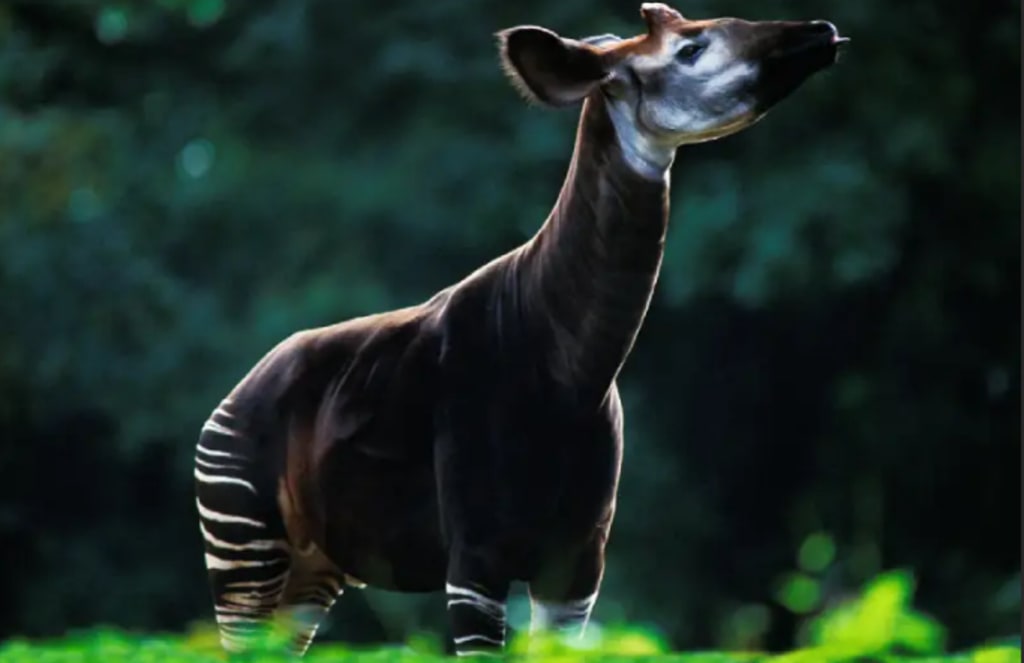
The okapi is a striking animal, often described as a cross between a giraffe and a zebra. It has a reddish-brown body, with distinctive white horizontal stripes on its legs and hindquarters, which provide camouflage in the dappled light of the forest. The okapi stands about 1.5 meters (4.9 feet) at the shoulder and measures around 2.5 meters (8.2 feet) in length. It weighs between 200 to 350 kilograms (440 to 770 pounds).
Unique Features
One of the okapi’s most unique features is its long, prehensile tongue, which it uses to strip leaves from trees and shrubs. This tongue can extend up to 18 inches and is also used for grooming. The okapi's large ears provide excellent hearing, essential for detecting predators in the dense forest.
Chapter 3: Habitat and Ecology
Range and Habitat
The okapi is endemic to the rainforests of the northeastern DRC, specifically the Ituri Forest. This region’s dense vegetation and high humidity create an ideal environment for the okapi, offering ample food sources and cover from predators.
Diet
Okapis are herbivores, primarily feeding on a variety of leaves, buds, grasses, fruits, and fungi. They have a highly selective diet, often feeding on over 100 different plant species. Some of these plants are toxic to humans but are processed safely by the okapi’s unique digestive system.
Role in the Ecosystem
As a browser, the okapi plays a crucial role in its ecosystem by helping to control plant growth and maintain the health of the forest. Its feeding habits contribute to the dispersal of seeds, promoting plant diversity and regeneration.
Chapter 4: Behavior and Social Structure
Solitary Nature
Okapis are largely solitary animals, with males and females only coming together for mating. They establish and defend territories, using scent marking to communicate with one another. Males tend to have larger territories that overlap with those of several females.
Communication
Okapis communicate through a variety of vocalizations, including infrasonic sounds that are below the range of human hearing. These low-frequency sounds can travel long distances through the dense forest, allowing okapis to stay in contact with one another.
Chapter 5: Reproduction and Lifespan
Mating and Gestation
The mating season for okapis is not strictly defined, as they can reproduce year-round. Following mating, the female undergoes a gestation period of approximately 14 to 16 months. She typically gives birth to a single calf, which is hidden in dense vegetation for the first few weeks of life to protect it from predators.
Growth and Development
Okapi calves grow rapidly, beginning to forage for solid food within a few months. They are weaned by six months but remain with their mothers for up to a year. Okapis reach sexual maturity at around two to three years of age and can live up to 30 years in captivity.
Chapter 6: Threats and Conservation
Human Impact
The primary threats to the okapi include habitat destruction due to logging, mining, and agricultural expansion. Poaching for bushmeat and the illegal wildlife trade also pose significant risks. Additionally, political instability in the region complicates conservation efforts.
Conservation Initiatives
Several initiatives are underway to protect the okapi and its habitat. The Okapi Wildlife Reserve, established in 1992, covers approximately 13,700 square kilometers of the Ituri Forest and is a UNESCO World Heritage Site. This reserve is home to a significant portion of the wild okapi population and serves as a critical area for research and conservation efforts.
The Okapi Conservation Project
Founded in 1987, the Okapi Conservation Project (OCP) works to protect okapis through a combination of habitat preservation, research, and community engagement. The OCP collaborates with local communities to promote sustainable land-use practices and reduce human-wildlife conflict.
Chapter 7: The Okapi in Culture and Myth
Indigenous Beliefs
The okapi holds a special place in the cultures of the indigenous peoples of the Congo Basin. It is often featured in folklore and is considered a symbol of the forest’s mystery and beauty. The Mbuti pygmies, for example, have numerous stories and songs about the okapi, reflecting their deep connection to the animal and its habitat.
Modern Representation
In modern times, the okapi has become an ambassador for rainforest conservation. Its unique appearance and elusive nature make it a powerful symbol for the need to protect biodiversity and preserve the world’s remaining wild places.
Chapter 8: The Okapi in Captivity
Zoos and Breeding Programs
Okapis have been successfully bred in captivity, with zoos around the world participating in coordinated breeding programs to ensure genetic diversity and the species' long-term survival. The first okapi was brought to a zoo in 1937, and since then, numerous institutions have contributed to the captive population.
Challenges and Successes
Breeding okapis in captivity presents several challenges, including their specific dietary needs and sensitivity to environmental changes. However, advancements in animal care and husbandry have led to numerous successful births and the development of comprehensive care protocols.
Chapter 9: Scientific Research
Field Studies
Field research on okapis is challenging due to their elusive nature and the dense rainforest habitat they occupy. However, advancements in technology, such as camera traps and GPS collars, have provided valuable insights into their behavior, movement patterns, and population dynamics.
Genetic Studies
Genetic research has revealed important information about the okapi’s evolutionary history and relationship to the giraffe. Despite their physical differences, the okapi and giraffe share a common ancestor, diverging around 11 to 12 million years ago.
Chapter 10: The Future of the Okapi
Conservation Outlook
The future of the okapi depends on sustained conservation efforts and international cooperation. Protecting the okapi’s habitat, combating poaching, and supporting local communities are essential for ensuring the survival of this remarkable species.
Role of Education
Education plays a crucial role in okapi conservation. Raising awareness about the okapi and its ecological importance can inspire people to support conservation initiatives and advocate for policies that protect wildlife and habitats.
Conclusion
The okapi, with its unique appearance and mysterious nature, continues to captivate and inspire those who encounter it. As we learn more about this enigmatic animal, we gain a deeper appreciation for the complexity and beauty of the natural world. By working together to protect the okapi and its rainforest home, we can ensure that future generations will have the opportunity to marvel at one of nature’s most extraordinary creations.
About the Creator
Francis C Okoro
"If you learn from defeat, you haven't really lost." - Zig Ziglar
Reader insights
Nice work
Very well written. Keep up the good work!
Top insight
Excellent storytelling
Original narrative & well developed characters
Keep reading
More stories from Francis C Okoro and writers in Petlife and other communities.
The Enigmatic Pangolin: Nature’s Armored Treasure
The Enigmatic Pangolin: Nature’s Armored Treasure Pangolins are one of the most unique and fascinating creatures on Earth. Often referred to as "scaly anteaters," these elusive mammals are covered in tough, overlapping scales made of keratin—the same protein that makes up human hair and nails. Found across Asia and Africa, pangolins are renowned for their distinct appearance and intriguing behaviors. Here are some interesting facts that highlight the remarkable nature of pangolins.
By Francis C Okoroabout a year ago in Petlife
A Dart at Dusk
Seconds ago, the sullen sun set on the two of us… my exuberant furry companion and me. A fresh breeze embraces us, delivering welcome relief from the day’s oppressive heat. His typical stumbling and staggering along — apace with a sloth — has turned into trip-trapping, high-stepping, almost skipping along.
By Angie the Archivist 📚🪶5 days ago in Petlife


Comments (2)
Excellent writing
I just heard there is such an animal name