
"The Crimson Sunbird: Beauty, Balance, and Biodiversity"
"A vibrant nectar-feeder with hummingbird moves and a heart full of color."

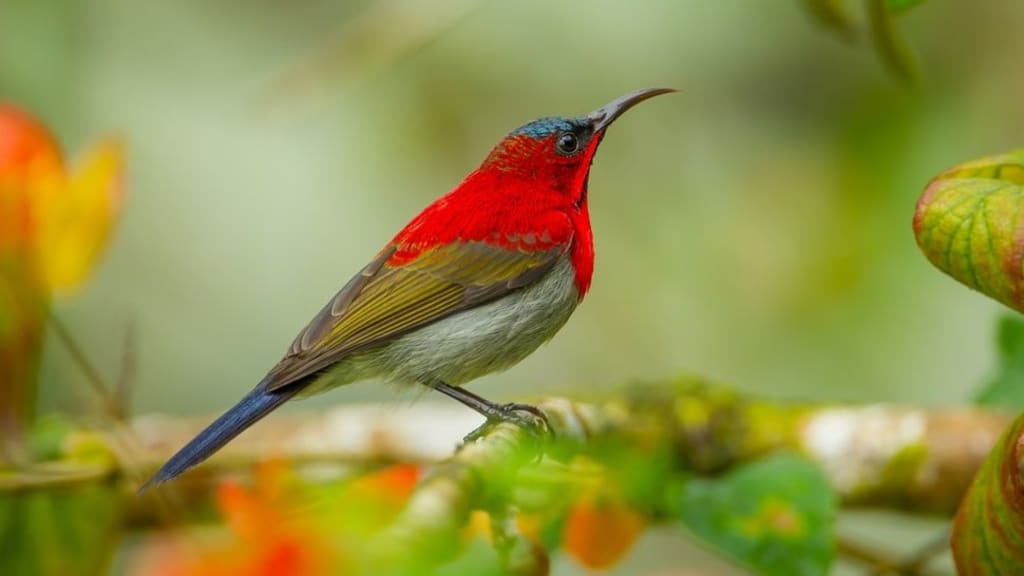
The Crimson Sunbird: Southeast Asia’s Tiny Jewel with a Hummingbird’s Heart
In the tropical landscapes of Southeast Asia, where jungles pulse with color and life, a tiny bird shines like a ruby in the sunlight. Meet the crimson sunbird (Aethopyga siparaja), a dazzling little creature that might be small in size but leaves a big impression wherever it flits.
A Living Jewel
The name "crimson sunbird" is no exaggeration. The males of this species wear a bright red coat of feathers that drapes across their breast and upper back, almost like a poncho made of fire. Their look is further enhanced by a shimmering blue crown on their heads and dark streaks near the neck, giving the appearance of a stylish mustache. These features make the male bird look like it’s dressed for a royal ceremony.
In contrast, the female is dressed more modestly in olive-yellow tones. While she may not have the vivid reds and blues of her male counterpart, her subtle colors help her blend into the green foliage, especially when nesting or caring for young.
Petite But Powerful
Despite their delicate appearance, crimson sunbirds are hardy and active birds. They grow to just about 5.3 inches (13.5 cm) long—roughly the length of an average smartphone. Yet their tiny frames are packed with energy. Like hummingbirds, they are constantly on the move, flitting from flower to flower in search of nectar.
What sets them apart, though, is their versatility. While hummingbirds feed almost exclusively while hovering, crimson sunbirds often perch when sipping nectar. Their slightly curved, slender beaks allow them to probe deep into flowers for sweet liquid, making them vital pollinators in the ecosystems they inhabit.
Where to Find Them
These sparkling birds are widely distributed across Southeast Asia. Their range stretches from the forests of northern India all the way through Malaysia and into the Indonesian archipelago. They thrive in a variety of habitats—from lush lowland rainforests to cultivated gardens and forest edges. If you’re walking through Southeast Asia and happen to notice a flash of red among the trees or hear a high-pitched, twittering call, there’s a good chance you’ve just spotted a crimson sunbird.
They’ve also adapted quite well to human presence. You can often see them darting among ornamental plants and flowering shrubs in parks and villages, bringing a splash of color and movement to otherwise quiet spaces.
More Than Just Pretty Feathers
Although the male’s radiant coloring might steal the spotlight, crimson sunbirds are more than just good looks. They play a critical role in pollination, helping to maintain the health of tropical forests and gardens. As they drink nectar, their heads often brush against pollen, which they carry from bloom to bloom, unintentionally aiding in plant reproduction.
In addition to nectar, these birds also eat small insects and spiders—especially important during the breeding season when they need extra protein for growing chicks.
The Courtship Dance
Like many colorful bird species, male crimson sunbirds use their plumage during courtship displays. In the right light, their feathers glisten with iridescent hues that shift as they move. During mating season, a male may perform an aerial display or sing a soft, high-pitched song to attract a female. Once paired, the female typically builds a hanging nest using plant fibers and spider silk, cleverly camouflaged among the leaves.
A Symbol of Tropical Beauty
In countries like Singapore, Thailand, and Malaysia, the crimson sunbird is a common and beloved sight. In fact, it's the national bird of Singapore. Its vibrant plumage and lively behavior make it a favorite among birdwatchers, photographers, and nature lovers alike.
These birds also serve as indicators of a healthy environment. A flourishing population of crimson sunbirds usually signals that the local flora is rich and well-balanced, with plenty of nectar-producing flowers and insects.
Protecting the Crimson Flame
Currently, the crimson sunbird is not endangered and enjoys a stable population across most of its range. However, deforestation and the loss of native flowering plants due to urban expansion could pose threats in the future. Conservation efforts that preserve natural habitats, promote sustainable land use, and encourage native plant gardening are crucial to keeping this beautiful bird common and thriving.
Even small actions, like planting nectar-rich flowers in gardens or protecting patches of native forest, can help support sunbirds and the pollinators they depend on.
A Tiny Bird with a Big Presence
The crimson sunbird is a glowing ember in the canopy, a symbol of life and beauty in tropical Asia. Though it weighs just a few grams, it carries with it the color of sunsets, the sparkle of gemstones, and the energy of a creature always in motion. Whether perched on a hibiscus or darting through a jungle trail, this little bird reminds us of the vibrant world just outside our windows—and why it's worth protecting.
About the Creator
Wow Genius
🕊️ Asalam-o-Alikum!
I'm Wow Genius — welcome to a space of peace, love, and inspiration. 🌿✨
Read stories that touch hearts, calm minds, and light souls. 📖💖
Thank you for joining this beautiful journey. 🌸🌙
Keep reading
More stories from Wow Genius and writers in Petlife and other communities.
A Dart at Dusk
Seconds ago, the sullen sun set on the two of us… my exuberant furry companion and me. A fresh breeze embraces us, delivering welcome relief from the day’s oppressive heat. His typical stumbling and staggering along — apace with a sloth — has turned into trip-trapping, high-stepping, almost skipping along.
By Angie the Archivist 📚🪶5 days ago in Petlife
Top Signs Your Pet Needs More Mental Stimulation
Mental stimulation is just as important for pets as physical exercise. Every pet, whether it is a dog, cat, rabbit, guinea pig or ferret requires mental stimulation to overcome stress, anxiety, or behavioral problems.
By Alice Adams5 days ago in Petlife
Wild Card Weekend Recap: What Happens Now?
I think I figured out why I love Wild Card Weekend so much. It's because it's the first playoff anything of the calendar year. The NFL season starts in the fall, and once upon a time, the champion was crowned either on or slightly before New Year's. The evolution of the NFL schedule has resulted in the playoffs starting just into the New Year, and currently, the final week of the season falls on the first weekend of the New Year, with Wild Card Weekend coming a week after that. So yes, chronologically, the NFL's Wild Card Weekend serves as the first playoff anything of the calendar year.
By Clyde E. Dawkins6 days ago in Unbalanced



Comments (5)
✨✨🍃
Wow amazing work
its real beauty
Enjoy and mention your opinion about beauty of birds & overhunting of birds.
Welcome to the beauty of bird.