
The animal with the "world champion" bite, 117 times stronger than humans: No one can hunt them!
When it comes to measuring what scientists call an animal's "bite force," there is both consensus and disagreement among those taking the measurements.


When it comes to measuring what scientists call an animal's "bite force," there is both consensus and disagreement among those taking the measurements.
Animals with the strongest bite in the world
Top 10: Hyenas - 1000 PSI
Top 9: Grizzly Bear - 900 to 1,200 PSI
Top 8: Polar Bear - 1,200 PSI
Top 7: Gorilla - 1,300 PSI
Top 6: Leopard - 1,500 PSI
Top 5: Hippo - 1,800 PSI
Top 4: American Alligator - 2,000 to 3,700 PSI
Top 3: Great White Shark - 4,000 PSI
Top 2: Nile crocodile - 5,000 PSI
Top 1: Killer Whale - 19,000 PSI - 117 times more bite force than humans
Bite force is understood as the force exerted when the teeth and jaws are brought together to bite and chew food. It is measured in pounds per square inch (PSI) of force an animal exerts on its prey.
Things like jaw size, tooth shape, and of course, the size and shape of the prey/food all affect bite force measurements.
For example, humans have evolved to eat omnivorous foods (both plants and meat), and the meat we eat is either cooked or broken down. Therefore, the bite/chewing force that scientists have measured in humans is 162 PSI.
Meanwhile, the animals on this list with the strongest bites must of course have caught their prey and eaten them alive, and as such, their bite strength must have evolved accordingly. Since there is some disagreement among scientists when it comes to measuring bite strength, most of the bite force measurements for these animals are estimates.
Worldatlas shares a list of the 10 animals with the strongest bites in the world (for animals still alive today), of which the species ranked Top 1 has a bite force 117 times stronger than that of humans - which species is it?
Top 10: Hyenas - 1000 PSI

Hyenas can bite into the marrow of their prey.
Interestingly, despite looking like members of the dog family, hyenas are more closely related to the cat family - and they're actually members of neither. They're so unique that they have their own family - the Hyaenidae.
Hyenas live in sub-Saharan Africa and parts of Asia and have surprisingly powerful bites for their size.
Their bite force is estimated at 1,100 PSI, designed to allow them to bite into the marrow of their prey's bones. Their teeth and digestive system are evolved to chew and digest bones.
Hyenas have a stronger bite force than wolves and domestic dogs (the largest of which is around 700 PSI). For comparison, members of the Felidae family have a stronger bite force than most lions, which have bite forces ranging from around 650 PSI to as much as 1000 PSI.
Top 9: Grizzly Bear - 900 to 1,200 PSI

A grizzly bear's bite is strong enough to crush a bowling ball with little effort.
Grizzly bears live in North America. They can weigh up to 700 pounds and their bite force ranges from 900 to 1,200 PSI. Unlike polar bears, grizzly bears are not strictly carnivores.
Omnivores like grizzly bears need to consume a diet that includes plants. They enjoy eating berries, roots, and grasses, as well as fish. In fact, grizzly bears are thought to be nearly 85% vegetarian. Grizzly bears also eat deer and elk when they can catch them, although these prey are more difficult to catch.
When hunting, they use their powerful bites, razor-sharp claws, and large bodies to hold down larger prey. Because they are not as agile when hunting as other animals, grizzly bears often prey on sick or injured animals.
Before hibernating in winter, grizzly bears need to eat enough food to help them survive the entire icy season. They can eat up to 40 kg of food per day during the pre-hibernation period.
Although their bite force is weaker than that of their polar bear relatives, it is still strong enough to crush a bowling ball with little effort.
Top 8: Polar Bear - 1,200 PSI

Polar bears are top predators in the Arctic marine ecosystem.
Polar bears live in the Arctic Circle, where they fight for survival in some of the harshest environments on Earth. They are apex predators in the Arctic marine ecosystem, primarily preying on seals.
Their bite force is over 1,200 PSI and is the strongest of the bear family. This may be partly due to the fact that they sometimes go without food for 3 or 4 months and need to stock up on food during times when food is plentiful in the Arctic.
To stay warm in the harsh Arctic cold, polar bears need to consume and digest large amounts of fat. Their stomachs are extremely efficient at extracting the nutrients (mainly fat and protein) needed to survive in such a cold environment.
Due to climate change, polar bears' hunting habitat is becoming increasingly inaccessible to them.
Top 7: Gorilla - 1,300 PSI
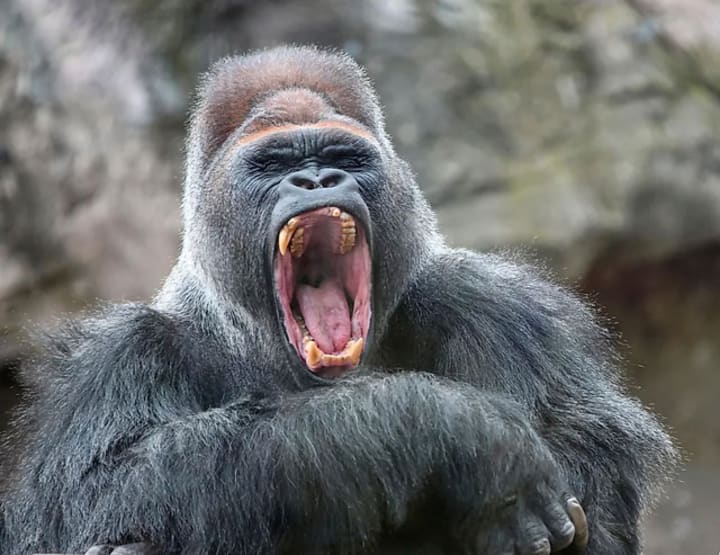
Gorillas use their powerful bites to strip tree bark in search of ants and larvae.
Despite their powerful bites, gorillas are primarily vegetarians. They live in the tropical forests of equatorial Africa and are primarily ground-dwelling. They use their powerful bites to strip tree bark in search of ants and grubs.
Interestingly, gorillas do not need to eat much protein in their diet because their digestive systems produce protein from the bacteria that live inside them. Despite being largely vegetarian, gorillas can grow to weigh up to 200 kg and can be as tall as an adult human.
Unfortunately, gorilla populations are declining due to climate change and industrialization. Their habitats are often encroached upon by expanding cities. According to the most recent count, there are only 1,063 mountain gorillas left in the world and they are considered an endangered species by the World Wildlife Federation.
Top 6: Leopard - 1,500 PSI

Cheetahs are extremely fast and can reach a terrifying speed of nearly 130 km/h.
Jaguars live in Central and South America, as well as the southwestern United States. They are large cats and can grow up to 6 feet (1.8 meters) long and weigh nearly 220 pounds (100 kilograms). They are extremely fast runners and can reach a top speed of nearly 80 miles (130 kilometers) per hour.
With a bite force of up to 1,500 PSI combined with that breakneck running speed, jaguars can hunt animals four times their size. Their name, “Jaguar,” comes from the indigenous word “Yaguar ,” which means “to kill with a single leap.”
The jaguar's powerful bite allows it to bite through the hard shells of turtles, the "armored skin" of crocodiles, and crush the skulls of any animal it can catch.
They are opportunistic carnivores, eating a wide variety of animals. Jaguars will eat snakes, lizards, large and small mammals, and even fish.
Like many other animals, deforestation and climate change threaten the jaguar's territory and numbers.
Top 5: Hippo - 1,800 PSI

Despite their powerful bite, hippos are vegetarians.
Hippos are the fifth largest land mammals on Earth. They are the third largest living mammals on Earth and are semi-aquatic, native to sub-Saharan Africa. The word “hippopotamus” can be roughly translated as “river horse” in Greek.
Despite their powerful bites, hippos are vegetarians. Their bites have evolved to help them ward off apex predators and fight other hippos for status in the herd.
Although primarily vegetarian, hippos are considered dangerous to humans and can be quite aggressive. Weighing up to 3.6 tonnes, hippos can move relatively quickly for their size. They can reach speeds of up to 50 km/h and are said to be very difficult to tame or train.
Like many other animals on this list, hippos are facing extinction due to shrinking habitats, with their numbers estimated at just 110,000 by the World Wildlife Fund.
Top 4: American Alligator - 2,000 to 3,700 PSI

Alligators are usually found only in freshwater.
With a bite force of over 2,000 PSI, the American alligator (short-nosed crocodile) is the next animal on this list. They live in parts of the United States, Mexico, and China.
As opportunistic predators, American alligators will patiently wait for the opportunity to strike and kill their prey. From snakes, fish and turtles to mammals and amphibians, even insects, they are not picky.
They are often referred to as "living fossils" and have remained virtually unchanged for 100 million years.
Alligators are typically found only in freshwater. Although they have special glands in their tongues to excrete salt from their bodies, this mechanism is not as effective as that of the Nile crocodile.
Top 3: Great White Shark - 4,000 PSI
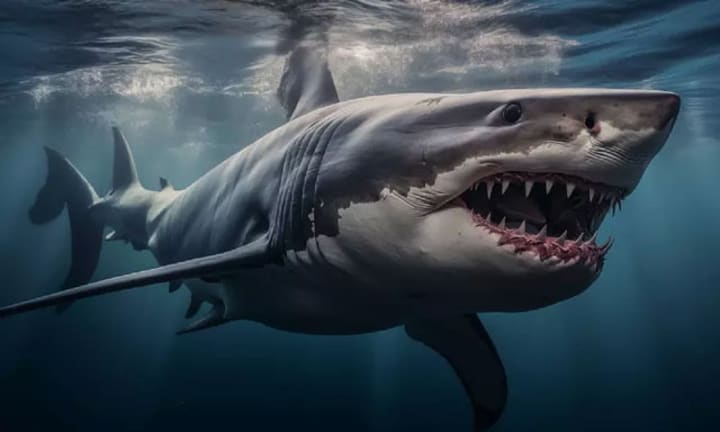
Great white sharks can live up to 70 years if they survive.
Great white sharks use an estimated bite force of 4,000 PSI to hunt pinnipeds like seals and sea lions. Juvenile great white sharks typically hunt smaller prey like fish.
These predators are found in coastal waters in major oceans around the world. Although many great white sharks do not survive past the juvenile stage, they can live up to 70 years if they do survive. They can grow up to 6 metres long.
Despite having nearly 300 teeth, sharks don't chew their food. They use their ferocious bites to tear their prey into manageable pieces, then swallow the flesh whole.
The World Wildlife Fund lists great white sharks as a vulnerable population. This is due to both climate change and years of shark hunting for their fins and teeth and as trophies.
Top 2: Nile crocodile - 5,000 PSI

Like other crocodile species, the life span of the Nile crocodile is up to 70 years.
The Nile Crocodile (also known as the long-nosed crocodile) has a bite force of 3,700 to 5,000 PSI. Although smaller than some other crocodiles, the Nile crocodile has the strongest bite of all reptiles. Like other crocodiles, the Nile crocodile has a lifespan of up to 70 years.
The Nile crocodile is native to sub-Saharan Africa and lives primarily in freshwater, although it can survive in saltwater and brackish conditions. Although it is generally smaller than its saltwater counterpart, the largest Nile crocodile ever recorded weighed more than a ton.
Nile crocodiles have a stronger bite than their larger cousins, earning them a place on the list of the top 10 animals with the strongest bites in the world.
Nile crocodiles can live in fresh, brackish and salt water thanks to a special gland on their tongue that can excrete salt from their bodies.
Top 1: Killer Whale - 19,000 PSI - 117 times more bite force than humans

Killer whales are social predators.
Killer whales are the reason why Nile crocodiles and saltwater crocodiles are combined on this list because their "world champion" bite force is said to surpass all other species in terms of maximum bite force.
Killer whales are pod predators that hunt and consume a wide variety of marine life, including fish, squid, dolphins, seals, sea lions, and other whales. As apex predators, killer whales are at the top of the food chain in their ecosystem and have no natural predators.
They need to eat about 4% of their total body weight every day. Females of this species can weigh up to 4 tons and live up to 50 years. Meanwhile, the largest adult males ever found in the wild reached more than 10 meters in length and weighed nearly 10 tons.
Although they are called killer whales, orcas are not members of the whale family – they are the largest members of the dolphin family (Delphinidae) and live in almost every ocean on Earth. Killer whales are a protected species and are at risk of extinction in some parts of the world due to climate change and declining access to adequate food sources.
About the Creator
HK Decor
Telling stories my heart needs to tell <3 life is a journey, not a competition
If you like what you read, feel free to leave a tip,I would love some feedback
https://s.shopee.vn/7fFUMxnnBx?share_channel_code=8
Keeping your pets safe (and calm) this holiday season
The holiday season may be magical for some humans, but for pets it only means confusion, changed routines, overstimulation, extra noise, guests or pet sitters come and go, and sometimes the festive season means danger for pets.
By Susan Fourtané 17 days ago in Petlife
Bruce Lee and The God of War: Kuan Ti
It starts with love.. The Power to the God Of War and Wealth Walk into a Chinese restaurant (even in Oklahoma, USA), a Chinese police station, a kung fu martial arts studio or even a Chinese temple and you often see a red faced warrior holding a heavy quan-do (spear like weapon).
By WILD WAYNE : The Dragon King5 days ago in Chapters


Comments
There are no comments for this story
Be the first to respond and start the conversation.