
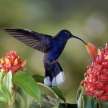

Smallest Birds on Earth
The Bee Hummingbird, found in Cuba, is the smallest bird in the world, measuring just 2 inches in length and weighing less than 2 grams.
Incredible Wing Speed
Hummingbirds beat their wings about 50 to 80 times per second, creating their characteristic humming sound.
Flying Marvels
These birds can hover in place, fly backward, and even upside down—unique abilities among birds.
High Metabolism
To fuel their energy-intensive lifestyle, hummingbirds eat up to twice their body weight in nectar daily and feed every 10-15 minutes.
Long Migration Journeys
Some species, like the Ruby-throated Hummingbird, migrate over 3,000 miles annually, including non-stop flights over the Gulf of Mexico.
Sharp Vision
Hummingbirds can see a wider range of colors than humans, including ultraviolet light, which helps them locate nectar-rich flowers.
Tiny but Territorial
Despite their small size, hummingbirds are fiercely territorial and will aggressively defend their feeding areas.
Rapid Heartbeat
Their hearts can beat up to 1,200 times per minute during flight, ensuring a constant supply of oxygen and energy.
Long Lifespan for Their Size
Although tiny, hummingbirds can live up to 5-10 years in the wild under favorable conditions.
Amazing Memory
They remember every flower they visit and the timing of nectar replenishment, showcasing impressive spatial memory skills.
Feather-Light Weight
Most hummingbirds weigh less than a nickel. For example, the Ruby-throated Hummingbird weighs around 3 grams.
Energy-Efficient Resting
At night or during cold weather, hummingbirds enter a state of torpor, significantly lowering their heart rate and metabolism to conserve energy.
Masters of Precision
Hummingbirds can pinpoint flowers with millimeter-level accuracy, making them some of nature’s best aerial acrobats.
Irreplaceable Pollinators
Many plant species depend entirely on hummingbirds for pollination, as their long beaks and tongues are perfectly adapted for deep flowers.
Tongue Magic
Their tongues are uniquely designed to extend twice the length of their beak and scoop nectar using rapid lapping motions.
Bright, Iridescent Feathers
The metallic sheen of hummingbird feathers isn’t due to pigment but microscopic platelets that refract light, creating vibrant colors.
One-of-a-Kind Birds
Hummingbirds are found only in the Americas, ranging from Alaska to Tierra del Fuego, with the highest diversity in tropical regions.
High Oxygen Demand
Hummingbirds have the largest heart-to-body-size ratio of any bird, ensuring a constant oxygen supply for their rapid movements.
Males Perform Dazzling Dives
Male hummingbirds court females with impressive dive displays, reaching speeds of up to 50 mph and pulling up sharply to show their agility.
Most Species Are Tropical
Over 300 of the roughly 360 species of hummingbirds live in tropical and subtropical environments.
Longest Beak-to-Body Ratio
The Sword-billed Hummingbird of South America has a beak longer than its body, the only bird with this characteristic.
Unique Nesting
Hummingbird nests are tiny, often smaller than a ping-pong ball, and built from soft materials like moss and spider silk for flexibility.
Capable of Rapid Liftoff
Unlike most birds, hummingbirds can take off vertically from a perch, an ability that contributes to their agility.
Heartbeats and Flights
Hummingbirds can fly at speeds of 30 mph in regular flight and up to 60 mph during courtship dives.
Oldest Fossil Record
The oldest known hummingbird fossils date back around 30 million years, found in Europe, although modern hummingbirds are native to the Americas.
Diet Beyond Nectar
While they primarily feed on nectar, hummingbirds also eat insects and spiders for protein and other nutrients.
Rain-Ready Birds
Hummingbirds shake their tiny bodies like dogs to dry off quickly after rain.
Symbolic Significance
In various cultures, hummingbirds symbolize joy, resilience, and the beauty of life, often inspiring art and folklore.
Surprising Strength
Despite their size, they can withstand high altitudes and have been observed flying over mountain ranges during migration.
A Rainbow of Species
Each hummingbird species has unique feather colors, beak shapes, and behaviors, reflecting the extraordinary diversity of these small wonders.
About the Creator
digitaloneindia portal
Live and Let Live !
Keep reading
More stories from digitaloneindia portal and writers in Petlife and other communities.
A Dart at Dusk
Seconds ago, the sullen sun set on the two of us… my exuberant furry companion and me. A fresh breeze embraces us, delivering welcome relief from the day’s oppressive heat. His typical stumbling and staggering along — apace with a sloth — has turned into trip-trapping, high-stepping, almost skipping along.
By Angie the Archivist 📚🪶7 days ago in Petlife
Top Signs Your Pet Needs More Mental Stimulation
Mental stimulation is just as important for pets as physical exercise. Every pet, whether it is a dog, cat, rabbit, guinea pig or ferret requires mental stimulation to overcome stress, anxiety, or behavioral problems.
By Alice Adams6 days ago in Petlife




Comments
There are no comments for this story
Be the first to respond and start the conversation.