
Sit, Stay, Transform: Inside the Quiet World of a Dog Trainer Academy
A firsthand journey into the art, science, and quiet revelations of training dogs—and ourselves.
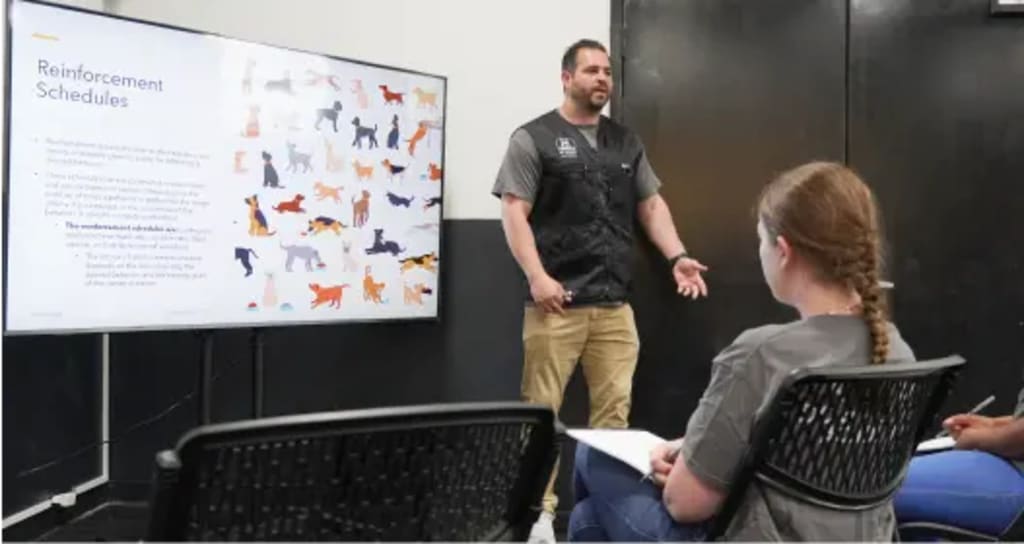
By the time the Labrador stopped lunging and settled into a calm sit, I had already started to cry. It wasn’t the dog—her name was Daisy and she was perfectly sweet. It was what she represented: the final step in a three-month journey that had pulled me from my apartment in Queens, dragged me through muddy fields in New Jersey, and planted me on the cold tile floor of a dog trainer academy in upstate New York.
Like many others who’ve felt their lives hollowed out by desk jobs and the weightless drift of adulthood, I found myself craving something tactile, something real. It began as a casual scroll through YouTube, watching a man in a beanie teach a trembling rescue how to walk without pulling. But what struck me wasn’t just the transformation of the dog—it was the transformation of the trainer. He was focused, still. He spoke softly. He was someone I wanted to be.
So I Googled.
Dog trainer academy. That was the phrase I typed into the search bar one night at 2 a.m., my cat asleep on my keyboard and a half-eaten tub of hummus at my side. A few weeks later, I’d quit my job in digital marketing, sublet my apartment, and enrolled in a program recommended by a quiet online community of behavior nerds and canine evangelists.
The academy was located in a converted dairy barn near Woodstock—part school, part sanctuary, and part psychological boot camp. Mornings began at 6:00 a.m., not with lectures or coffee but with poop bags and leads. Before breakfast, we were already walking five to seven dogs, each one a behavioral case study on four legs.
There was Max, a border collie with the intensity of a war general, who’d been surrendered after snapping at a toddler. There was Luna, a husky with separation anxiety so profound she once chewed through a door. And then there was Daisy, the aforementioned Labrador with eyes that seemed to plead for direction.
Our instructor, Karen, was a retired police K9 handler who moved like a ballet dancer and spoke like a therapist. “Training dogs isn’t about commands,” she’d say. “It’s about creating moments where a dog can choose trust over fear.” She never raised her voice, but we all stood straighter when she entered the room.
Each day at the dog trainer academy was divided between theory and practice. We’d spend hours breaking down Pavlov, Skinner, and Dunbar, arguing the merits of positive reinforcement versus balanced training, and examining case studies like they were legal briefs. But the real education came in the kennels and the fields.
It’s a humbling thing to be ignored by a 30-pound cockapoo while shouting “sit” like it’s a magic spell. One of the first lessons we learned was that dogs can smell desperation. If your energy is anxious, they’ll mirror it. If you lie, they’ll know. It’s a brutal kind of honesty that strips away ego, leaving you standing there, treat pouch in hand, wondering why this small animal won’t love you.
And yet, slowly, something shifts. You stop shouting and start listening. You begin to understand the difference between obedience and understanding. You recognize that a dog’s behavior isn’t defiance—it’s communication. And when they begin to respond—not just perform—you feel something close to grace.
I remember the first time Max laid down on command without the usual 30-second power struggle. He looked at me not with submission but with consideration. We had reached an agreement, not imposed a rule. Karen called it “the handshake moment”—the instant trust begins to replace tension.
Many of my classmates had similar epiphanies. Amy, a former nurse from Philly, found training dogs helped her grieve the loss of her son. Jorge, a quiet guy from Miami who used to work in security, said learning canine body language taught him how to read people better. Even the cynics among us—the ones who rolled their eyes at "energy talk"—couldn’t deny the transformation we saw in the mirror.
By the final week, we were each assigned a dog to “graduate” with. Daisy was mine. We had started rocky—she pulled, she barked, she ignored every prompt. But after three weeks of consistency, patience, and more than a few missteps, she began to soften. Our last test was a mock adoption event, filled with distractions: kids, balloons, loud music. Daisy stayed calm, walked in heel, even sat for pats from strangers.
I bent down beside her and scratched her chest, fighting the tears that came faster than I expected. It wasn’t just pride. It was the realization that, in trying to change her, I’d changed too.
Graduating from a dog trainer academy isn’t marked by caps and gowns. There are no valedictorians or commencement speeches. Just a line of dogs waiting their turn, and a group of humans learning how to be still, how to listen, and how to lead without force.
Back in Queens, my life looks very different. I no longer work in marketing. I take private clients now—mostly rescue dogs and confused owners. I meet them in parks, on sidewalks, in cramped apartments filled with barking echoes. I bring treats, but also that quiet confidence Karen taught us. The ability to wait. To observe. To earn trust.
Sometimes, on the good days, I think about Max and Daisy. I think about that barn in Woodstock, about the cold tile floors and the smell of kibble and hope. I think about what it means to train a dog, and how, in doing so, you might just train yourself to be a little more human.
About the Creator
JAKE MULLER
Jake is a certified AKC Canine Good Citizen Evaluator and Head Trainer at K9 Mania Dog Trainer Academy. He loves writing about dog training, behavior, and everything canine.
Keep reading
More stories from writers in Petlife and other communities.
The Summer I Was Chosen by a Northern Mockingbird
During the long, suspended days of the pandemic, a wild mockingbird began visiting my driveway and chose me, again and again. What started as a strange encounter became a brief, meaningful connection that I still carry with me.
By Erica Roberts 22 days ago in Petlife
How to Train Your Dog in Just One Week
Dog training can seem like a long, difficult process, but with consistency, patience, and the right technique, you can teach your dog basic obedience in just one week. Of course, some habits take longer to solidify — but a focused seven-day plan can get your dog on the path to being well-behaved and responsive.
By Paw Planet 6 days ago in Petlife
Blessed 33
So I woke up on the morning of February 5, 2026 and guess what and you know what I realized? It’s my 33rd birthday. Do you know what that means? Yes, technically I’m getting old, but what I couldn’t have guessed was this would be one of the best days of my life.
By Joe Patterson3 days ago in Confessions




Comments
There are no comments for this story
Be the first to respond and start the conversation.