

“When a resolute young fellow steps up to the great bully, the world, and takes him boldly by the beard, he is often surprised to find it comes off in his hand, and that it was only tied on to scare away the timid adventurers.” — Ralph Waldo Emerson
This quote is a good resume for a dog's aggression: a mask. Not always, but often enough, dogs attack to scare away something that is scaring them. And if "the thing" does not go away, it can end up with a bite.
Think of it, dogs cannot talk, but it does not mean they cannot communicate. It's humans who are not so good at reading their language due to lack of general education and years of wrong knowledge about dogs.
Pet dogs are not wolves. Full stop. They do not try to dominate humans nor do they try to take over our lives. They are pets, and all they want is what we want to: a safe, cozy, loving life environment. They became dogs to do just that, be with us. If they wanted to "dominate us" they would still be wolves.
Recognizing signs of fear:
Whereas we find it quite easy to understand when a dog is happy, recognizing fear might be one of the most important skills to learn if we own a dog. It can prevent harmful consequences for you, your dog, other people or other dogs. Fear is often the primary reason a dog gets injured or injures another being, as dogs are usually not biting animals despite having the full potential for it. Their decision to bite most often emerges from not being able to “flight” from a fearful situation; being constrained, on a leash or chained to a all or other fixed place can cause extreme fear because the dog might not be able to get away from something he considered a threat, resulting in a bite instead.
Recognizing fear signals is therefore our biggest tool for everyone’s safety and it can be done with a little bit of attention and getting to know our dog. Be it our cute and little Maltese or our big and mouthful Rottweiler, they all have the right to be kept safe and fear free.
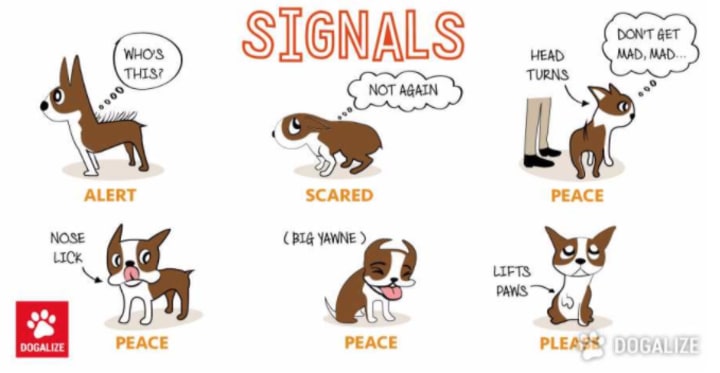
Dogs fear signals, as well as anxiety and stress, are more subtle than joyful ones and can often be misinterpreted. Some are:
• Tucking their tail. You see that all the time at the vet. Look at the waiting room and notice how many dogs have their tail tucked. You’ll be surprised!
• Ears held backwards. This can be more difficult to see in dogs having hanging or flat ears. It is easy to see in a Husky, less evident in a Cavalier King Charles Spaniel.
• Licking their lips and nose. If they have not just finished eating and are in a situation where lip licking is not expected, take notice. Is she doing it repeatedly? Is she showing other signs of stress? It might be due to fear or anxiety.
• Whale eyes. That is how we call fearful eyes; we will notice their eyes becoming wide open and showing a lot of white around the sclera. Anxiety, uncertainty, fearful situations can create whale eyes. More difficult to notice with brachiocephalic dogs and breeds where eyes are naturally showing more white such as Chihuahuas.
• Looking away. Dogs find it uncomfortable to directly look at what causes them fear, it is quite easy to notice because they might take a short look to immediately look away again.
• Lifting a paw. Another sign that can be interpreted as cute or funny, but when in a situation in which the dog shows other signs on this list, paw lifting can indeed be an indication of stress and fear.
• Shaking and trembling. This is one of the most obvious, unless of course it occurs in a short hair dog, outside, in the winter, then it might be the dog is cold, look for other signs.
• Panting. Without activities such like running or playing or any other physical reason a dog should be panting, look for other signs and try to find out if, and why, he is anxious.
• Yawning. As with humans and many other mammals, dogs yawn when stressed. It can be a milder sign of stress, but it can also be pared with other more prominent signs. Yawning also seems to be a calming sign of a dog relaxing after a stressful situation is over. Scientists are still debating this one a little.
• Sniffing. This can be very hard to identify as a sign of stress alone, and might require a deeper relationship with your dog and an understanding of the environment, but when a dog starts sniffing around for “no apparent reason”, the reason might be anxiety. It becomes a way for the dog to: “Do this so I don’t think about that”, that being what creates fear.
• Hiding and not moving, frozen behavior. This is obvious and easy to spot, but still some underestimate a fearful dog and impose her to “face her fears”. It might be wise to try and understand what the dog is afraid of and help her face her fears with compassion and support instead of imposition.
Many pet owners still believe a dog needs to "man-up" and be though, simply do to the fact they have teeth in their mouth, yet they miss the point where a confident and supported dog is what makes the tough dog they are looking for. Conversely, a dog forced to feel scared will very likely become a fearful and vulnerable dog, ending up to be aggressive for no "apparent reasons".
Interesting fact
Small dogs tend to bit owners more than big ones. The reason for this seems to be owners of small dogs tend to do two things wrong: they jerk their dogs around a lot more when on a walk, as if the small and light dog was a little toy needing to keep up with the pace of the owner, thus provoking anxiety and/or pain. Second, they seem to ignore fear and aggression signs more often than big dogs owners. When a Chihuahua growls people tend to tease him or say things like "how cute", and keep doing what they were doing until the dog bites. When a Rottie growls, we usually stop doing whatever we were doing and make sure the dog stops growling, which in the end, is exactly what the dog was trying to tell us in the first place.
Conclusions
Learn to speak dog. There are lots of good resources in the world today to help us understand our pets. A good communication will ensure a happy and fearless journey with our loved ones.
Thanks for reading from me and from your pet! If you found this useful consider liking and sharing and, why not, tips are welcomed to keep spreading the words for dogs! Moni V
About the Creator
Moni V.
Author, Poet, Editor, Story-teller and Tales-chaser. There is no fiction when a story knocks at your door, only revisions of events. Even those occurred only in someone's mind.
For Italian readers find me at moniv.club
A Dart at Dusk
Seconds ago, the sullen sun set on the two of us… my exuberant furry companion and me. A fresh breeze embraces us, delivering welcome relief from the day’s oppressive heat. His typical stumbling and staggering along — apace with a sloth — has turned into trip-trapping, high-stepping, almost skipping along.
By Angie the Archivist 📚🪶5 days ago in Petlife



Comments
There are no comments for this story
Be the first to respond and start the conversation.