
Lightening the Mood with Trick Training!
Step 1: The Plan

In the Beginning . . .
I own terriers, so naturally I'm a glutton for punishment. For that reason, I'm not going to be trick training Widget. I will instead be trick training Widget, Sassi, and Badger, Heaven help me. All three Toy Fox Terriers are at different stages of training. This fact will allow me to share more of what is involved in the process ad how trick training can be used to build a dog's confidence and skills. We'll also be building skills from Bella's Trix "Manners Matter, primarily for Widget and for Sassi. Sassi is, at this very minute, demanding that I get up from writing and feed her, so yeah. Manners . . .
Because I find terriers can be a, hmmm, challenge, to train at times, I find that lightening th mood is important. It's like that spoonful of sugar: training can be a lot easier if you allow the dog occasional opportunities to be goofy and show off how well he can jump into the box. The best thing about early trick training is that it allows the dog to get lots of rewards for lots of small efforts. It's not hard for the dog to follow a treat lure into a "spin," for example, and then to get the treat after three revolutions. It's such an easy trick to learn, that your dog might start "offering" it to you every time he wants attention!
Easy skills or not, all dog training starts with a plan. The plan is followed by the execution and, with luck, reaching the goal. To keep me on track, I try to keep a training log, to note what movement--either forward or backward--each dog has made. At times, noting the failures in training can be even more important than noting the successes. In this instance, I will attempt to make a bi-weekly progress report, even if it's just to say that no one made any progress at all. So, without further ado, here's what we'll be working toward! I will make a video of each skill as each dog masters it, eventually chaining all of each dog's new skills together for our submissions to Bella's Trix.
Badger
Qualifying for the TDI was just the first step. He and I have to represent TFTs everywhere and show our "skillz," given that we are still the only team qualified with a Toy Fox Terrier! We need to refine his behaviors and work on precision. Badger's tricks will be all about bringing him in closer to me and giving him more control over his rear end. Dogs typically don't realize that they have a back end, which is what causes sloppy and crooked sits to begin with. Badger will be working on the tricks below, selected from Bella-Trix's Beginner's list.
- Balance beam: This trick will help him control his rear in a straight line. Useful for Rally obedience and for agility.
- Go to bed from three feet: Teaches a dog to move away from the handler. and to remain in one place. Useful for directed jumping in traditional obedience.
- Hoop Jump: Prepares the dog for the agility tire jump.
- Jump over bar: Helps the dog build strength in hind quarters. Useful in agility, Rally obedience, and traditional obedience.
- Paws up (on an object): Predecessor to paws up and circling an object. Builds core strength.
- Paw Touch Floor Target: Teaches dog to find a starting line or
- Send around from three feet: Super exercise for creating body awareness. Sets up agility skills.
- Spin: Increases body awareness and builds core muscles. Prepares dog for working in tight circles.
- Stand: Many dog sports use a "stand" at one time or another. It's just an all-around useful skill.
- Target hand with nose: Increases the dog's awareness of the handler's hands, preparing them for signal exercises. In addition, hand targeting sets the stage for other targeting.
Sassi
I have neglected Sassi's training quite badly, so we need to pretend that she is a puppy. I will be starting with the extreme basics of Manners Matter, Level One. The six criteria for passing this level are:
- Name recognition--the dog responds to his or her name
- Basic play with your dog--the dog expresses a willingness to play an unstructured game
- Basic handling--the handler can run his or her hands over the dog's body
- Basic food manners--does not lunge for food or snatch a treat from the handler's hand. Did I mention terrier?
- Basic positions--Sit. The dog can be lured in position and doesn't need to stay.
- Basic collar manners--the dog must permit the handler to put his or her collar on, without showing reluctance or fear. This one will be a challenge for me, because I like slip collars and the criteria do not permit them.
If all of these skills seem like Anydog skills, they really are. Your dog is capable of them. So are my dogs. So are the dogs belonging to famous professional dog handler, Clint Livingston. Even better, any dog of any age can learn them! It doesn't matter if the dog is four years old and untrained (yes, I'm looking at you, Sassi!), he or she can learn these things and become a better companion. But I digress! Once we get Sassi secure with these skills, we'll be working on most of the same Freshers tricks that I'll be doing with Widget.
Widget
Because he is my "project dog, we'll be doing just a bit more with Widget. He's pretty secure with the skills that Sassi needs to learn, so we'll probably be doing a video of him to submit to Bella's-Trix fairly soon. Because he's a bit more advanced than Sassi, we'll be working on the Manner's Matter Level 2, as well as his Freshers Level of tricks. The nice thing about Bella's-Trix, as opposed to other organizations, is that they have this entry level for dogs and puppies--and owners!--who are new to training. For the Fresher's level, a dog need only master five skills to move on to the next.
Manners Matter Skills
Novice play with a toy--should engage willingness to play with the handler and must be under control at all times. Shows willingness to give up toy.
Novice handling and health inspection--the handler should be able check the dog's ears, as well as being able to run his or her hands over the dog's body. (This criterion is getting into the territory that has caused Widget so much trouble, so we need to move slowly with it.)
Novice food manners: impulse control--the dog must wait to take food until it is offered to him. The dog must not snatch or grab the food away when told to take it.
Novice leash manners--willingly allows the leash to be attached to the collar.
Novice recall--the dog should come when called from a minimum distance of three steps and allow the handler to grasp his or her collar. (We'll be practicing this skill in the enclosed pen, because he does not have a reliable recall yet.)
Novice position: Down--for many dogs, the "down" is difficult, given that we're asking the dog to take a submissive position. I've noticed that many TFTs have a hard time settling in with their elbows firmly on the ground. "Elbows down" will be ingrained from the beginning of Widget's training.
Novice "take item"--the retrieve is an advanced obedience skill. However, even retrievers need to be taught how to retrieve from an early age. Teaching the dog to release what he has retrieved can be tricky, so early teaching is imperative.
Novice leash walking--walk 10 steps on a loose leash without distractions.
Novice socialization & controlled greeting--Aye, Cap'n, thar's the rub. The dog must be able to greet a "new" person without "any signs of aggression, stress or undue nervousness when meeting new people." Widget has been doing okay with my friend Dan, when I'm holding Widget in my arms. On the floor? We'll see.
Novice stay (10 seconds)--Widget will be working on his sit-stay. This will give him a foundation for his first Rally obedience level.
Novice toy manners--the dog must not jump at or grab a toy held near to him.
Freshers Tricks
Sit--requires no duration, so a "gimme" trick with Manners Matter Level One training
Walk on loose leash--another "gimme," as he's better at walking on a loose leash than anything else. We'll use this one to simply walk him into the pen and set up the other tricks.
Fetch--chase a toy and bring it back to my general vicinity. Sets the foundation for the "retrieve" later on.
Kisses--Widget isn't big on sitting still in my arms, so holding him still to kiss my cheek will be a good step forward for him. Sets the foundation for nothing, but it's fun!
Find treat--the dog has to find a treat hidden under something, such as a cup, a box, or a bowl. At this stage, the dog can watch the treat being placed. Creates a foundation for nosework or barn hunt.
What's up with the Tongue Depressors?
The absolute best way to keep track of what you've trained is to keep a thorough log. If you are a good and organized trainer, then you should note the date, the time of day, the behaviors you've trained along with the repetitions of each, the treats you've used, the location, and, if you train outside, the weather (including humidity and wind speed). However, if you are a person who lives in the real world, you might not have time to do all that record-keeping. I find that, unless I maintain a checklist type of log--and will, once I print out some forms when I go to town in a couple of weeks--I am unable to keep a log right now. That's where the sticks come in handy.
Each tongue depressor is color-coded for the dog I am training, as I am training three at the same time. At one end of the stick, I record the trick or behavior being trained. At the other end, I write the word "done." Each day, I select the number of tricks/behaviors I feel we'll be able to reasonably train in the time I have set aside. If I feel we've made good progress during the training session, I put the stick back into the cup with the word "done" facing up. Otherwise, the stick goes back into the cup for another selection. Once all tricks/behaviors are trained with progress, we start again. Choosing the sticks at random helps keep the sessions fresh, which is important with terriers. This method might not work with all dogs--some may need more consistency with repetitions to make forward progress. I'll know by the end of the first cupful of behaviors which dog or dogs benefit from this method.
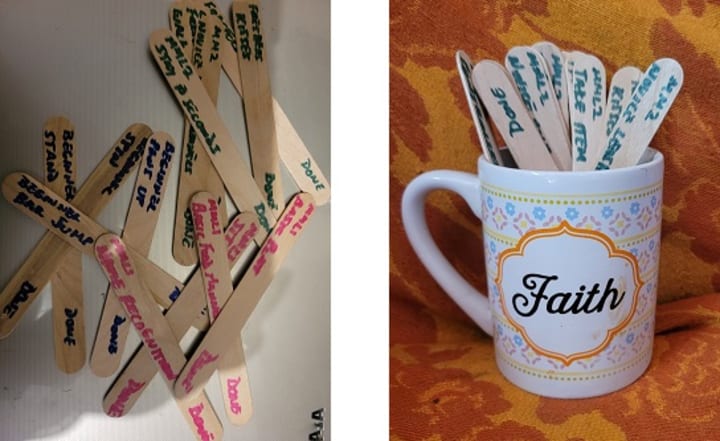
Preparation is DONE! Now on to training!
About the Creator
Kimberly J Egan
Welcome to LoupGarou/Conri Terriers and Not 1040 Farm! I try to write about what I know best: my dogs and my homestead. I'm currently working on a series of articles introducing my readers to some of my animals, as well as to my daily life!
Keep reading
More stories from Kimberly J Egan and writers in Petlife and other communities.
What on Earth is a Toy Fox Terrier?
If the Airedale is the "King of the Terriers," then the Toy Fox Terrier (TFT) perceives itself to be the Emperor of All Terrier Kind. TFTs are typically slightly larger than a Chihuahua, with show-quality dogs not exceeding 7 pounds or 11.5 inches at the shoulder, so they need to pack all of that confidence into a truly tiny package. They can be fun, exasperating, loving, exhausting, sweet, and challenging dogs. When someone comes to me looking for a puppy, the questionnaire they are required to fill out asks if they have previous dog experience. TFTs are small dogs but they are not beginner dogs. They are still terriers, with all that being a terrier implies.
By Kimberly J Egan4 years ago in Petlife
Off the Leash: The Essential Gear Guide for Adventurous Dogs
There’s something wildly freeing about unclipping the leash and letting your dog move the way they were built to. If you’re hiking in areas that truly allow off-lead exploration, your gear list shifts. No harness. No leash dragging through dust. Instead, it’s about smart, lightweight essentials that keep your dog safe, hydrated, and easy to manage when adventure gets messy. Long walks off lead are less about control and more about preparation.
By Shabbir Ahmad7 days ago in Petlife
The Ones Left Behind:
Shelters overflow every week with wagging tails and hopeful eyes. The young ones—the puppies and kittens—disappear within hours, scooped up by families eager for a blank slate. The old ones stay behind. They wait days, then weeks, often in silent confusion, still listening for footsteps they recognize.
By Dr. Mozelle Martin5 days ago in Petlife



Comments
There are no comments for this story
Be the first to respond and start the conversation.