
Left Behind
Her eyes are the color of Dulse seaweed.


Jennifer Hayes’ voice harmonized with the young host of Utah’s Public Radio. Atop the wooden box bed, layers of padding and blankets stacked midway up the passenger window where Lacy slept soundly, swayed by Goblin Valley road. Deep shadows caught in the crevasses of the hoodoo towers, the late summer sun spreading across the red desert, seductive as a house cat on a leather couch. It was four in the afternoon. Jennifer is an underwater ice photographer, speaking on her expedition to the Gulf of St. Lawrence during the 2014 Harp Seal pup season. The radio wavered. She had set out to capture the behaviors of Harp Seals in adolescence. When Jennifer and her team arrived in February, the pups were still so young they were not yet swimming for regular periods of time. Puffs of white fur waited along the edges of ice for their mothers to buoy up and touch noses in familial recognition. She took snap shots from below of their black noses and long whiskers dipped into the water, just four degrees above freezing. Jennifer dove down and back up, coming face to face with a young seal. She at once registered the pup’s confusion and curiosity at this new creature appearing where their mother usually would. Their true mother gracefully floated up beside Jennifer, touched noses with the pup, fastidiously looked them over to ensure the stranger had done no harm, and they left together under the ice. Jennifer swam behind the two, clicking her camera clumsily with thick gloves. Following the pair, she attracted the attention of a nearby male seal who bullied Jennifer away from his potential mate. The mother seal attacked the male offender. Jennifer and the pup floated together, watching from above as the mother banished him. Jennifer stayed swimming behind the two until the mother decided it was no longer worth the risk for them to be in the water. She nudged her pup back towards the ice, then Jennifer, then the pup, guiding them both to safety. That night, as Jennifer’s human team packed their gear to leave, a storm came in. Winds whirling, they made it back to shore. They tossed their gear off the boat as fast as they could when, Jennifer's guide came to her, “All the ice is gone. The Seals are gone.” She knew this did not mean the ice was gone, so the seals would move on to a new home. It meant the storm broke the ice up into shards, whipping the blades around in the winds and tides to blend the pups into the sea water. “What do you mean the ice is gone?” The grief was too much to comprehend. Eighty percent of the colony was lost that season. I reached my right hand behind the head of the passenger seat to pet Lacey, dazed by the passing red land, a stark contrast to the icy world being told to us over the radio. My fingers twisted through the longer white fur of her collar in soothing circles, she sighed. Her black ears hung low on her head, UPR was doing a fundraiser for the sound technician’s 61st birthday, matching every 61 dollars donated that day.
Three years ago, Lacey gave birth to her third litter. Four of seven survived. Two passed the night of the birth. The third lived on into early the next evening. Lacey was alone in the kitchen panting heavily, three wet puppies glistened with newness around her. The bigger of the three lay very still while the other two wiggled blindly after their mother’s warmth. I went to the still pup. Picking her up, she lay across my palm barely spilling onto my wrist, her bones soft from soaking in the womb. With just the tip of my finger, I pressed on her infant lungs. One pump and out of her nostril a bubble grew and stretched with heavy mucus, then sucked back in. Controlled even pumps, two breaths, always concerned with the delicate tissues of her newly formed body. One breath. Mucus spilled out of her pink and black nose. Two, she let out a weak gasp. I wiped her nose with my shirt. Turning to grab kitchen towels, I saw a fourth puppy had been born. Lacey hadn’t taken the placenta off of their face yet. I wrap the resuscitated pup in the towels, rubbing her sides back and forth like a stick starting a fire, angling her to keep the fluids dripping out. The fourth pup dies of suffocation and soon after the larger spotted one dies in my hands from fluids in her lungs. I swaddled them both in wait for others to come home. Three more puppies were born that night. We monitored them the next day, into the evening, when the last faintly stopped breathing. Tuberculosis overpowering their tiny frame. We took her back to her mother’s bed, laying her at Lacey’s paws. I lifted the white cloth from her small face. Lacey lay down her head, touching her nose to her baby's nose. I saw the recognition of lifelessness. Loss filled her eyes. I stood at the sidelines of my loved one’s grief only able to be her witness. The tender sadness moved throughout her body. She tucked her head to the corner and curled her fox tail tightly around her four new pups.
Lacey was born in the same kitchen eleven years ago. One of four half border collie mutts. Her grandmother, Gracie, was a Wyoming dog I got when I was thirteen. We pulled off the highway, “Minnie Australian Shepherds!” Gracie’s mostly black barrel shaped body suggested the breeding process had not been exactly strict. One summer, all three of our female dogs went into heat at the same time. The male got out, and all three litters were born within days of each other. Twenty puppies in total. Gracie had three puppies. So proud, she would stand outside the box wiggling her whole short stubby body, flattening her ears to the side of her head as you examined her babies. She had an expressive face, with many smiles and listening eyes. We were pals and I took the best care of her as I could. Three days after the birth, my father accidentally backed over Gracie with his truck. Her three pups were adopted by our hunting dog, Tucker, and assimilated in with her new litter. Gracie’s fur remained soft as I pet her body in the driveway. Time compounded. I imagine her fur did not become coarse until months after her having been buried. My mom said I could keep one of Gracie’s puppies if I wished. I named her Casie in honor of her late mother. So when I left for college and Casie had her first litter, it was only fitting my mother named one Lacey.
The radio turned to static. Lace and I slept under the hoodoos and prayed in their caverns. In the morning we crossed into Idaho to visit The City of Rocks. Granite towers, some estimated to be 2.5 billion years old, emerged next to the car. Slow deep curves in the dirt road lead us further into the mountains. More huge boulders cropped up, surrounding us with shadows and sage. We parked after dusk under a wall of million year old stone. In the darkness, I made myself a cup of peppermint tea and took the pink blanket, the one used to keep my grandmother’s feet warm in her passing, out to sit on the head of a great granite dragon. I sat and watched the sky. A star, or clump of space trash, or a wish, burned long and bright in the sky. My palm petted the blanked. Lacey sniffed about, following the remnants of small migrations. I could not see her black body in the night, but could occasionally hear her stop to drink fresh rain water from a pool in the pitted face of a nearby boulder. Every year for the past three years, I have lost a grandmother. My step grandma Diane from Parkinson's. Grandmother Evelin from Dementia. Grandma Judy, how tired she was. I feel for the first time, a generation’s farewell. I never expected to feel it, the collective loss of an ancestral linkage. It sits in the same place I hold my fondness and heartache for trees and whales. The moving on, a whole peoples, bound by their arrival in the 30's. These people built us, built what we have and know. These roads belong to them. Not even the stars or the stones remain unchanged. Lacey nudged me and slid under my knee. She was ready to go back to camp. In the morning we would continue north, headed for the Olympic Peninsula. Once, her and I sat for hours on a warm rock at the mouth of the Northern Atlantic. Watching the birds hunt and listening to the shells dragged by the waves, we leaned on one another in the salted spring air. We've moved through forests and time together, crossing mountain ranges and prairies, stopping to see our mothers in the high desert. Home is a fickle thing for me. My biggest fear and deepest need is that I will find it in the ones I love.
Lace wakes up happy, as she does every morning. The windows are fogged and dripping with the early fall rain. We crawl out of our den to a vivaciously green world and a forest mouse crossing the site. The slowest mouse either of us have ever seen. Lacey bounds after it. The creature does not react. It simply keeps at its wobbling pace. She opens her mouth, teeth hovering over them. No reaction. She is confused and pleased, and crouches low to follow behind it, into the damp ferns.
About the Creator
Angela Michelle
A continual practice.
Short essays, poetry, esoteric musings
Keep reading
More stories from Angela Michelle and writers in Petlife and other communities.
Cleo's First Puppy Show
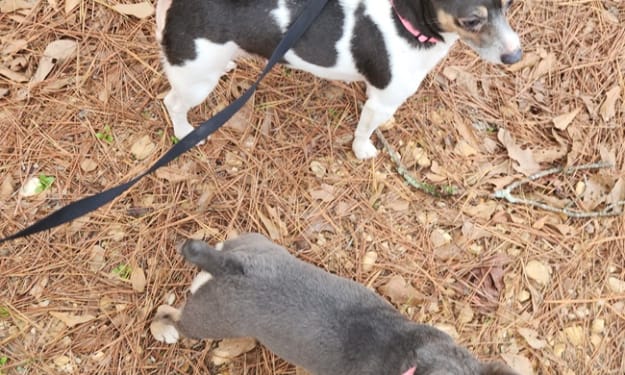
"How would you feel about doing the Corsicana show in November?" Kathleen asked me last September. Dog exhibitors speak in shorthand that way. It's easier to say "the Corsicana show" than it is to say the "North East Texas American Eskimo Dog Association Show." And yes, "North East." I guess "Northeast" shortened the name too much for some people's taste . . . But I digress. In response, I asked two of the three important questions that every exhibitor thinks, first thing.
By Kimberly J Egan27 days ago in Petlife
The Story of a Hawk
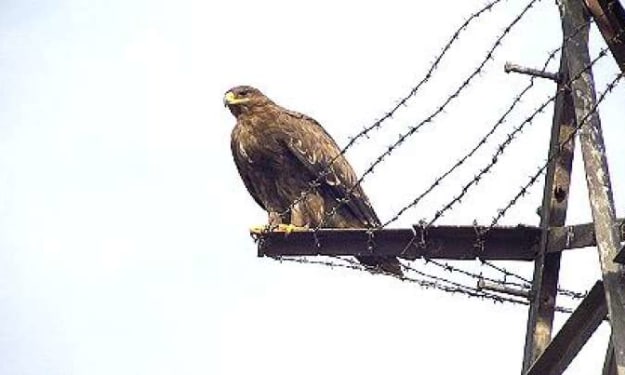
The Story of a Hawk Children! This is the story of a hawk that had been circling around a large pigeon loft for several days, waiting for the right moment to swoop down and snatch a flying pigeon. But the pigeons were very clever, alert, and quick in flight. Every time the hawk tried to catch one, they managed to escape, which left the hawk frustrated, unsure of what to do next.
By Sudais Zakwan8 days ago in Petlife

Comments
There are no comments for this story
Be the first to respond and start the conversation.