
King of the Northern Venomous Snakes: Lives well at -3 degrees Celsius, has 1 completely different characteristic from the king cobra
This snake belongs to the viper family. They possess very distinct characteristics.


This snake belongs to the viper family. They possess very distinct characteristics.
In nature, there are some animals such as turtles, bears, snakes... that will enter a state of hibernation every time the cold winter comes to reduce metabolism, thereby saving energy and maintaining life in harsh weather.
Regarding snakes, temperature is a factor that directly affects their survival , because snakes in particular are cold-blooded creatures - that is, they do not have a system that can regulate body temperature like humans, so their body temperature will change according to changes in the surrounding environmental temperature.
The most favorable temperature for this reptile is between 20 degrees and 30 degrees Celsius. Once the temperature drops below zero, the snake will freeze or even freeze to death. When the temperature drops to about 10 degrees Celsius, the snake's physiological functions decrease to the lowest level. At this time, they begin to stop all activities and go into hibernation mode to survive.
However, in northwestern China, there is a species of venomous snake that also chooses hibernation but can still survive the "biting cold" when the temperature drops to -3 degrees Celsius.
Because of this poisonous characteristic, this snake species in China is known as the "King of Northern Venomous Snakes" (in China).
So what is the "King of Northern Venomous Snakes" and where does it live in China?
We are talking about the viper Vipera berus , which lives in the Xinjiang Uyghur Autonomous Region of northwestern China.

Vipera berus.
Vipera berus is the scientific name of the European viper (European viper) of the Viperidae family. This venomous snake is widely distributed throughout Asia and Europe (up to the Arctic Circle). This species is usually identified by its body color - mainly brown or gray, with dark streaks or rings depending on habitat and sex. The head is slightly triangular, the eyes are large. The whole body is patterned and has large scales.
The most "unique" feature of the Vipera berus is its ability to survive and recover quickly in temperatures down to -3.1 degrees Celsius , Researchgate reported. That is why the Vipera berus is the species found further north than any other snake species on Earth.
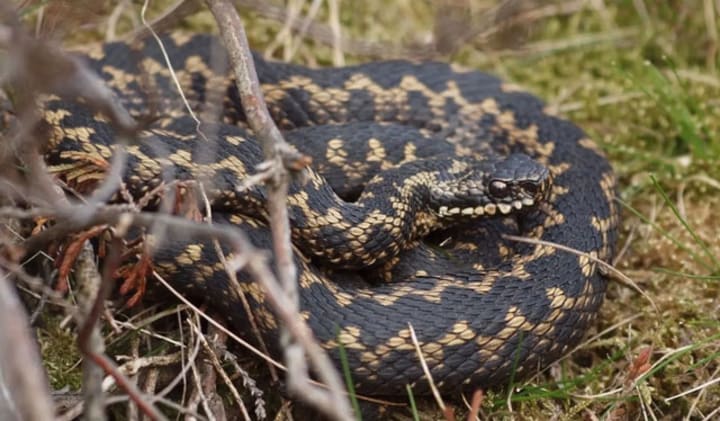
This snake species can survive and recover quickly in temperatures down to -3.1 degrees Celsius.
In addition to its ability to live in cold regions, Vipera berus lives in a wide variety of habitats, including grasslands, rocky hillsides, pastures, forest edges, clearings, coastal dunes and quarries. They will venture into wetlands if there is dry land nearby and can therefore be found on the banks of streams, lakes and ponds.
Vipera berus venom: Attacks cells, blood
One terrifying feature of this stout-bodied viper - which grows to just 90cm in length - is that it causes more snakebite accidents than any other species in the genus Vipera of the family Viperidae . The venom of Vipera berus is primarily proteolytic, hemolytic and cytotoxic.
Due to the rapid expansion of human encroachment into the species' range, bites are relatively common. Domestic animals and livestock are frequent victims. In the UK, most cases occur between March and October.

Vipera berus venom has mainly proteolytic, hemolytic and cytotoxic properties.
There are at least eight different antidotes to protect against bites from this species . Rarely, bites can be life-threatening, especially in young children, while adults may experience pain and swelling long after the bite. Recovery times vary but can take up to a year.
Local symptoms include immediate, severe pain, followed by swelling and tingling after a few minutes (but can last up to 30 minutes). Pain and inflammation can last for several hours. Immediately after the bite, the victim may experience nausea and vomiting, abdominal pain and diarrhea, sweating, fever, vasoconstriction, tachycardia, dizziness, loss of consciousness, temporary blindness, shock, hives, and bronchospasm. If left untreated, these symptoms can last for up to 48 hours. In severe cases, cardiovascular failure may occur.

Unlike the king cobra, which lays eggs, the viper Vipera berus gives birth to live young.
Another unusual feature compared to most other snakes is that Vipera berus give birth. They do not lay eggs like the King Cobra or Black Mamba. April is the most common month for this species to breed. Their gestation period is 3 to 4 months. Female vipers usually give birth to about 12 young. At birth, young Vipera berus vipers are about 16 to 18 cm long.
The viper Vipera berus is carnivorous and consumes a wide variety of prey, including small mammals such as voles (Arvicolinae), shrews (Soricidae), and mice (Murinae), as well as small lizards, birds, and frogs.
There are two hunting tactics commonly used by Vipera berus. The first tactic is called ambush. Vipera berus can wait patiently in one place for prey to pass by so they can attack, using their fangs to inject enough venom to kill the prey. They then use their keen sense of smell to track the wounded animal to death, after which Vipera berus will proceed to eat the animal's head first.
The second tactic involves actively searching for prey. Vipers often use this tactic when they are most excited - at dusk. This is when their venom is at its peak, which can easily cause a quick death of their prey.

There are several major predators that may hunt Vipera berus.
In the wider natural world, Vipera berus is not immune to natural predators. There are a number of major predators that may prey on Vipera berus. The most prominent include foxes, Eurasian badgers, large diurnal birds of prey, and owls. European vipers may also be preyed upon by larger snakes.
According to the International Union for Conservation of Nature (IUCN), the European pit viper is locally common and widely distributed throughout its range but there are no overall population estimates. It is currently classified as Least Concern (LC) on the IUCN Red List but its numbers are currently declining.
About the Creator
HK Decor
Telling stories my heart needs to tell <3 life is a journey, not a competition
If you like what you read, feel free to leave a tip,I would love some feedback
https://s.shopee.vn/7fFUMxnnBx?share_channel_code=8
Cleo's First Puppy Show
"How would you feel about doing the Corsicana show in November?" Kathleen asked me last September. Dog exhibitors speak in shorthand that way. It's easier to say "the Corsicana show" than it is to say the "North East Texas American Eskimo Dog Association Show." And yes, "North East." I guess "Northeast" shortened the name too much for some people's taste . . . But I digress. In response, I asked two of the three important questions that every exhibitor thinks, first thing.
By Kimberly J Egan8 days ago in Petlife
Why Losing a Cat Feels Like Losing a Piece of Your Soul
You never think it will happen to you. You wake up in the morning, your cat curled up on your chest, purring softly as if nothing in the world could ever go wrong. But life, as it often does, has other plans. One day, your beloved feline companion is gone, and with them, it feels like a part of your own heart has disappeared too.
By Ahmed aldeabella6 days ago in Petlife
Bruce Lee and The God of War: Kuan Ti
It starts with love.. The Power to the God Of War and Wealth Walk into a Chinese restaurant (even in Oklahoma, USA), a Chinese police station, a kung fu martial arts studio or even a Chinese temple and you often see a red faced warrior holding a heavy quan-do (spear like weapon).
By WILD WAYNE : The Dragon King5 days ago in Chapters



Comments
There are no comments for this story
Be the first to respond and start the conversation.