
In future Can animals learn to talk like humans?
The possibility of animals learning to speak like humans has long fascinated and intrigued both scientists and the public


The future of animal communication: Can animals learn to talk like humans?
The possibility of animals learning to speak like humans has long fascinated and intrigued both scientists and the public. The idea of conversing with animals as we do with other humans is a concept that raises many questions and possibilities. Although this is an attractive idea, the practical and ethical considerations involved are complex. In this article, we explore the current state of animal communication, the future development opportunities and the challenges that must be met.
1. The complexity of animal communication
Animals both within and between species communicate in different ways. These forms of communication are incredibly complex and refined to meet their needs in the wild. From the intricate dances of bees that communicate the location of food sources to the acoustic signals of dolphins, each species has developed its own unique language.
Animals' natural forms of communication often serve important functions in their lives, including mating, warning of danger, and maintaining social hierarchies. For example, the vocalizations of birds such as songbirds and parrots play a crucial role in attracting mates and defending territory.
2.Human-animal communication
Weand has made significant progress in teaching certain animals to understand and to some extent respond to human language. Dogs are an excellent example of domesticated animals that can respond to verbal commands. They can learn many words and phrases and interpret tone and body language. Additionally, they can form a strong emotional bond with their human partners.
In addition to dogs, certain primates have been trained to use sign language to communicate with humans. Perhaps the most famous example is Koko, a western lowland gorilla who learned a modified version of American Sign Language (ASL) and was able to communicate a wide range of thoughts and feelings.
Parrots, especially African gray parrots, have also shown the ability to imitate human speech. Although they may not understand words like humans, they can imitate a wide variety of sounds and use them to communicate even basic needs or wants.
These cases of human-animal interactions, although limited, show the remarkable adaptability and intelligence of certain species. However, they are far from being animals that speak like humans, they have a comprehensive understanding of language and the ability to engage in meaningful conversation.
3.Technological development and animal communication
Recent technological advances have brought us closer to the possibility of interacting with advanced animals. An example of this is brain-computer interfaces (BCI). BCIs can record and interpret neural activity, which has allowed researchers to make a more direct connection between animals and #039; thought processes. In some experiments, researchers used BCIs to convert neural signals into specific actions or commands.
One notable example of this technology is the development of devices that allow paralyzed people to communicate with their thoughts or control objects. BCIs can decode these thoughts and convert them into commands for computer systems or even robotic devices. BCIs applied to animals offer an opportunity to reduce the communication gap between species.
4. Ethical and practical challenges
While the prospect of animals learning to speak like humans is exciting, there are important ethical and practical considerations.
A. Respect for Animal Welfare:
Any attempt to teach animals to interact more with humans must prioritize their welfare and well-being. Animals must not be unreasonably stressed or harmed during the process. BCI or other advanced technology should be used in a way that respects the autonomy and human dignity of the animals involved.
B. Understanding the nuances:
Although animals can communicate in more complex ways, understanding their nuances and emotions can be a difficult task. Finding out their perspective, desires or concerns requires a deep understanding of their psychology, which is not always easy.
C. Biological Limits:
Animals and humans have evolved differently over millions of years, resulting in different biological structures and abilities. Achieving human language abilities in animals would require profound biological changes that could push the limits of what is ethically and practically achievable.
D. Language and Consciousness:
Human language is closely related to our consciousness, our self-awareness and our ability to think abstractly. It is still unclear to what extent animals have these abilities. This raises questions about whether animals can actually hold a meaningful, human conversation.
Conclusion: explore new horizons
Although it is unlikely that animals will learn to speak like humans in the near future, interspecies communication is evolving. Advances in technology, including BCIs, offer exciting opportunities to improve our understanding of animals and potentially expand the ways we interact with them.
About the Creator
Sarang Panhwar
Welcomes to my Account Hi i am here for you to share some hidden information's about the world that i gather for you i hope you will enjoy the reading and get more information's
Keep reading
More stories from Sarang Panhwar and writers in Petlife and other communities.
why do Camels poisonous Snakes?
The camel is one of the most famous domesticated mammals and domesticated animals, mostly used in the dry and cold desert. The camel family (Camelidae) first evolved in North America approximately 44 million years ago during the Eocene period. Camelops first appeared as fossils in the late Pliocene of North America 4-3 million years ago. A camel is a large animal that lives in the desert and is used to transport goods and people. Camels have long necks and one or two humps on their backs. Camels are large land mammals known for their humps. There are three types of camels: dromedary camels, Bactrian camels and wild Bactrian camels. The one-humped dromedary makes up 90 percent of the world's camel population. Bactrian camels are of two kinds, wild and tame, both having two humps. Wild Bactrian camels are critically endangered, with fewer than 1,000 individuals left.
By Sarang Panhwar2 years ago in Petlife
30 Days in a Shelter
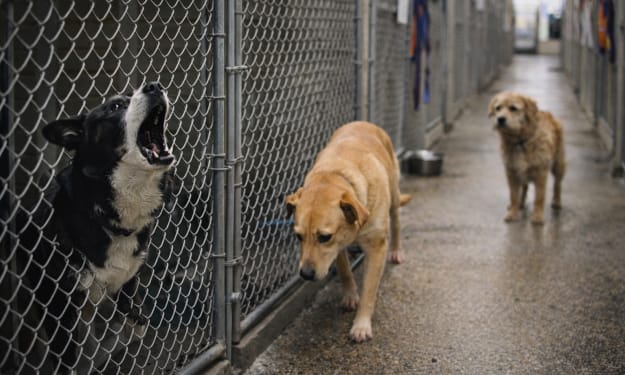
By day 3, the barking changes. The first 48 hours are chaos. Intake processing. New smells. Metallic doors slamming. By day 3, some dogs bark constantly. Others stop almost entirely. One paces the kennel line until the pads on his feet redden. Another stands motionless, eyes half-lidded, ignoring visitors.
By Dr. Mozelle Martin4 days ago in Petlife



Comments
There are no comments for this story
Be the first to respond and start the conversation.