
Fifteen Years in Seven Sentences:
The Psychology of Loving a Dog from Start to Finish

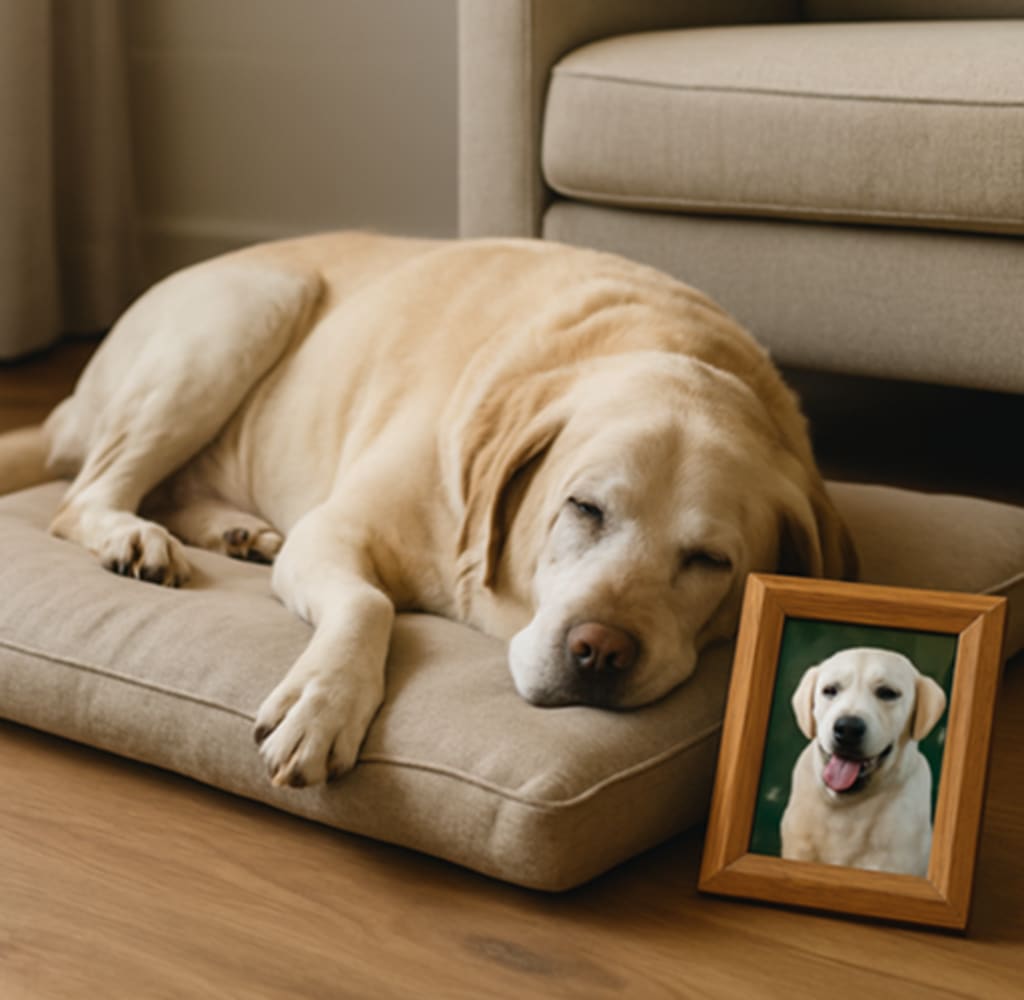
The emotional lifespan of a dog could be written in 7 sentences. They start with chaos, crescendo into friendship, and close with silence. Every stage along that line tells us as much about ourselves as it does about them.
(1) At four months old, we marvel at their curiosity, their clumsy steps, their oversized paws. The human nervous system interprets their innocence as purity. We call them “cute,” but what we’re really responding to is recognition.
- Their trust is unguarded.
- Their excitement about life feels like relief from our own exhaustion.
This is limbic resonance—one mammal’s brain syncing with another’s through warmth, movement, and tone. What begins as affection is already a biological agreement.
(2) By six months old, novelty has worn off and discipline begins. The same curiosity that once made us laugh now tests patience.
- Chewed shoes,
- barking fits, and
- endless messes introduce frustration.
But this is the behavioral hinge point. A young dog’s brain is mapping cause and consequence while the human’s is learning unconditional consistency. This stage separates ownership from partnership. Those who leave the relationship here never experience what comes next.
(3) At one year old, the bond stabilizes but the behavior peaks.
- Adolescent dogs act impulsively, push boundaries, and misread cues.
In clinical terms, they’re neurologically unfinished. Humans often call it “defiance” when it’s simply developmental misfire—an immature prefrontal cortex trying to self-regulate without experience. Every repetition of calm correction rewires their nervous system to associate leadership with safety rather than fear. When people mistake correction for control, they lose the lesson altogether: boundaries build trust, not dominance. I wrote more about this HERE.
(4) At two years old, predictability emerges.
- The household becomes a pattern—feeding times, walks, tonal language, and shared energy cycles.
- The cortisol that once drove chaos lowers to baseline.
- Serotonin rises.
This is when real attachment forms. The human begins to understand the quiet intelligence behind routine. The dog begins to interpret subtle tone shifts and gestures that humans aren’t even aware they’re giving. Both nervous systems are communicating below language.
(5) By five years old, attunement becomes second nature.
- The dog reads a sigh before it becomes words.
- The human senses unease before it becomes behavior.
It’s the same bond seen in therapy animals and trauma survivors—the biological feedback loop where presence itself becomes medicine. Science calls it parasympathetic regulation; the heart just calls it belonging. The relationship now functions like emotional gravity. Each stabilizes the other.
(6) At nine years old, the relationship matures into simplicity.
- The chaos and novelty are long gone. What remains is rhythm and understanding.
- The dog no longer needs commands to follow, and the human no longer needs validation to give affection.
It’s mutual comprehension without transaction—a level of trust that few humans reach with each other. That is why so many say their dog “gets” them better than people do. It isn’t fantasy; it’s chemistry. Two organisms that have spent nearly a decade co-regulating no longer operate separately. They move as one.
(7) By fifteen years old, the arc closes.
- The body slows, the eyes soften, and mortality creeps in like an unwelcome guest who still commands respect.
- Humans grieve long before the end arrives.
- Every small change—a missed meal, a shorter walk, a longer nap—becomes its own funeral. Yet this period may be the most humanizing of all.
- The caregiver role reverses. We learn that love is not about keeping something alive—it’s about keeping it comfortable, safe, and seen until the end. When death finally comes, gratitude replaces grief. We realize that frustration, laughter, and loss were all part of the same curriculum. I wrote more about this HERE.
To love a dog from beginning to end is to participate in a living laboratory of empathy.
- It teaches consistency, patience, nonverbal attunement, and grief literacy.
- It refines emotional intelligence in ways no theory or classroom could.
- The dog learns trust through pattern.
- The human learns compassion through imperfection.
And both walk away neurologically changed.
The miracle is not that dogs love us back. It’s that they trust us enough to teach us how to be human again. They arrive without cynicism, without armor, without any reason to believe that this time will be different—and yet they believe anyway.
Every wag, every returned glance, every quiet moment at our feet is a lesson in forgiveness delivered without language. They don’t care about our flaws, our tempers, or the days we fail to be patient. They care that we return. That we try again. That we keep showing up.
In their world, effort counts as proof of love. And somewhere along the way, that proof begins to change us.
- It softens what the world hardened.
- It steadies what fear fractured.
- It makes us capable of gentleness again—not because they demanded it, but because they modeled it.
This is the real transformation. The miracle is not affection. It’s redemption through trust and unconditional love.
And that's largely why I created this PET VR program. But it can't exist without your help!
Sources That Don’t Suck:
American Veterinary Medical Association. Pet Behavior & Welfare Reports, 2023.
Beerda, B. et al. “Behavioral and Hormonal Correlates of Chronic Stress in Dogs.” Physiology & Behavior, 1999.
Bekoff, M. The Emotional Lives of Animals. New World Library, 2007.
Horwitz, D.F. Clinical Behavioral Medicine for Small Animals. Elsevier, 2018.
Nagasawa, M. et al. “Oxytocin-Gaze Positive Loop and the Coevolution of Human-Dog Bonds.” Science, 2015.
University of Bristol Veterinary School. Human-Animal Interaction Study Series, 2022.
About the Creator
Dr. Mozelle Martin
Behavioral analyst and investigative writer examining how people, institutions, and narratives behave under pressure—and what remains when systems fail.
Keep reading
More stories from Dr. Mozelle Martin and writers in Petlife and other communities.
Do Cats and Dogs Remember Their Abuse
Ask anyone who’s worked in animal rescue what happens when a once-beaten dog sees a raised hand or when a starved cat flinches at the sound of keys. They’ll tell you the same thing: these animals remember. But not as a story. As a sensation.
By Dr. Mozelle Martin5 months ago in Petlife
Off the Leash: The Essential Gear Guide for Adventurous Dogs
There’s something wildly freeing about unclipping the leash and letting your dog move the way they were built to. If you’re hiking in areas that truly allow off-lead exploration, your gear list shifts. No harness. No leash dragging through dust. Instead, it’s about smart, lightweight essentials that keep your dog safe, hydrated, and easy to manage when adventure gets messy. Long walks off lead are less about control and more about preparation.
By Shabbir Ahmad4 days ago in Petlife
Worth the Wait: Puerto Viejo, Costa Rica
Beach bumming in a small Caribbean beach town sounded like a perfect way to end our 6-month trip through Mexico and Central America. Or so we thought. The foul, fishy stench of rotten seaweed hit our nostrils as we stepped from the cramped bus and looked out at a rather depressing, empty, and underwhelming black sand beach. It was pouring with rain, and we had to quickly fish out our ponchos. We thought, this couldn’t be it, could it?
By Sh*t Happens - Lost Girl Travel7 days ago in Wander




Comments