
Famous Horses
Well-known horses from history, the movies, TV, and the races

Movie and TV horses
People enjoyed the exciting adventures of a man called the Lone Ranger and he had a horse called Silver. Whenever the Lone Ranger was ready to ride away he shouted, "Hi-Yo Silver! Away!" Silver, the fictional white stallion became popular along with his master on the US radio show and TV series.
The predecessor of Sliver was a chestnut mare named Dusty, which was revealed in the 1938 episode titled "The Legend Of Silver." When The Lone Ranger saved the life of Silver from a savage buffalo, Silver gave up living in the wild and became the loyal companion of the masked marvel The Lone Ranger.
New generations got to enjoy the adventures of The Lone Ranger and Silver in the 2013 movie starring Johnny Depp.

A beautiful horse called Black Beauty came from the pages of an 1877 novel by Anne Sewell. The book was adapted for the stage, made into several movies, and a TV series. Everyone loved to follow the adventures of the beautiful black stallion.
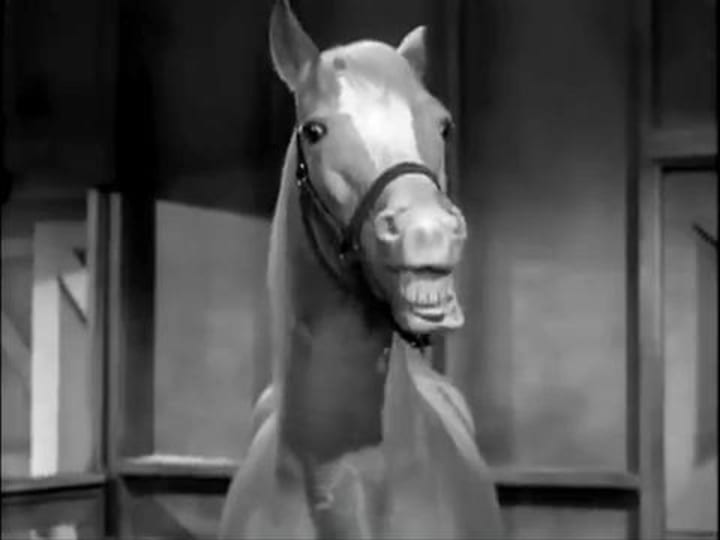
Everyone for a time knew the words to the theme song that opened the TV show "Mr Ed" which became a favorite comedy about a talking horse. Mr. Ed was played by a gelding named Bamboo Harvester. To get the horse to appear like he was talking a thin nylon thread was put through his mouth and what looked like the horse was talking was actually the horse trying to get that thread out of his mouth.
"A horse is a horse, of course, of course, and no one can talk to a horse unless of course, the horse is the famous Mister Ed!"
Mister Ed was a troublesome palomino who had the gift of talk (voiced by former Western star Allan Lane) and gave his owner Wilbur Post a whole lot of trouble. The horse had a lot of opinions and only spoke to his owner played by Alan Young. The TV series aired from 1961 to 1966 and had a cast of guest stars among them, Clint Eastwood and Zsa Zsa Gabor. The series won a Golden Globe Award in 1963 for Best Comedy TV Series.

Trigger is perhaps the most famous of TV horses. Originally the horse was called Golden Cloud and was owned by Roy Rogers. The horse appeared on TV, made personal appearances, and was in parades with TV cowboy Rogers.
Trigger was also seen with his famous buddy Buttermilk, owned and ridden by the wife of Rogers, Dale Evans. Trigger was a palomino Thoroughbred X Grade stallion. Over the years the horse knew how to perform more than 150 tricks and was used in the Roy Rogers TV series.
The original Trigger was taxidermied and in 2010 was to be placed in a museum however up to today is not on display to the public.

Racehorses
Seattle Slew became one of the biggest names in horse racing history. In 1977 he won the Triple Crown as well as six other raves to make a perfect 9-0 for the year. Seattle Slew held the record for many years until in 2018 Justify matched it winning the Triple Crown as well as having a perfect record for the year.

Seabiscuit came around during the Great Depression, The thoroughbred horse suffered 17 career defeats until he registered his first victory in 1935. The horse became unstoppable when he was paired with Canadian jockey Johnny Red Pollard and by 1937 Seabiscuit claimed seven consecutive victories.
Among his most memorable victories was against the 1937 Triple Crown winner War Admiral and Seabiscuit outclassed his rival in what became known as the "Match Race of the Century." A movie was made about the horse in 2003 and was nominated for seven Academy Awards.
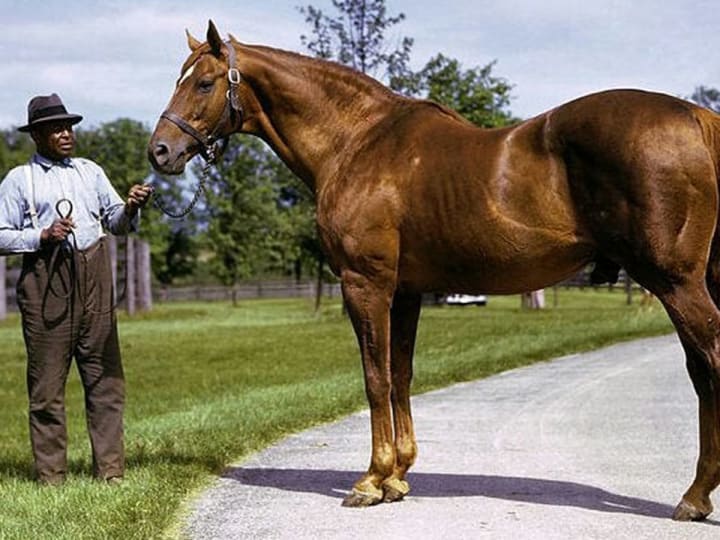
Man o’ War was looked upon as one of the greatest racehorses of all time and dominated American horse racing in the 1920s. During his racing career, the horse suffered only one defeat at Saratoga Springs losing by a small margin to a colt named Upset. Man O' War remained victorious in all the remaining 20 races of his career. It is said that this legendary horse had a 28-foot stride which is looked upon as the longest of all time. His successes increased the popularity of horse racing.

Citation was the greatest racehorse ever ridden by the greatest jockey in the history of American Thoroughbred horse racing. His claim to fame is being the only jockey to win the US Triple Crown twice. Citation won the Triple Crown in 1948 and became the first horse in history to win one million dollars.

American Pharoah was foaled in 2012 and was the first horse ever to win the Triple Crown and the Breeders' Cup Classic in 2015. The horse was the 12th Triple Crown winner in history and in winning all four races. American Pharoah became the first horse to win the "Grand Slam of Horse Racing." He now stands at stud at Ashford Stud in Kentucky.

Horses In History
One of the earliest horse breeds developed in the US is the Morgan horse breed. The lineage was started by a horse named Figure who was a small bay stallion. Even though he was small in size he was strong, fast, and had a stylish way of moving. At 3 years old Figure was given to Justin Morgan, a music teacher, and composer.
Under Morgan's care, Figure gained fame for his abilities as a workhorse and in speed as a racehorse. He beat out two New York racehorses in a 1796 sweepstakes race and became known as the Justin Morgan horse.
The American Morgan Horse Association states that Figure's ability to out-walk, out-trot, out-run, and out-pull other horses was legendary.
Figure continued to sire foals as he was traded from owner to owner in his later years. He was used for everything from logging to racing to being a parade mount. Levi Bean was his final owner in 1819 as he was put out to pasture and in 1821 Figure died having been injured by a kick from another horse.
The story of the legendary sire of a new horse breed is the center of a book by Marguerite Henry "Justin Morgan Had a Horse" and also a 1972 Disney movie with the same name.
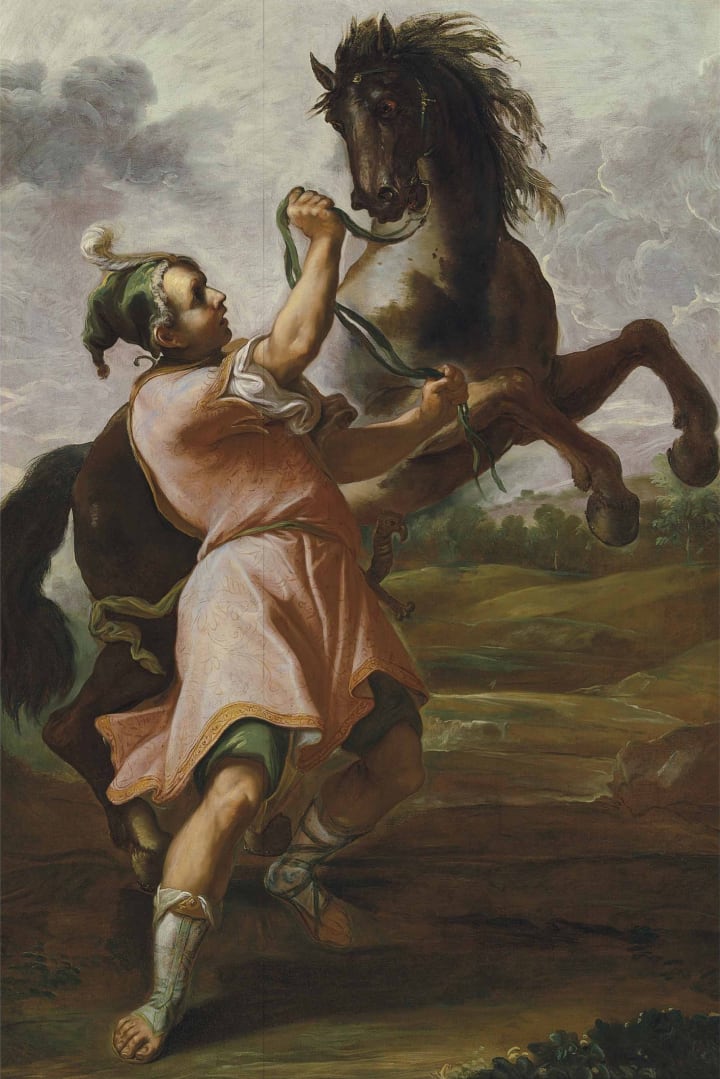
Whizzing way back through the centuries we come to the favorite steed of Alexander the Great named Bucephalus, a huge black stallion. The horse was skittish and would rear when anyone approached him until Alexander came along and turned the horse around toward the sun, putting his shadow behind him, which had been the source of his fears.
Bucephalus became Alexander's favorite horse and he rode with him in battle. When the steed was stolen Alexander threatened to lay waste to the land and kill the inhabitants and of course, the horse was returned to him.
Bucephalus died in 326 BC after the Battle of Hydaspes and Alexander founded the city of Bucephala in honor of his horse.
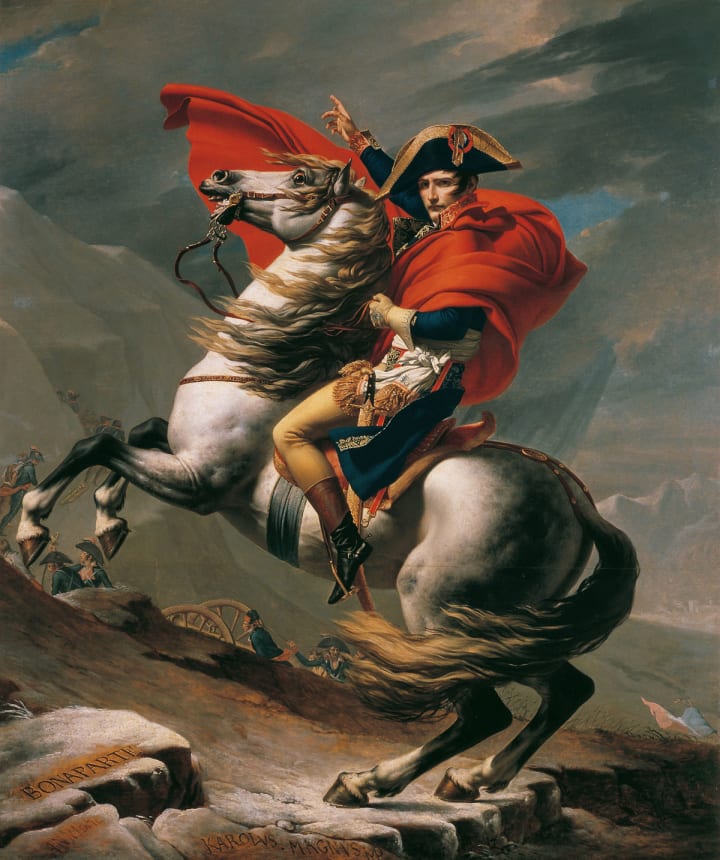
Marengo was the famous horse owned by Napoleon Bonaparte and fought in the battles at Austerlitz and Waterloo. The horse was capable of going as far as 80 miles in just five hours and was known for his long-distance gallops. During the Battle of Waterloo Marengo was captured by the English and brought back to the UK to live out his remaining days. You can see the skeleton of this famous horse on display at the National Army Museum in London, England.
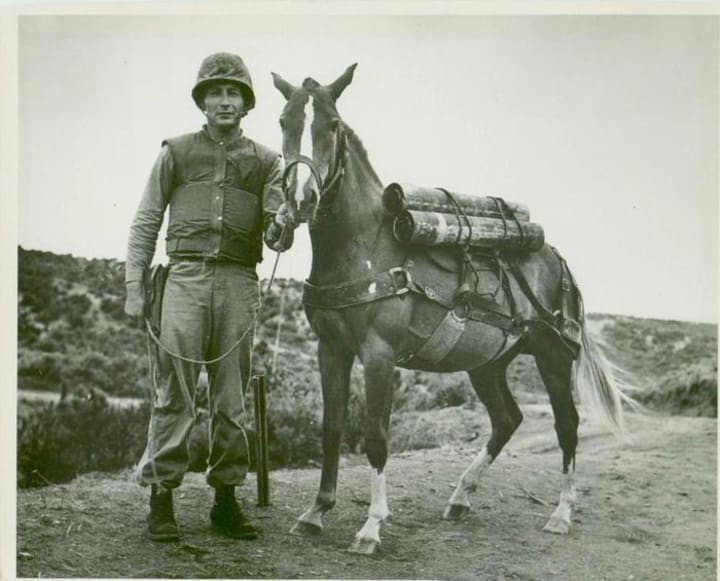
Sergeant Reckless was a noble horse and she became the most decorated horse in US military history. in 1952 the young mare became part of the US Marine corps when Lieutenant Eric Pedersen bought the mare from a young Korean man. She became a packhorse carrying ammunition for recoilless or "reckless" rifles and other supplies to the soldiers during the Korean War.
During the five-day battle, in one day alone, Sergeant Reckless made 51 trips from the Ammunition Supply Point to the firing sites, 95 per cent of the time on her own. Her ability was such that she could carry 386 rounds of ammunition ( weighing more than 9,000 pounds), walked more than 15 miles through open rice paddies and up steep mountains with enemy fire coming in at the rate of 500 rounds per minute, The horse would also carry wounded soldiers down the mountain to safety, unload them, get reloaded with ammo, and back she would go.
Sergeant Reckless was brought back to the US in 1954 and cared for by the 5th Marines, In 1959 she was promoted to Staff Sergeant and in 1960 retired with full military honors. The mare received two Purple Hearts, a Good Conduct Medal, a Presidential Unit Citation with star, National Defense Service Medal, Korean Service Medal, United Nation Service Medal, and Republic of Korea Presidential Unit Citation. Several books have been written about Sergeant Reckless.

Beautiful Jim Key was a performer during the turn of the 20th century. He became known as the smartest horse in the world. He could count and do math, spell words by selecting letters from the alphabet, cite Bible verses, tell time, use a phone, and take cash to a cash register and return with the correct change.
Beautiful Jim Key and his trainer were a huge act, traveling about the country performing before audiences from 1897 to 1906 and were the biggest act of the 1904 St. Louis World's Fair.
One of the most amazing things was that his trainer Dr William Key was a former slave and a self-taught veterinarian who advocated for the kind treatment of animals and taught Jim Key without using a whip. William Key became the first African American recipient of MSPCA's Humanitarian Gold Medal and Beautiful Jim Key was the first non-human recipient of multiple humane and literacy awards. Two million children joined the "Jim Key Band of Mercy" signing his pledge that stated 'I promise to be kind to animals.'
About the Creator
Rasma Raisters
My passions are writing and creating poetry. I write for several sites online and have four themed blogs on Wordpress. Please follow me on Twitter.
Keep reading
More stories from Rasma Raisters and writers in Petlife and other communities.
Animals Come Together
Obstinant Buffalo If you would try to get a large number of buffalo to do something they do not wish to do you would discover that buffalo are obstinant. A fact you might not know is that both bison and buffalo in North America are referred to under the term American bison. This is because buffalo can only be found in South Asia and Africa.
By Rasma Raisters5 years ago in Petlife
Off the Leash: The Essential Gear Guide for Adventurous Dogs
There’s something wildly freeing about unclipping the leash and letting your dog move the way they were built to. If you’re hiking in areas that truly allow off-lead exploration, your gear list shifts. No harness. No leash dragging through dust. Instead, it’s about smart, lightweight essentials that keep your dog safe, hydrated, and easy to manage when adventure gets messy. Long walks off lead are less about control and more about preparation.
By Shabbir Ahmad5 days ago in Petlife


Comments
There are no comments for this story
Be the first to respond and start the conversation.