
Cuckoo - The Heartless Mother and the Killer Child
In their motherly role, the cuckoo does not know how to incubate eggs, but goes to incubate others. Their children later also defeat their opponents the moment they see the sunlight.

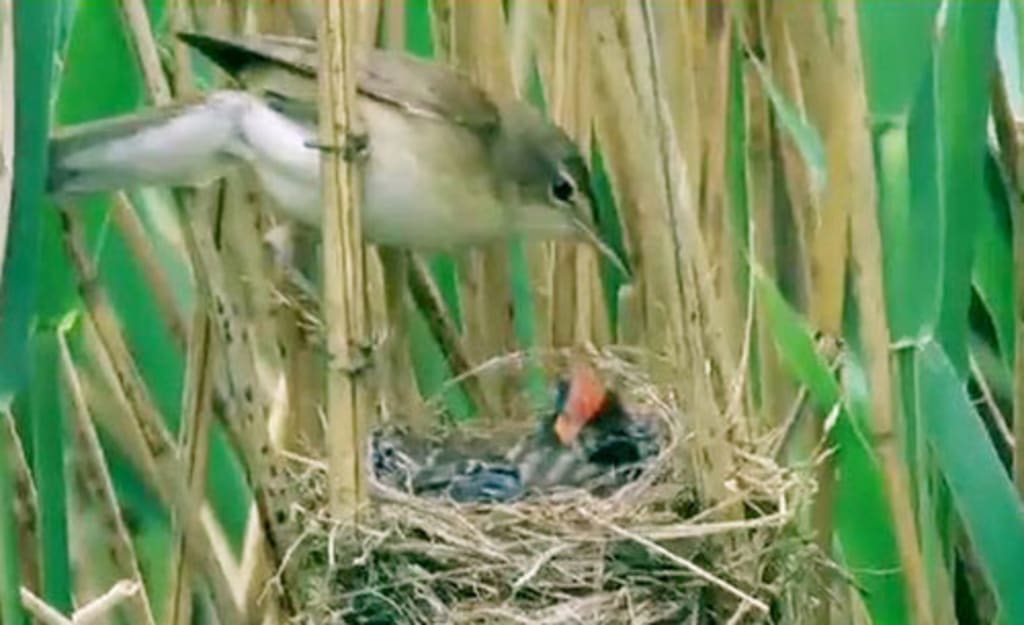
The rainy season is a wonderful time for new life to begin to revive in the tropical rainforests. Plants put on a new green coat and somewhere in the forest, wetlands, reeds and reeds also grow. It is an ideal shelter and nesting place for some species of marsh warblers of the genus Locustella. It is also the right time for cuckoos to carry out the "desirable breeding mission" that their ancestors passed down in the struggle for survival.
In the natural world, every living thing is born and raised by its parents, but the cuckoo is an exception to that rule. Instead of building a nest, laying eggs, incubating and taking care of its young, the cuckoo often finds a warbler's nest to "send" its eggs. This is also known as the "cuckoo egg depositing strategy".
First, the female cuckoo finds a nest where a warbler has laid eggs and rewards herself with one of its eggs. After she has had her fill, she lays another egg in the nest. This egg is about the same size as the warbler's egg and has a pattern so similar that the warbler pair think it is their own.
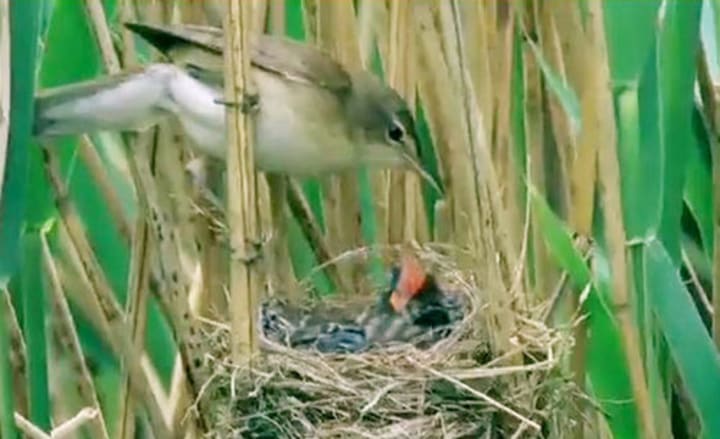
Mother cuckoo brings food to her baby cuckoo Endynamis scolopacea.
After a period of incubation by the warbler , although it was just hatched and still red, the baby cuckoo showed its ability as a villain. It quickly used its muscles, wings and back to push the newly hatched warbler and the remaining eggs out of the nest. Its plot was to monopolize the food source to feed the brood of the parent warbler pair.
After completing its "mission" , it grew up very quickly and spent all day calling for food from its small parent birds. To satisfy the greedy needs of its wild child, which was many times larger than its parents, the pair of birds had to work hard to find food.
When it has grown feathers and wings, the baby cuckoo will fly away, abandoning its foster parent. One day, it may lay eggs in the very nest of its foster parent. The phenomenon of "laying eggs" in the cuckoo bird is considered strange in the natural world.
The mother cuckoo cannot carry food to feed her young because she specializes in eating worms, including poisonous worms. For adult species, their bodies are immune to the toxins of poisonous worms. Meanwhile, the baby cuckoo does not have an immune system, so if it eats poisonous worms, it may die. Therefore, the mother cuckoo must rely on other birds to feed her young. This is also a special piece in the vivid picture of the struggle for survival and maintaining the species of all species in the wild.
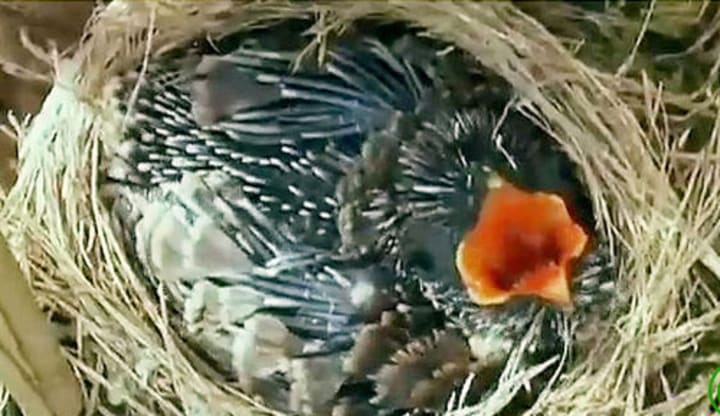
The baby cuckoo calls and demands food from its "foster parents".
The scientific name of the cuckoo is Endynamis scolopacea . The male has black plumage with a dark blue sheen. The female has pale black and white speckled plumage. The female's head is slightly paler and more rufous than the male's. The young bird has black feathers all over its body, but after the first molt it changes to plumage similar to that of the female. The male has red plumage for a while and then gradually changes to adult plumage with red eyes, a blue-gray beak, a black base, and leaden gray legs.
Cuckoos are distributed in Thailand, Laos, Cambodia, Vietnam, southeastern China and Malaysia. In Vietnam, cuckoos are distributed throughout the plains and midlands. In winter, people rarely see this species because most of them fly south to avoid the cold.
About the Creator
Ken Daklak
Telling stories my heart needs to tell <3 life is a journey, not a competition
If you like what you read, feel free to leave a tip,I would love some feedback
https://s.shopee.vn/VwwLTGLe9
Keep reading
More stories from Ken Daklak and writers in Petlife and other communities.
Check out the 12 animals with the most powerful bites in the natural world
Animals with the most powerful bites in the natural world 1. African crocodile (bite force 2.6 million kg/m2) With a terrifying bite force of up to 2.6 million kg/m2, the African crocodile is ranked at the top of the list of animals with the most powerful bites.
By Ken Daklak2 years ago in Petlife
Authenticity and Presence: What Animals Can Teach Actors About Emotional Truth
Actors spend years searching for authenticity. Acting schools teach technique, rehearsal methods focus on emotional preparation, and directors guide performers toward believable moments on screen. Yet sometimes the most meaningful lessons about authenticity come from unexpected places.
By Andreas Szakacs2 days ago in Petlife
A System That Isn’t Working Challenge Winners
Systems promise order. They organize behavior, distribute opportunity, and suggest that if everyone follows the rules, things will work. The entries in A System That Isn’t Working look closely at what happens when that promise begins to slip.
By Vocal Curation Team5 days ago in Resources



Comments
There are no comments for this story
Be the first to respond and start the conversation.