
Cohabitation between dogs and cats
Making the dream come true!
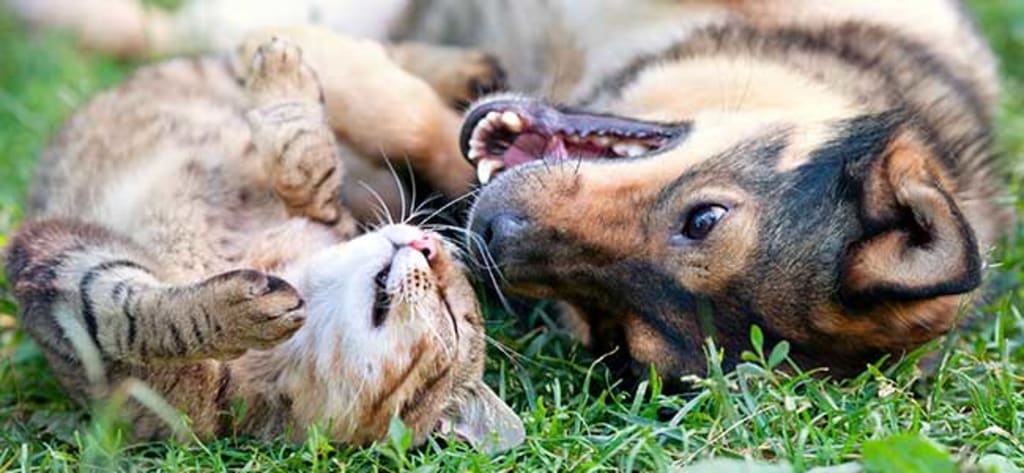
Have you just got a new cat or a new dog and you want Pitou and Minou to know how to live together well, to become the best friends in the world? Here are some tips from feline behavior professionals to ensure that the first meetings are less stressful and more positive for your two furballs!
The perfect environment for your feline and canine!
Here, we are not asking you to embark on renovations and excavations! Just a few little touches, a few small gestures to change your environment in order to generate the least stress for your two animals... And therefore less stress for you! You avoid fights, howling, yapping and peeing outside the litter box (which are often caused by stress)!
- Provide as much height as possible in the house for the cat (in all rooms) so that it can escape from the dog at any time;
- Ensure that these heights are not reachable by the dog;
- Favor cat trees of good height (1.5 – 2 meters) so that there are small shelves where the dog should not be able to climb;
- Put the cat's food and water on a high piece of furniture where the dog will never have access, thus creating a feeling of security for the cat who will not be disturbed. This place can be the kitchen counter for example;
- Do the same for the places where the cat will rest: provide a place where the dog cannot climb and place a small Minou bed, a blanket or a cushion there, thus allowing your purring friend to rest and sleep without having to fear of being surprised by Pitou;
- Offer hiding places where only the cat can sneak in and take shelter from the dog who becomes too curious or insistent (a small box for example);
- Providing hiding places and heights in each room of the house will make your cat feel safer and more inclined to explore the house easily knowing that he always has a safe zone no matter where he is.
Introduce your dog to your cat:
You can't wait for your dog or cat to meet their new friend! However, rushing things, making presentations too fast risks triggering reactions of fear and aggression (and even predation!) on both sides!
Here is the list of important points to remember:
- Never hold the cat in your arms, put it in a carrier or even in the crate with the dog . The cat must be able to escape at any time if it is afraid of the dog;
- Even if the cat was in the house before the dog, it is best to isolate it in a room with all its things (litter box, food, water);
- Let the cat get used to this room. Take the opportunity to hide lots of treats that your cat likes and play with him regularly to make isolation pleasant. Wait until he is calm before taking him out. A calm cat walks with its tail and head held high. This may take one or several days. The dog and the cat can smell and touch each other under the door, but that's all;
- Be careful when entering and leaving the room to prevent the cat from running away or the dog from entering. You can add a barrier that you can climb over (examples: baby fence, wooden board, mosquito net, etc.) to help you enter the room.
Is it time to leave them together?
SO! Has the time come to introduce the two animals for good and let them live together? No! Attention! The work has only just begun! Here's how to proceed so that felines and canines learn to tolerate each other, and eventually love each other!
- Let the cat go out freely in the absence of the dog, having taken care to place treats everywhere in the house, especially in the places most frequented by the dog so that the cat makes pleasant associations with the scent of Pitou;
- Do small 10-minute sessions where the two animals see each other through a small opening, on each side of the door while giving them each their favorite food or treats. Start as far away as possible from either side of the door;
- Reduce the distance between the 2 bowls of food or treats very gradually at each session. Observe how the dog and cat behave. If they continue to eat despite the distance being reduced and the fact that they can see each other, that's a good sign! If one of you stops eating, you've moved too quickly. Move the food or treat bowls back to the previous distance and do not move the bowls for a few sessions while the animals get used to it again;
- It is also possible to do similar sessions, but instead of using the door as a safety barrier, you can keep the dog on a leash. BUT BE CAREFUL . Never pull or jerk on the leash to try to call order, punish your dog or stop him from barking. Do not use a choke or prong collar . This would only have the effect of associating the cat with something unpleasant for the dog and creating aversion towards the cat. Instead, reward your dog when he adopts good behavior, i.e. when he is calm and does not run after the cat. We can reward the dog in several ways: food that he likes a lot, toys or caresses (depending on what he likes the most);
- Once the animals are eating very close together, allow your cat to move freely around the house. But first, make sure your dog doesn't get too excited when the cat plays near him. A dog may be calm in front of a calm cat, but certain instinctive predation sequences may be triggered at the sight of a cat that moves quickly. Playing with the cat in the presence of the dog on a leash will allow you to do this check: if he reacts, it would be wise to contact a dog trainer to counter-condition this reaction which could be very negative for your cat;
- Leave the door to the isolation room open to allow your cat to find shelter if necessary and to rest or reassure himself.
Dealing with fights between cats and dogs
We would like our animals to get along as well as possible and their relationship to be friendly, but cohabiting with another individual (even of the same species!) can generate conflicts! Here are some tips to prevent their occasional skirmishes from becoming daily hell!
- Never punish growling, howling or barking between animals . Not only must animals learn to recognize the distances to be respected in others, but punishing animals will only serve to associate the presence of the other with punishment and therefore create aversion between animals;
- Always supervise encounters, but if altercations occur between the two, let them resolve them alone as much as possible (if your dog has no history of fighting causing harm to another animal and he tends to give several warnings before coming to an inhibited bite). This way, your dog will learn what the cat's limits are and vice versa. Make sure to trim your cat's claws to avoid incidents;
- If the dog reacts every time he sees the cat or runs after it, it is possible to train the dog to stay seated for example every time he sees the cat;
- If a fight breaks out between the two, separate the two animals quickly and then do not wait before consulting a canine behavior specialist or feline behaviorist .
In addition, make sure that cat and dog have their respective places to rest, or the other animal will not come and disturb them.
How long does it take for cats and dogs to become best friends?
How long will all this take? It depends on the two animals. Usually, owners want to go too quickly and don't take the necessary time at each step, which inevitably causes incidents. It is important to respect the speed of adaptation of each animal and to realize that any incident between the animals will greatly affect the relationship between them and will lengthen the adaptation period.
It is essential to take your time. It is not uncommon to see 3 weeks pass before the animals can tolerate each other and several months before they can live together harmoniously. In the meantime, enriching your cat's environment and offering mental stimulation games to both your animals will significantly reduce their stress and expend their excess energy, giving you a little respite!
UNLOCK THE SECRETS OF PERFECT PET TRAINING
About the Creator
Keep reading
More stories from Mohammed Nageh and writers in Petlife and other communities.
Tips and explanations for properly training your dog
Owning a dog means being accompanied by one of the most affectionate animals for man. If the acquisition of a dog is generally a source of a lot of happiness and love for its owner and his entire family, it is also a responsibility that falls on its owner. And for good reason: it is almost essential to educate and train your dog so that it responds to your orders and injunctions. Dog training and learning are a set of techniques that have evolved over time and are based on both the needs of the dog and the needs of its owner. But then, how can you train your dog well? Advice and explanations.
By Mohammed Nageh2 years ago in Petlife
The Gourmet Grumble: Navigating Life with Dog Breeds That Are Picky Eaters
We’ve all seen the commercials: a happy Golden Retriever hears a kibble bag crinkle from three rooms away, skids across the hardwood floor, and inhales a bowl of dry food in approximately four seconds. It’s the universal image of canine appetite.
By MINNIE PEARL’S LIVER LEAVIN’Sabout an hour ago in Petlife




Comments
There are no comments for this story
Be the first to respond and start the conversation.