
Are the animals happy in the zoo?
If you compare the life of an animal trapped in a small cage with that of a wild animal at large, its life is extremely miserable.
What is the purpose of the zoo? ! Protect and treat animals? ! Of course not. They are in it for profit. Then you can imagine, if the animal is sick, is it convenient to spend manpower and resources to cure or let it die and then buy a more convenient. Without further ado, I am a regular visitor to the Shanghai Zoo because I love reptiles and live in Shanghai. Shanghai Zoo is one of the best zoos in China. But the way animals are treated still bothers me. Because I love reptiles, I'll tell you about climbing. I remember the first time I went there, there was a large area with a mix of pythons (apparently recovered from players) and I saw a Burmese python with eyes that looked almost blind and a ball python that was in pretty bad condition in its box. A few months later, the two snakes were gone, and there were several reticulated pythons in the area that hadn't been there before. As for where the two snakes went, hehe. The Burmese python with the eye injury was apparently untreated. In addition to the boa constrictors these larger and more expensive snakes, there is also an area in the museum to raise some common national snakes, it is not difficult to know that these snakes are not expensive. There are many kinds of snakes in this box, and I don't have the heart to make fun of them for mixing the snake-eating snakes with the common snakes. But to my surprise, every time I went to the zoo, the snake in the box was different. Later, I realized that it was normal to exchange one batch for another. Such is the case with Shanghai Zoo, and zoos in second - and third-tier cities in China are even worse. Forget happiness, it's hard enough for animals to survive without being abused.
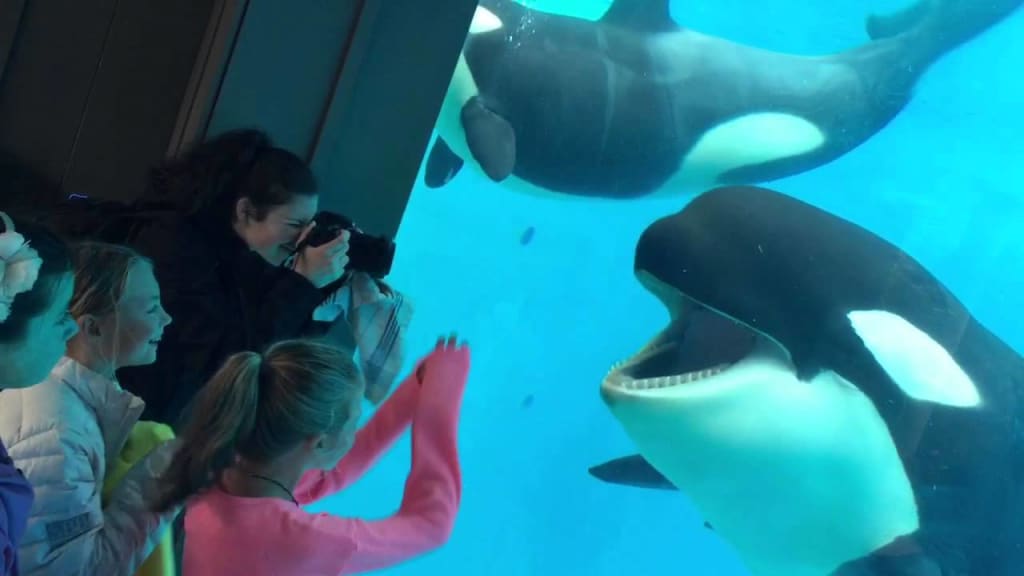
If you compare the life of an animal trapped in a small cage with that of a wild animal at large, its life is extremely miserable. Take the killer whale (orca, or killer whale, as it's called) : it's a star animal found in every major Marine park. Ocean Park often uses such an advertisement to attract consumers. Against a blue background, children and whales interact joyfully through heavy pressure glass. However, behind this seemingly harmonious scene lies a very bloody industrial chain.
In commercial whaling, ships often scoop up small groups of killer whales and send them from the same group to commercial aquariums around the world. In the process of capture and transport, many orcas died quickly due to struggle and maladjustment.
In 1970, commercial whalers captured eight live baby killer whales, including the famous one, Lolita, off the coast of Washington state. The capture resulted in the death of one adult killer whale and four calves. Lolita is sent to the seaaquarium in Miami, where she is lucky to be accompanied by Hugo, one of her own race (they are from the same race). The other seven calves, sent to aquariums in Texas, Japan, France, Australia and The United Kingdom, were not so lucky. Within five years, the seven orcas were dying in isolation. During the 2003 Russian hunt off Kamchatka, one killer whale died while struggling and another died in transit. Only a few killer whales survive, like Lolita. But that's just breathing. The average life span of a killer whale in the wild is 30 to 35 years, with some older adults living to be more than 60 years or longer. However, the average life span of a killer whale in an aquarium is only 20 years. Small Spaces make it difficult for orcas to adapt. Especially for cruise orcas, which often roam the vast ocean between the poles and the tropic of cancer, a few swimming pools in an aquarium is no different from prolonged confinement.
At the same time, killer whales are highly social animals. In the wild, the same group of killer whales would have their own special calls and communication patterns. In many cases, different groups of orcas are not only unable to communicate with each other, but never interact with each other. When groups of orcas are forced together, they clash. The aquarium often covers up the deaths of these orcas. Make people think their star is still out there. Three years before lolita's capture, Shamu, a young killer whale caught in the same area, was taken to Sea Park in Miami. His mother died of an infected harpoon wound during the hunt. Shamu lived and performed at Ocean Park for six years before he died. However, the park has since caught many other baby killer whales, which have been named Shamu. Because the audience can't tell if it's just Shamu. Orcas that have lost their group can become very strange and even aggressive. In 2010, a male killer whale dragged a 40-year-old female keeper into the water and drowned her. And on the day of the killing, none of the orcas in the aquarium listened to their trainers. In the wild, killer whales are known as killer whales, but no killing has ever been recorded by humans. They are a large, highly aggressive group of wild animals that have never attacked a human. However, their captivity in zoos has made them oddly bloodthirsty.
About the Creator
Keep reading
More stories from writers in Petlife and other communities.
A Dart at Dusk
Seconds ago, the sullen sun set on the two of us… my exuberant furry companion and me. A fresh breeze embraces us, delivering welcome relief from the day’s oppressive heat. His typical stumbling and staggering along — apace with a sloth — has turned into trip-trapping, high-stepping, almost skipping along.
By Angie the Archivist 📚🪶7 days ago in Petlife
Thoughts on Vocal and the way the world is
"Death cannot stop true love, only delay it." – Wesley in The Princess Bride. I decided to come back to Vocal on a very cold and dark night at the end of December. I had been, and still am, convalescing from a horrible staph infection that had gone misdiagnosed for months. This, paired with the increasing challenges of being healthy, making the best choices for my co-parented child, being a wife, and being a director at a new job, was a lot to manage.
By Jazzy 2 days ago in Confessions


Comments
There are no comments for this story
Be the first to respond and start the conversation.